Daly Michael, Robinson Eric
Department of Psychology, Maynooth University, Kildare, Ireland.
Institute of Population Health Sciences, University of Liverpool, Liverpool, United Kingdom.
Am J Prev Med. 2021 Jun;60(6):766-773. doi: 10.1016/j.amepre.2021.01.008. Epub 2021 Feb 15.
Vaccines against COVID-19 have been developed in unprecedented time. However, the effectiveness of any vaccine is dictated by the proportion of the population willing to be vaccinated. This observational population-based study examines intentions to be vaccinated against COVID-19 throughout the pandemic.
In November 2020, longitudinal data from a nationally representative sample of 7,547 U.S. adults enrolled in the Understanding America Study were analyzed using multinomial logistic regression. Participants reported being willing, undecided, and unwilling to get vaccinated against COVID-19 across 13 assessments conducted from April to October 2020. Public attitudes to vaccination against COVID-19 were also assessed on a 4-point Likert-type scale.
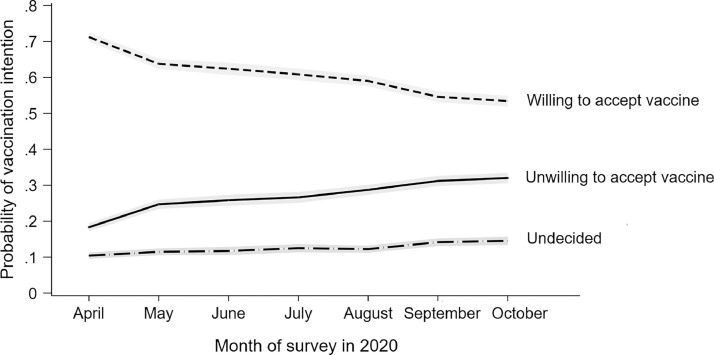
Willingness to vaccinate declined from 71% in April to 53.6% in October. This was explained by an increase in the percentage of participants undecided about vaccinating (from 10.5% to 14.4%) and the proportion of the sample unwilling to vaccinate (from 18.5% to 32%). The population subgroups most likely to be undecided/unwilling to vaccinate were those without a degree (undecided: RR=2.47, 95% CI=2.04, 3.00; unwilling: RR=1.92, 95% CI=1.67, 2.20), Black participants (undecided: RR=2.18, 95% CI=1.73, 2.74; unwilling: RR=1.98, 95% CI=1.63, 2.42), and female participants (undecided: RR=1.41, 95% CI=1.20, 1.65; unwilling: RR=1.29, 95% CI=1.14, 1.46). Participants who were older or were on higher incomes were least likely to be undecided or unwilling to vaccinate. Concerns about potential side effects of a vaccine were common.
Intentions to be vaccinated against COVID-19 have declined rapidly during the pandemic, and close to half of Americans are undecided or unwilling to be vaccinated.
针对新冠病毒的疫苗在前所未有的短时间内研发出来。然而,任何疫苗的有效性都取决于愿意接种疫苗的人群比例。这项基于观察性人群的研究考察了在整个疫情期间接种新冠疫苗的意愿。
2020年11月,使用多项逻辑回归分析了来自参与“了解美国研究”的7547名美国成年人的全国代表性样本的纵向数据。参与者报告了在2020年4月至10月进行的13次评估中愿意、不确定和不愿意接种新冠疫苗的情况。还使用4点李克特量表评估了公众对新冠疫苗接种的态度。
接种意愿从4月的71%下降到10月的53.6%。这可以通过不确定是否接种的参与者百分比增加(从10.5%增至14.4%)以及样本中不愿意接种的比例增加(从18.5%增至32%)来解释。最有可能不确定/不愿意接种的人群亚组是没有学位的人(不确定:相对风险=2.47,95%置信区间=2.04,3.00;不愿意:相对风险=1.92,95%置信区间=1.67,2.20)、黑人参与者(不确定:相对风险=2.18,95%置信区间=1.73,2.74;不愿意:相对风险=1.98,95%置信区间=1.63,2.42)以及女性参与者(不确定:相对风险=1.41,95%置信区间=1.20,1.65;不愿意:相对风险=1.29,95%置信区间=1.14,1.46)。年龄较大或收入较高的参与者最不可能不确定或不愿意接种。对疫苗潜在副作用的担忧很常见。
在疫情期间,接种新冠疫苗的意愿迅速下降,近一半的美国人不确定或不愿意接种。