Cardiovascular Research Institute Maastricht, Maastricht University Medical Centre, Maastricht, The Netherlands.
Synapse Research Institute, Maastricht, The Netherlands.
J Thromb Haemost. 2021 Jul;19(7):1776-1782. doi: 10.1111/jth.15320. Epub 2021 May 5.
Arterial and venous thrombosis are both common in antiphospholipid syndrome (APS). Recent studies have shown that anti-factor Xa (FXa) therapy in APS patients leads to a greater number of patients with arterial thrombosis than with warfarin. We hypothesize that this may be due to the lowering of prothrombin levels by warfarin.
To investigate whether antiprothrombin antibodies induce platelet aggregation and to identify the platelet receptors involved. A second aim was to investigate the effect of reduced prothrombin levels on antiprothrombin antibody-induced platelet aggregation.
Enzyme-linked immunosorbent assays were performed to measure binding of antiprothrombin antibodies to prothrombin fragment 1+2 and prothrombin. Platelet aggregation assays in washed platelets were performed. FcγRIIA was immunoprecipitated and tyrosine-phosphorylated FcγRIIA was measured by western blot.
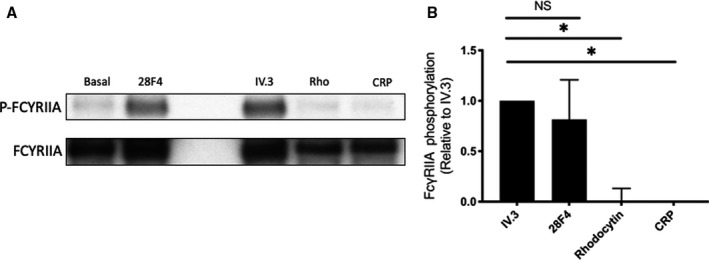
The antiprothrombin antibodies 28F4 and 3B1 had lupus anticoagulant (LAC) activity and caused platelet aggregation in the presence of Ca and prothrombin. Antiprothrombin antibodies without LAC activity did not activate platelets. Inhibition of Syk and Src kinases and FcγRIIA blocked platelet aggregation. Fab and F(ab') fragments of 28F4 were unable to induce platelet aggregation. Immunoprecipitations showed that whole 28F4 immunoglobulin G induced tyrosine phosphorylation of FcγRIIA. Platelet aggregation was significantly reduced when prothrombin levels were reduced from 1 µM to 0.2 µM.
Antiprothrombin antibodies with LAC activity are able to activate platelets via FcγRIIA. Decreased prothrombin levels resulted in less antiprothrombin antibody-mediated platelet aggregation. This may explain the lower incidence of arterial thrombosis in patients treated with warfarin than with anti-FXa therapy.
抗磷脂综合征(APS)中既存在动脉血栓又存在静脉血栓。最近的研究表明,在 APS 患者中,使用抗因子 Xa(FXa)治疗比使用华法林导致更多的动脉血栓形成。我们假设这可能是由于华法林降低了凝血酶原水平。
研究抗凝血酶原抗体是否诱导血小板聚集,并确定涉及的血小板受体。第二个目的是研究凝血酶原水平降低对抗凝血酶原抗体诱导的血小板聚集的影响。
通过酶联免疫吸附试验(ELISA)测量抗凝血酶原抗体与凝血酶原片段 1+2 和凝血酶原的结合。在洗涤血小板中进行血小板聚集试验。通过 Western blot 测量 FcγRIIA 的免疫沉淀和酪氨酸磷酸化的 FcγRIIA。
抗凝血酶原抗体 28F4 和 3B1 具有狼疮抗凝剂(LAC)活性,并在 Ca 和凝血酶原存在的情况下引起血小板聚集。无 LAC 活性的抗凝血酶原抗体不能激活血小板。抑制 Syk 和 Src 激酶和 FcγRIIA 阻断了血小板聚集。28F4 的 Fab 和 F(ab')片段不能诱导血小板聚集。免疫沉淀表明,整个 28F4 免疫球蛋白 G 诱导了 FcγRIIA 的酪氨酸磷酸化。当凝血酶原水平从 1µM 降低至 0.2µM 时,血小板聚集明显减少。
具有 LAC 活性的抗凝血酶原抗体能够通过 FcγRIIA 激活血小板。凝血酶原水平降低导致较少的抗凝血酶原抗体介导的血小板聚集。这可能解释了在接受华法林治疗的患者中动脉血栓形成发生率低于接受抗 FXa 治疗的患者的原因。