Department of Genetics and Molecular Biology, Vision Research Foundation, Chennai, 600- 006, India.
Computational Toxicology Facility, Centre for Innovation and Translational Research, Environmental Monitoring and Intervention Hub (DSIR-CRTDH), CSIR-Indian Institute of Toxicology Research, Vishvigyan Bhawan, 31, M. G. Marg, Lucknow, 226001, Uttar Pradesh, India.
Environ Res. 2021 Jun;197:111015. doi: 10.1016/j.envres.2021.111015. Epub 2021 Mar 26.
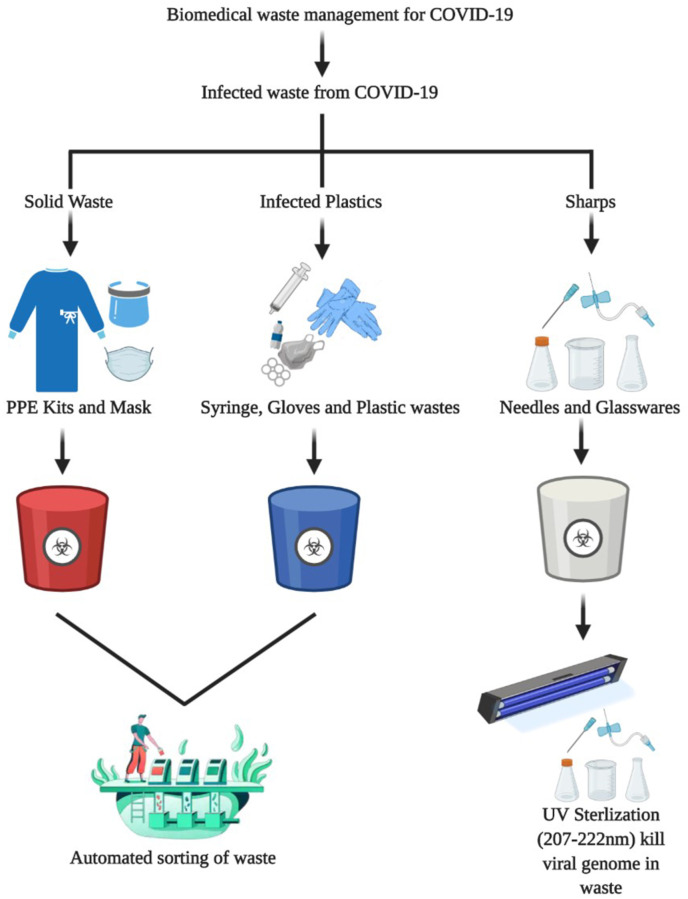
The advent of COVID-19 has kept the whole world on their toes. Countries are maximizing their efforts to combat the virus and to minimize the infection. Since infectious microorganisms may be transmitted by variety of routes, respiratory and facial protection is required for those that are usually transmitted via droplets/aerosols. Therefore this pandemic has caused a sudden increase in the demand for personal protective equipment (PPE) such as gloves, masks, and many other important items since, the evidence of individual-to-individual transmission (through respiratory droplets/coughing) and secondary infection of severe acute respiratory syndrome coronavirus 2 (SARS-CoV-2). But the disposal of these personal protective measures remains a huge question mark towards the environmental impact. Huge waste generation demands proper segregation according to waste types, collection, and recycling to minimize the risk of infection spread through aerosols and attempts to implement measures to monitor infections. Hence, this review focuses on the impact of environment due to improper disposal of these personal protective measures and to investigate the safe disposal methods for these protective measures by using the safe, secure and innovative biological methods such as the use of Artificial Intelligence (AI) and Ultraviolet (UV) lights for killing such deadly viruses.
新冠疫情的爆发让全世界都处于紧张状态。各国都在竭尽全力抗击病毒,将感染率降到最低。由于传染性微生物可能通过多种途径传播,因此通常通过飞沫/气溶胶传播的人需要进行呼吸道和面部防护。因此,由于个人之间的传播(通过呼吸道飞沫/咳嗽)和严重急性呼吸综合征冠状病毒 2(SARS-CoV-2)的二次感染的证据,这种大流行导致对个人防护设备(PPE)的需求突然增加,例如手套、口罩和许多其他重要物品。但是,这些个人防护措施的处置仍然对环境影响构成巨大的问号。大量的废物产生需要根据废物类型进行适当的分类、收集和回收,以最大程度地降低通过气溶胶传播感染的风险,并采取措施监测感染。因此,本综述重点关注由于这些个人防护措施处置不当对环境造成的影响,并研究使用人工智能(AI)和紫外线(UV)灯等安全、可靠和创新的生物方法安全处理这些防护措施的方法,以杀死这些致命病毒。