Aviv Dorit, Chen Kian Wee, Teitelbaum Eric, Sheppard Denon, Pantelic Jovan, Rysanek Adam, Meggers Forrest
University of Pennsylvania, Philadelphia, PA, USA.
Princeton University, Princeton, NJ, USA.
Appl Energy. 2021 Jun 15;292:116848. doi: 10.1016/j.apenergy.2021.116848. Epub 2021 Mar 22.
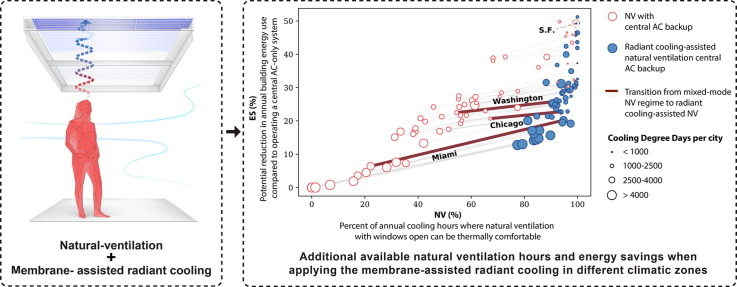
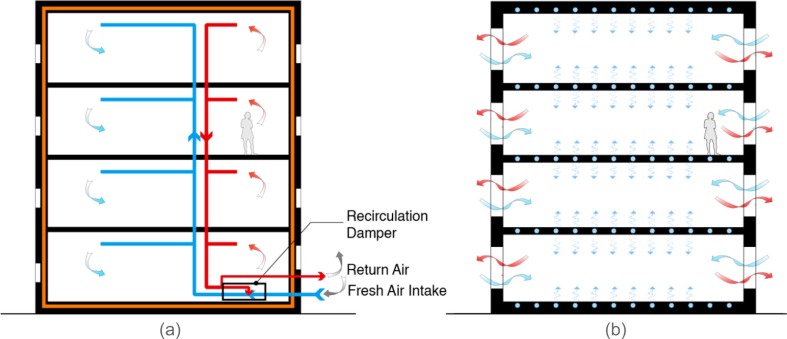
Radiant cooling-assisted natural ventilation is an innovative technical approach that combines new radiant cooling technology with natural ventilation to increase fresh air delivery into buildings year-round with minimal energy cost and improvment of air quality. Currently, the standard paradigm for HVAC (heating, ventilation and air conditioning) is based on central air systems that tie the delivery of heating and cooling to the delivery of fresh air. To prevent heat loss, the delivery of fresh air must be tightly controlled and is often limited through recirculation of already heated or cooled air. Buildings are designed with airtight envelopes, which do not allow for natural ventilation, and depend on energy-intensive central-air systems. As closed environments, buildings have become sites of rapid COVID-19 transmission. In this research, we demonstrate the energy cost of increasing outdoor air supply with standard systems per COVID-19 recommendations and introduce an alternative HVAC paradigm that maximizes the decoupling of ventilation and thermal control. We first consider a novel analysis of the energy costs of increasing the amount of conditioned fresh air using standard HVAC systems to address COVID-19 concerns. We then present an alternative that includes a novel membrane-assisted radiant system we have studied for cooling in humid climates, in place of an air conditioning system. The proposed system can work in conjunction with natural ventilation and thus decreases the risk of indoor spread of infectious diseases and significantly lowers energy consumption in buildings. Our results for modeling HVAC energy in different climates show that increasing outdoor air in standard systems can double cooling costs, while increasing natural ventilation with radiant systems can halve costs. More specifically, it is possible to add up to 100 days' worth of natural ventilation while saving energy when coupling natural ventilation and radiant systems. This combination decreases energy costs by 10-45% in 60 major cities globally, while increasing fresh air intake.
辐射制冷辅助自然通风是一种创新技术方法,它将新型辐射制冷技术与自然通风相结合,以最低的能源成本增加全年送入建筑物的新鲜空气量,并改善空气质量。目前,暖通空调(供暖、通风和空调)的标准模式基于中央空气系统,该系统将供暖和制冷的输送与新鲜空气的输送联系在一起。为防止热量损失,必须严格控制新鲜空气的输送,并且通常通过再循环已经加热或冷却的空气来限制输送量。建筑物设计有密封围护结构,不允许自然通风,而是依赖能源密集型的中央空气系统。作为封闭环境,建筑物已成为新冠病毒快速传播的场所。在本研究中,我们展示了按照新冠病毒防控建议使用标准系统增加室外空气供应的能源成本,并引入了一种替代的暖通空调模式,该模式可最大限度地使通风与热控制解耦。我们首先对使用标准暖通空调系统增加调节后新鲜空气量以应对新冠病毒问题的能源成本进行了新颖的分析。然后,我们提出了一种替代方案,其中包括我们为潮湿气候下的制冷研究的新型膜辅助辐射系统,以取代空调系统。所提出的系统可以与自然通风协同工作,从而降低传染病在室内传播的风险,并显著降低建筑物的能源消耗。我们对不同气候下暖通空调能源建模的结果表明,在标准系统中增加室外空气会使制冷成本翻倍,而通过辐射系统增加自然通风可使成本减半。更具体地说,当将自然通风与辐射系统结合使用时,在节省能源的同时可以增加多达100天的自然通风时间量。这种组合在全球60个主要城市中可将能源成本降低10% - 45%,同时增加新鲜空气摄入量。