Mangalesh Sridhar, Dudani Sharmila, Malik Ajay
Army College of Medical Sciences, Delhi, New Delhi India.
Department of Pathology, Army College of Medical Sciences, Delhi, New Delhi India.
Indian J Hematol Blood Transfus. 2021 Oct;37(4):600-608. doi: 10.1007/s12288-021-01411-2. Epub 2021 Mar 24.
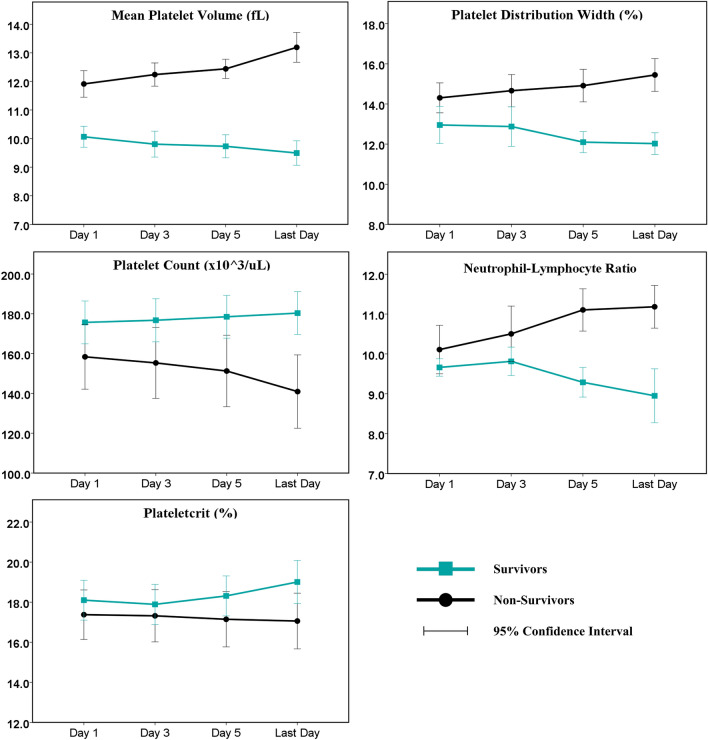
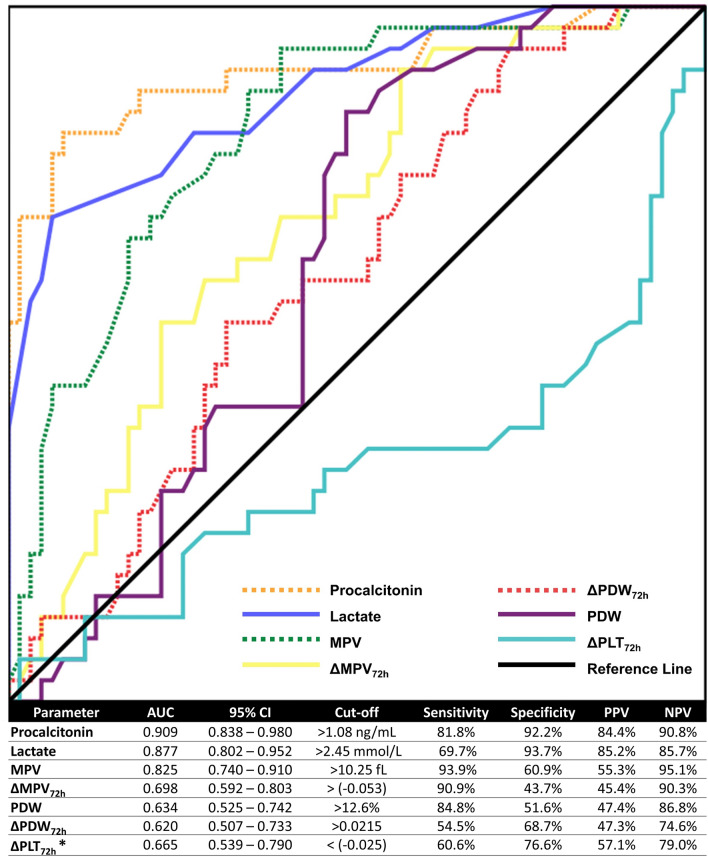
Platelet indices are inexpensive, easily accessible parameters and potentially useful prognostic indicators in sepsis. In this study we explore the differences in platelet indices and their kinetics between sepsis survivors and non-survivors. A retrospective cohort-study of 97 cases of culture-positive sepsis at a tertiary-care center in North India. Demographics, clinical and laboratory parameters at admission were assessed. Platelet count (PLT), mean-platelet-volume (MPV), platelet-distribution-width (PDW) and plateletcrit (PCT) on admission, and third, fifth and last days of hospitalization were analyzed. Fractional change in platelet indices (ΔMPV ΔPDW, ΔPCT, and ΔPLT) by day-3 were calculated. Unpaired and paired t-tests were used to compare survivors with non-survivors, and to study the change in platelet indices with time. Logistic regression was used for multivariate analysis. ROC-curves and optimum cut-offs to predict mortality were obtained. There were 64 survivors. Non-survivors had significantly higher ΔMPV ΔPDW day-1 MPV and PDW, and lower ΔPLT. MPV and PDW increased, and PLT decreased with time among non-survivors. Trends were reversed in survivors. Only MPV and PDW showed significant change by day-3. Both were independent predictors of mortality on multivariate analysis, alongside ΔMPV and ΔPLT. On ROC analysis, MPV, PDW, ΔMPV ΔPDW and ΔPLT effectively predicted mortality. Cut-off for MPV was 10.25 fL (sensitivity = 93.9%, specificity = 60.9%), and PDW, 12.6% (sensitivity = 84.8%, specificity = 51.6%). A rise in MPV and a fall in PLT was associated with mortality in this study. MPV and PDW values at admission are effective predictors of mortality and may be used in conjunction with traditional parameters.
血小板指标成本低廉、易于获取,是脓毒症中潜在有用的预后指标。在本研究中,我们探讨了脓毒症幸存者与非幸存者之间血小板指标及其动力学的差异。对印度北部一家三级医疗中心的97例血培养阳性脓毒症病例进行了一项回顾性队列研究。评估了入院时的人口统计学、临床和实验室参数。分析了入院时以及住院第3天、第5天和最后一天的血小板计数(PLT)、平均血小板体积(MPV)、血小板分布宽度(PDW)和血小板压积(PCT)。计算了第3天时血小板指标的分数变化(ΔMPV、ΔPDW、ΔPCT和ΔPLT)。采用非配对和配对t检验比较幸存者与非幸存者,并研究血小板指标随时间的变化。采用逻辑回归进行多变量分析。获得了预测死亡率的ROC曲线和最佳截断值。有64名幸存者。非幸存者第1天的ΔMPV、ΔPDW、MPV和PDW显著更高,而ΔPLT更低。在非幸存者中,MPV和PDW随时间增加,而PLT随时间减少。幸存者中的趋势则相反。只有MPV和PDW在第3天时显示出显著变化。在多变量分析中,两者与ΔMPV和ΔPLT一起都是死亡率的独立预测因素。在ROC分析中,MPV、PDW、ΔMPV、ΔPDW和ΔPLT有效地预测了死亡率。MPV的截断值为10.25 fL(敏感性=93.9%,特异性=60.9%),PDW的截断值为12.6%(敏感性=84.8%,特异性=51.6%)。在本研究中,MPV升高和PLT降低与死亡率相关。入院时的MPV和PDW值是死亡率的有效预测指标,可与传统参数一起使用。