Harzer Claudia, Bezuglova Natalia, Weber Marco
Department of Psychology, Technical University Darmstadt, Darmstadt, Germany.
Department of Psychology, University of Greifswald, Greifswald, Germany.
Front Psychol. 2021 Mar 12;12:518369. doi: 10.3389/fpsyg.2021.518369. eCollection 2021.
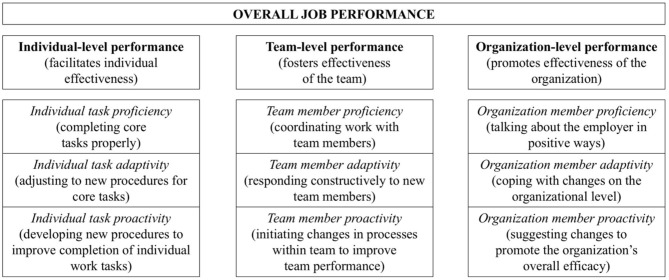
Over the last decades, various predictors have proven relevant for job performance [e.g., general mental ability (GMA), broad personality traits, such as the Big Five]. However, prediction of job performance is far from perfect, and further potentially relevant predictors need to be investigated. Narrower personality traits, such as individuals' character strengths, have emerged as meaningfully related to different aspects of job performance. However, it is still unclear whether character strengths can explain additional variance in job performance over and above already known powerful predictors. Consequently, the present study aimed at (1) examining the incremental validity of character strengths as predictors of job performance beyond GMA and/or the Big Five traits and (2) identifying the most important predictors of job performance out of the 24 character strengths, GMA, and the Big Five. Job performance was operationalized with multidimensional measures of both productive and counterproductive work behavior. A sample of 169 employees from different occupations completed web-based self-assessments on character strengths, GMA, and the Big Five. Additionally, the employees' supervisors provided web-based ratings of their job performance. Results showed that character strengths incrementally predicted job performance beyond GMA, the Big Five, or GMA plus the Big Five; explained variance increased up to 54.8, 43.1, and 38.4%, respectively, depending on the dimension of job performance. Exploratory relative weight analyses revealed that for each of the dimensions of job performance, at least one character strength explained a numerically higher amount of variance than GMA and the Big Five, except for individual task proactivity, where GMA exhibited the numerically highest amount of explained variance. The present study shows that character strengths are relevant predictors of job performance in addition to GMA and other conceptualizations of personality (i.e., the Big Five). This also highlights the role of socio-emotional skills, such as character strengths, for the understanding of performance outcomes above and beyond cognitive ability.
在过去几十年中,各种预测因素已被证明与工作绩效相关[例如,一般心理能力(GMA)、宽泛的人格特质,如大五人格]。然而,对工作绩效的预测远非完美,还需要研究更多潜在相关的预测因素。更狭义的人格特质,如个体的性格优势,已被证明与工作绩效的不同方面有显著关联。然而,性格优势是否能在已知的强大预测因素之外,进一步解释工作绩效中的额外变异,仍不明确。因此,本研究旨在:(1)检验性格优势作为工作绩效预测因素相对于GMA和/或大五人格特质的增量效度;(2)从24种性格优势、GMA和大五人格中识别出工作绩效的最重要预测因素。工作绩效通过对生产性和反生产性工作行为的多维度测量来操作化。来自不同职业的169名员工完成了关于性格优势、GMA和大五人格的基于网络的自我评估。此外,员工的上级对他们的工作绩效进行了基于网络的评级。结果表明,性格优势在GMA、大五人格或GMA加 大五人格之外,对工作绩效有增量预测作用;根据工作绩效的维度不同,解释变异分别增加到54.8%、43.1%和38.4%。探索性相对权重分析表明,对于工作绩效的每个维度,至少有一种性格优势解释的变异量在数值上高于GMA和大五人格,除了个体任务主动性,其中GMA解释的变异量在数值上最高。本研究表明,除了GMA和其他人格概念(即大五人格)外,性格优势也是工作绩效的相关预测因素。这也凸显了社会情感技能,如性格优势,在理解认知能力之外的绩效结果方面的作用。