Jin Yuan Qing, Lin Chien-Liang, Zhao Qun, Yu Sung-Wen, Su Yu-Sheng
College of Science and Technology Ningbo University, Ningbo, China.
Department of Marketing and Distribution Management, National Pingtung University, Pingtung, Taiwan.
Front Psychol. 2021 Mar 11;12:632787. doi: 10.3389/fpsyg.2021.632787. eCollection 2021.
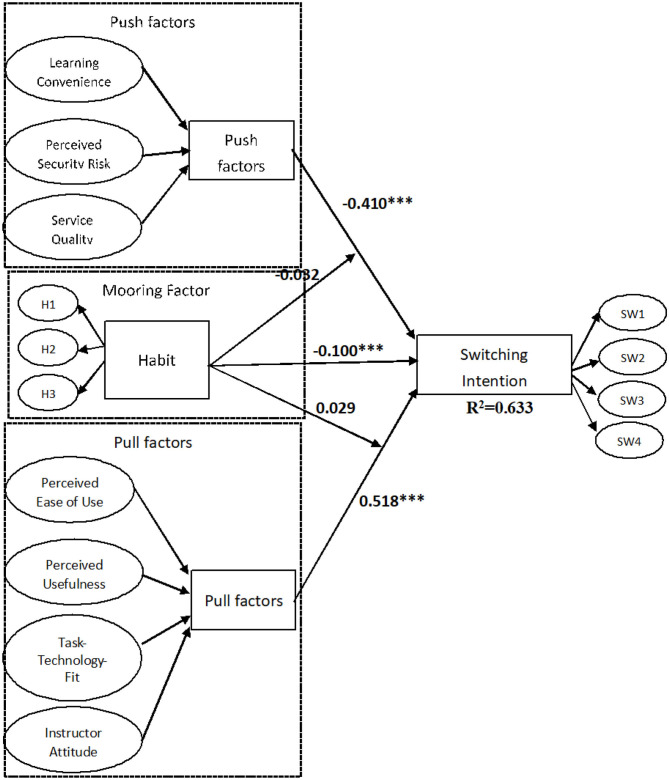
In response to the Covid-19 pandemic, online learning has been carried out in many countries with different types of online learning models being promoted and implemented. In the global pandemic continues, the education environment is forced to change from traditional classroom or blended teaching mode to online learning teaching model. With the outbreak of COVID-19, China was the first to announce that online courses are to be implemented in February 2020. In China, whether online learning can replace traditional offline teaching has become a topic worth discussing. Therefore, this study investigates university students in China by questionnaires and discussions of this topic. The study is based on the Push-Pull Mooring model. Based on 854 valid responses collected from an online survey questionnaire, structural equation modeling was employed to examine the research model. The results show that push effects (Perceived security risk, Learning convenience, and Service quality), pull effects (Usefulness, Ease of use, Teacher's Teaching Attitude, Task-technology Fit), and mooring effects (habit) all significantly influence users' switching intentions from offline to online learning platform. Finally, this study explores whether push-pull-mooring can be a reference for promoting and implementing online learning courses in Chinese colleges and universities in the future after the pandemic.
为应对新冠疫情,许多国家开展了在线学习,并推广实施了不同类型的在线学习模式。在全球疫情持续的情况下,教育环境被迫从传统课堂或混合教学模式转变为在线学习教学模式。随着新冠疫情的爆发,中国于2020年2月率先宣布将实施在线课程。在中国,在线学习能否取代传统线下教学已成为一个值得探讨的话题。因此,本研究通过问卷调查和对此话题的讨论对中国大学生进行了调查。该研究基于推拉锚定模型。基于从在线调查问卷中收集的854份有效回复,采用结构方程模型对研究模型进行了检验。结果表明,推动因素(感知安全风险、学习便利性和服务质量)、拉动因素(有用性、易用性、教师教学态度、任务-技术匹配度)和锚定因素(习惯)均对用户从线下学习平台转向在线学习平台的转换意愿有显著影响。最后,本研究探讨了推拉锚定模型在疫情后能否为未来中国高校推广实施在线学习课程提供参考。