Liu Mei, Chen You, Shi Dan, Yan Tingwu
Department of Business Administration, College of Economics and Management, Huazhong Agricultural University, Wuhan, China.
Department of Agricultural Economics and Management, College of Economics and Management, Huazhong Agricultural University, Wuhan, China.
Front Psychol. 2021 Mar 12;12:649180. doi: 10.3389/fpsyg.2021.649180. eCollection 2021.
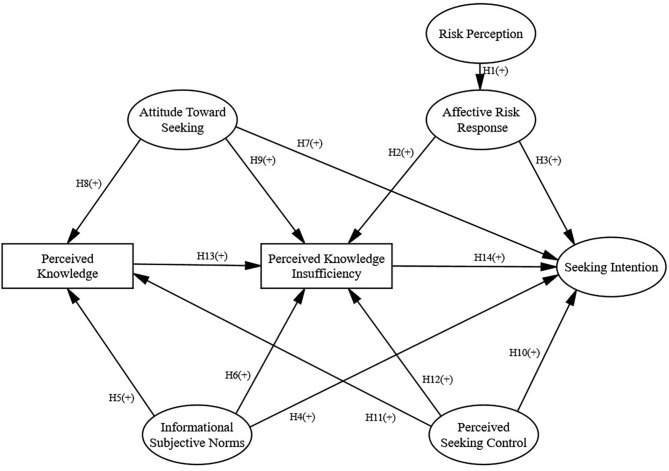
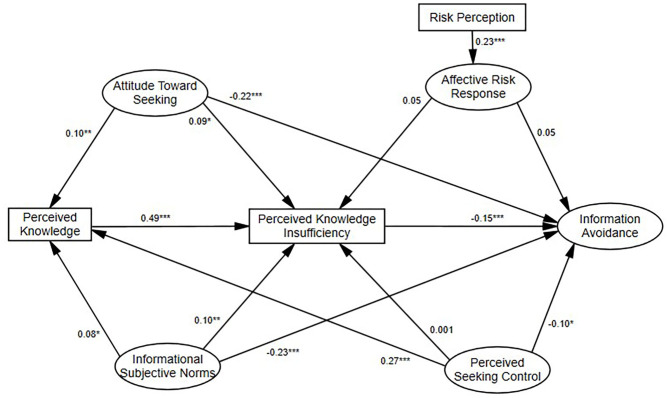
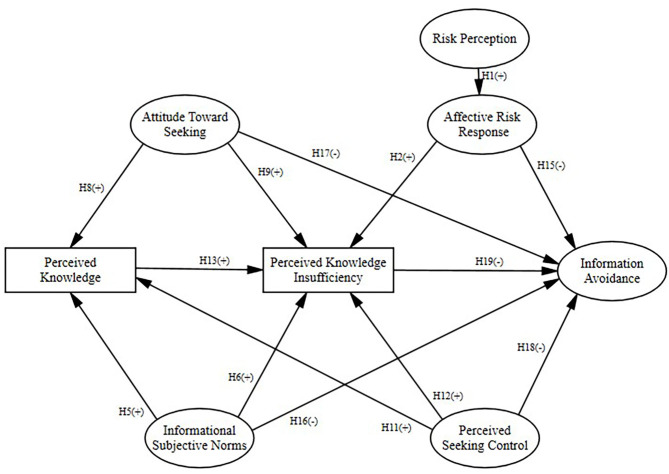
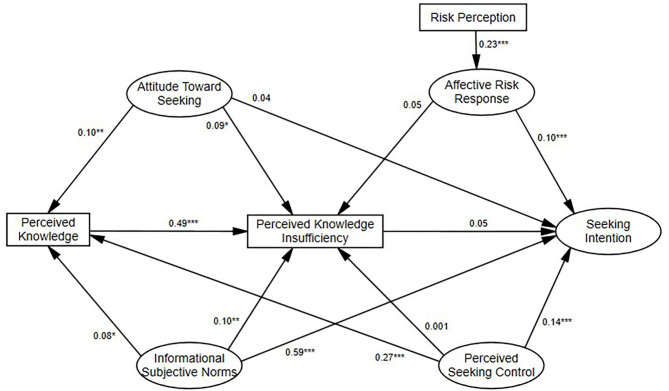
This study uses the Planned Risk Information Seeking Model (PRISM) to estimate the public's information seeking and avoidance intentions during the COVID-19 outbreak based on an online sample of 1031 Chinese adults and provides support for the applicability of PRISM framework in the situation of a novel high-level risk. The results indicate that information seeking is primarily directed by informational subjective norms (ISN) and perceived seeking control (PSC), while the main predictors of information avoidance include ISN and attitude toward seeking. Because ISN are the strongest predictor of both information seeking and avoidance, the way the public copes with COVID-19 information may be strongly affected by individuals' social environment. Furthermore, a significant relationship between risk perception and affective risk response is identified. Our results also indicate that people who perceive greater knowledge of COVID-19 are more likely to report greater knowledge insufficiency, which results in less information avoidance.
本研究运用计划风险信息寻求模型(PRISM),基于对1031名中国成年人的在线抽样调查,估计新冠疫情期间公众的信息寻求和回避意图,并为PRISM框架在新型高风险情况下的适用性提供了支持。结果表明,信息寻求主要受信息主观规范(ISN)和感知寻求控制(PSC)的引导,而信息回避的主要预测因素包括ISN和对寻求的态度。由于ISN是信息寻求和回避的最强预测因素,公众应对新冠疫情信息的方式可能会受到个人社会环境的强烈影响。此外,还发现了风险感知与情感风险反应之间的显著关系。我们的结果还表明,自认为对新冠疫情了解更多的人更有可能报告自己知识不足,从而减少信息回避。