Department of Immunology, Faculty of Health Sciences, University of Pretoria, Pretoria, South Africa.
Front Immunol. 2021 Mar 12;12:634386. doi: 10.3389/fimmu.2021.634386. eCollection 2021.
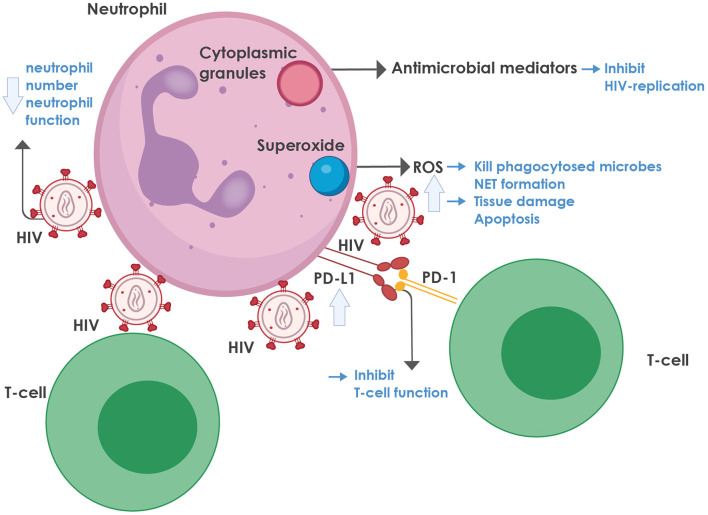
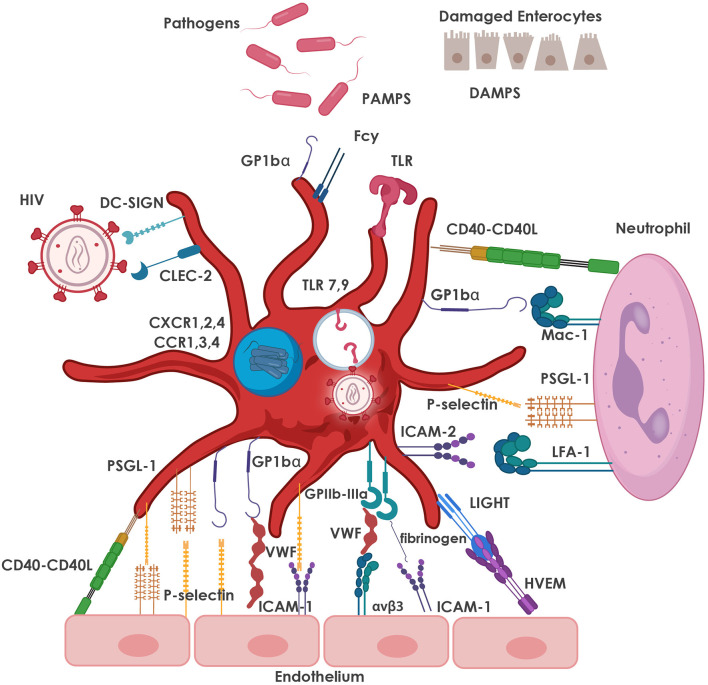
Neutrophils are important components of the innate immune system that mediate pathogen defense by multiple processes including phagocytosis, release of proteolytic enzymes, production of reactive oxygen species, and neutrophil extracellular trap formation. Abnormalities of neutrophil count and function have been described in the setting of HIV infection, with the majority of antiretroviral agents (ARVs), excluding zidovudine, having been reported to correct neutropenia. Questions still remain, however, about their impact on neutrophil function, particularly the possibility of persistent neutrophil activation, which could predispose people living with HIV to chronic inflammatory disorders, even in the presence of virally-suppressive treatment. In this context, the effects of protease inhibitors and integrase strand transfer inhibitors, in particular, on neutrophil function remain poorly understood and deserve further study. Besides mediating hemostatic functions, platelets are increasingly recognized as critical role players in the immune response against infection. In the setting of HIV, these cells have been found to harbor the virus, even in the presence of antiretroviral therapy (ART) potentially promoting viral dissemination. While HIV-infected individuals often present with thrombocytopenia, they have also been reported to have increased platelet activation, as measured by an upregulation of expression of CD62P (P-selectin), CD40 ligand, glycoprotein IV, and RANTES. Despite ART-mediated viral suppression, HIV-infected individuals reportedly have sustained platelet activation and dysfunction. This, in turn, contributes to persistent immune activation and an inflammatory vascular environment, seemingly involving neutrophil-platelet-endothelium interactions that increase the risk for development of comorbidities such as cardiovascular disease (CVD) that has become the leading cause of morbidity and mortality in HIV-infected individuals on treatment, clearly underscoring the importance of unraveling the possible etiologic roles of ARVs. In this context, abacavir and ritonavir-boosted lopinavir and darunavir have all been linked to an increased risk of CVD. This narrative review is therefore focused primarily on the role of neutrophils and platelets in HIV transmission and disease, as well as on the effect of HIV and the most common ARVs on the numbers and functions of these cells, including neutrophil-platelet-endothelial interactions.
中性粒细胞是先天免疫系统的重要组成部分,通过多种过程介导病原体防御,包括吞噬作用、释放蛋白水解酶、产生活性氧物质和中性粒细胞细胞外陷阱形成。在 HIV 感染的情况下,已经描述了中性粒细胞计数和功能的异常,大多数抗逆转录病毒药物(ARV),除了齐多夫定,已被报道可以纠正中性粒细胞减少症。然而,关于它们对中性粒细胞功能的影响,仍存在疑问,特别是中性粒细胞持续激活的可能性,这可能使 HIV 感染者易患慢性炎症性疾病,即使在病毒抑制治疗的情况下也是如此。在这种情况下,蛋白酶抑制剂和整合酶链转移抑制剂,特别是,对中性粒细胞功能的影响仍然知之甚少,值得进一步研究。除了介导止血功能外,血小板也越来越被认为是对感染免疫反应的关键角色扮演者。在 HIV 感染的情况下,已经发现这些细胞携带病毒,即使存在抗逆转录病毒治疗(ART)也可能促进病毒传播。虽然 HIV 感染者通常会出现血小板减少症,但据报道,他们的血小板也被激活,这表现为 CD62P(P-选择素)、CD40 配体、糖蛋白 IV 和 RANTES 的表达上调。尽管通过 ART 介导的病毒抑制,但据报道,HIV 感染者仍存在持续的血小板激活和功能障碍。这反过来又导致持续的免疫激活和炎症性血管环境,似乎涉及中性粒细胞-血小板-内皮细胞相互作用,增加了合并症(如心血管疾病 (CVD))的发展风险,这已成为接受治疗的 HIV 感染者发病率和死亡率的主要原因,这清楚地强调了解开 ARV 可能的病因作用的重要性。在这种情况下,阿巴卡韦、利托那韦增强洛匹那韦和达芦那韦都与 CVD 风险增加有关。因此,这篇叙述性综述主要集中在中性粒细胞和血小板在 HIV 传播和疾病中的作用,以及 HIV 和最常见的 ARV 对这些细胞的数量和功能的影响,包括中性粒细胞-血小板-内皮细胞相互作用。