Department of Clinical Microbiology, First Affiliated Hospital of Nanchang University, Nanchang University, Nanchang, China.
Department of Respiratory, First Affiliated Hospital of Nanchang University, Nanchang University, Nanchang, China.
Front Cell Infect Microbiol. 2021 Mar 12;10:556654. doi: 10.3389/fcimb.2020.556654. eCollection 2020.
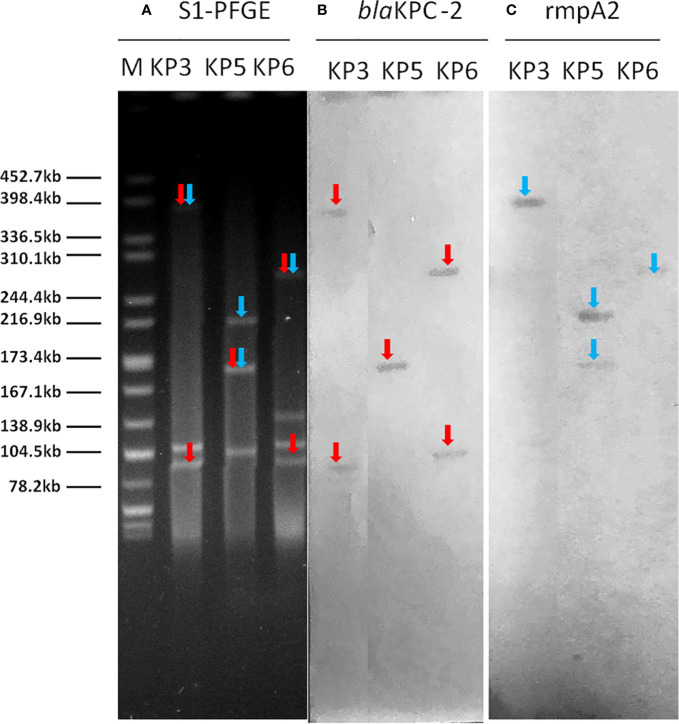
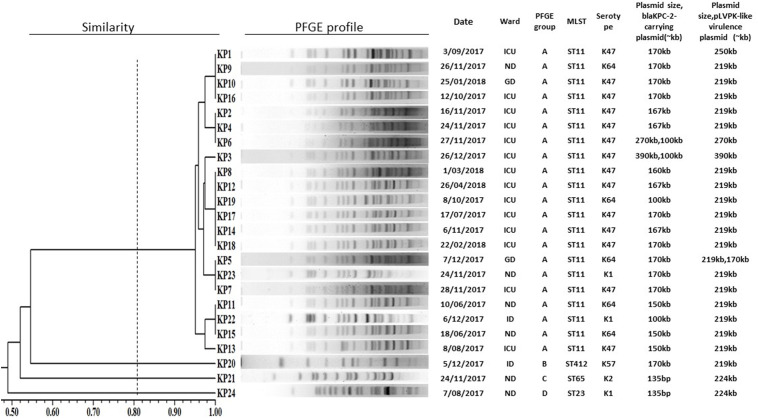
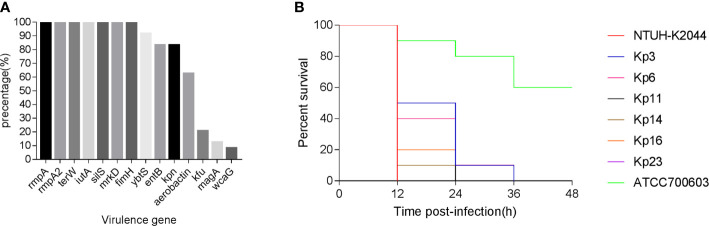
This study aimed to characterize carbapenem-resistant (CR-KP) co-harboring -carrying plasmid and pLVPK-like virulence plasmid. Between December 2017 and April 2018, 24 CR-KP isolates were recovered from 24 patients with bacteremia. The mortality was 66.7%. Pulsed-field gel electrophoresis and multilocus sequence typing results indicated four clusters, of which cluster A (n = 21, 87.5%) belonged to ST11 and the three remaining isolates (ST412, ST65, ST23) had different pulsotypes (cluster B, C, D). The -carrying plasmids all belonged to IncFII type, and the size ranged from 100 to 390 kb. Nineteen strains (79.2%) had a 219-kb virulence plasmid possessed high similarity to pLVPK from CG43 with serotype K2. Two strains had a 224-kb virulence plasmid resembled plasmid pK2044 from NTUH-K2044(ST23). Moreover, three strains carried three different hybrid resistance- and virulence-encoding plasmids. Conjugation assays showed that both and genes could be successfully transferred to J53 in 62.5% of the strains at frequencies of 4.5 × 10 to 2.4 × 10, of which three co-transferred along with in large plasmids. Infection assays in the model demonstrated the virulence level of these isolates was found to be consistently higher than that of classic . In conclusion, CR-KP co-harboring -carrying plasmid and pLVPK-like virulence plasmid were characterized by multi-drug resistance, enhanced virulence, and transferability, and should, therefore, be regarded as a real superbug that could pose a serious threat to public health. Hence, heightened efforts are urgently needed to avoid its co-transmission of the virulent plasmid (gene) and resistant plasmid (gene) in clinical isolates.
本研究旨在对携带碳青霉烯酶的(CR-KP)并共同携带-携带质粒和 pLVPK 样毒力质粒的细菌进行特征描述。2017 年 12 月至 2018 年 4 月,从 24 例菌血症患者中分离出 24 株 CR-KP 株。死亡率为 66.7%。脉冲场凝胶电泳和多位点序列分型结果显示 4 个聚类,其中 A 群(n=21,87.5%)属于 ST11,其余 3 个分离株(ST412、ST65、ST23)具有不同的脉冲场型(B、C、D 群)。-携带的质粒均属于 IncFII 型,大小为 100-390kb。19 株(79.2%)含有 219kb 的毒力质粒,与 CG43 中的 pLVPK 具有高度相似性,血清型为 K2。2 株含有 224kb 的毒力质粒,类似于 NTUH-K2044(ST23)中的质粒 pK2044。此外,3 株携带 3 种不同的混合耐药和毒力编码质粒。接合试验表明,在 62.5%的菌株中,基因和 基因可成功转移到 J53 中,转移频率为 4.5×10 至 2.4×10 ,其中 3 株在大质粒中同时转移 和 。在感染模型中的试验表明,这些分离株的毒力水平明显高于经典 。综上所述,CR-KP 共同携带-携带质粒和 pLVPK 样毒力质粒具有多药耐药性、增强的毒力和可转移性,因此应被视为真正的超级细菌,对公共健康构成严重威胁。因此,迫切需要加强努力,避免临床分离株中携带毒力质粒(基因)和耐药质粒(基因)的共同传播。