Daehre Katrin, Projahn Michaela, Friese Anika, Semmler Torsten, Guenther Sebastian, Roesler Uwe H
Institute for Animal Hygiene and Environmental Health, Freie Universität Berlin, Berlin, Germany.
NG1-Microbial Genomics, Robert Koch Institute, Berlin, Germany.
Front Microbiol. 2018 Oct 3;9:2302. doi: 10.3389/fmicb.2018.02302. eCollection 2018.
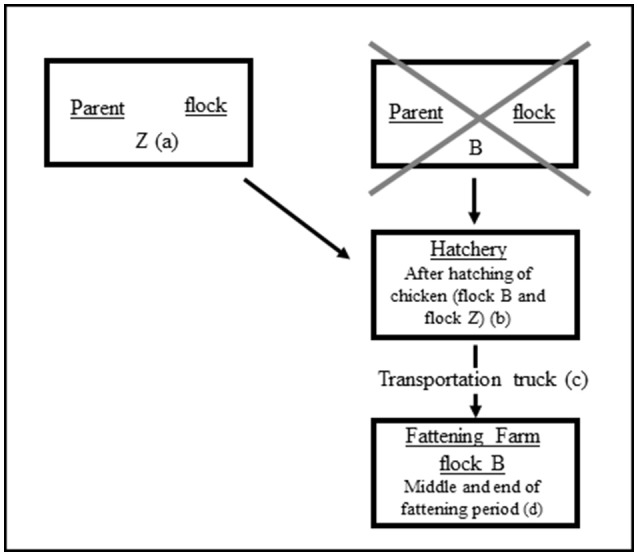
ESBL-producing represent an increasing problem both in human and veterinary medicine. As SHV-2 - encoding were recently detected in the broiler production we were interested in investigating a possible transmission along the broiler production chain and furthermore, in evaluating their possible impact on human health. Therefore, 41 ESBL-producing originating from a parent flock, from the hatcherys' environment during the hatching of that parent flocks' chickens, and from an associated fattening flock were investigated on an Illumina Miseq. Whole genome sequences were analyzed concerning their MLST-type, cgMLST-type, genotypic and phenotypic resistance, plasmid profiles and virulence genes. Irrespective of the origin of isolation all investigated isolates were multi-drug resistant, harbored the same ESBL-gene , shared the same sequence type (ST3128) and displayed 100% similarity in core genome multilocus sequence typing (cgMLST). In addition, plasmid typing found several Inc/Rep types associated with ESBL-plasmids. Summarizing, identical clones of SHV-2-producing were detected in different stages of the industrial broiler production in one out of seven investigated broiler chains. This proves the possibility of pseudo-vertical transmission of multi-resistant human pathogens from parent flocks to hatcheries and fattening flocks. Furthermore, the importance of cross-contamination along the production chain was shown. Although the ESBL-producing clone detected here in the broiler production has not been associated with clinical settings so far, our findings present a potential public health threat.
产超广谱β-内酰胺酶(ESBL)的细菌在人类医学和兽医学中都构成了日益严重的问题。由于最近在肉鸡生产中检测到了编码SHV-2的细菌,我们有兴趣调查其在肉鸡生产链中可能的传播情况,此外,还想评估它们对人类健康可能产生的影响。因此,我们在Illumina Miseq平台上对41株产ESBL的细菌进行了研究,这些细菌分别来自一个亲本鸡群、该亲本鸡群孵化期间孵化场的环境以及一个相关的育肥鸡群。对全基因组序列进行了分析,包括它们的多位点序列分型(MLST)类型、核心多位点序列分型(cgMLST)类型、基因型和表型耐药性、质粒图谱以及毒力基因。无论分离源如何,所有调查的分离株均具有多重耐药性,携带相同的ESBL基因,共享相同的序列类型(ST3128),并且在核心基因组多位点序列分型(cgMLST)中显示出100%的相似性。此外,质粒分型发现了几种与ESBL质粒相关的Inc/Rep类型。总之,在七条调查的肉鸡链中的一条中,在工业肉鸡生产的不同阶段检测到了产生SHV-2的相同克隆。这证明了多重耐药性人类病原体从亲本鸡群到孵化场和育肥鸡群的假垂直传播的可能性。此外,还显示了生产链中交叉污染的重要性。尽管目前在肉鸡生产中检测到的产ESBL克隆尚未与临床病例相关联,但我们的发现提出了潜在的公共卫生威胁。