Cavallo Federica, Mohn Angelika, Chiarelli Francesco, Giannini Cosimo
Department of Pediatrics, University of Chieti-Pescara, Chieti, Italy.
Front Pediatr. 2021 Mar 12;9:580314. doi: 10.3389/fped.2021.580314. eCollection 2021.
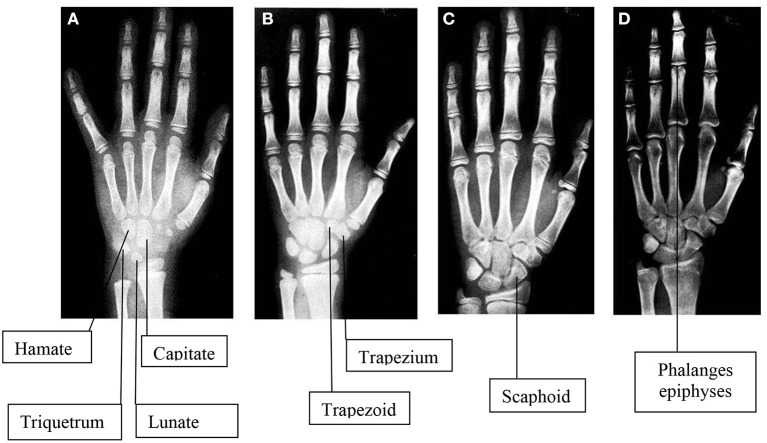
Bone age represents a common index utilized in pediatric radiology and endocrinology departments worldwide for the definition of skeletal maturity for medical and non-medical purpose. It is defined by the age expressed in years that corresponds to the level of maturation of bones. Although several bones have been studied to better define bone age, the hand and wrist X-rays are the most used images. In fact, the images obtained by hand and wrist X-ray reflect the maturity of different types of bones of the skeletal segment evaluated. This information, associated to the characterization of the shape and changes of bone components configuration, represent an important factor of the biological maturation process of a subject. Bone age may be affected by several factors, including gender, nutrition, as well as metabolic, genetic, and social factors and either acute and chronic pathologies especially hormone alteration. As well several differences can be characterized according to the numerous standardized methods developed over the past decades. Therefore, the complete characterization of the main methods and procedure available and particularly of all their advantages and disadvantages need to be known in order to properly utilized this information for all its medical and non-medical main fields of application.
骨龄是全球儿科放射科和内分泌科用于确定骨骼成熟度的一个常用指标,用于医学和非医学目的。它由与骨骼成熟水平相对应的周岁年龄来定义。尽管为了更好地定义骨龄已经对几块骨骼进行了研究,但手部和腕部的X线片是最常用的影像。实际上,通过手部和腕部X线获得的影像反映了所评估骨骼段不同类型骨骼的成熟度。这些信息,连同骨骼组成结构的形状特征和变化,是一个人生物成熟过程的重要因素。骨龄可能受到多种因素的影响,包括性别、营养以及代谢、遗传和社会因素,还有急慢性疾病,尤其是激素改变。此外,根据过去几十年开发的众多标准化方法,可以发现一些差异。因此,需要了解现有主要方法和程序的完整特征,特别是它们所有的优缺点,以便在其所有医学和非医学主要应用领域正确利用这些信息。