Shyngys Moldir, Ren Jia, Liang Xiaoqi, Miao Jiechen, Blocki Anna, Beyer Sebastian
Department of Biomedical Engineering, The Chinese University of Hong Kong, Shatin, Hong Kong.
Institute for Tissue Engineering & Regenerative Medicine, The Chinese University of Hong Kong, Shatin, Hong Kong.
Front Bioeng Biotechnol. 2021 Mar 11;9:603608. doi: 10.3389/fbioe.2021.603608. eCollection 2021.
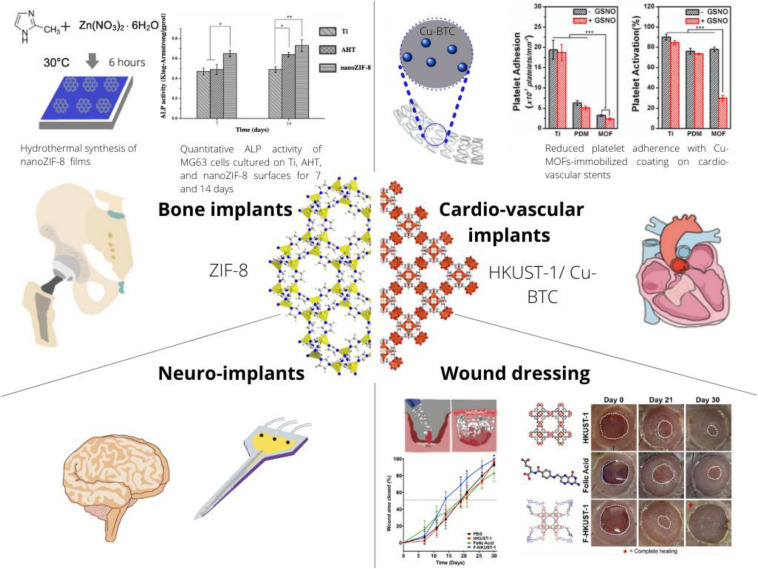
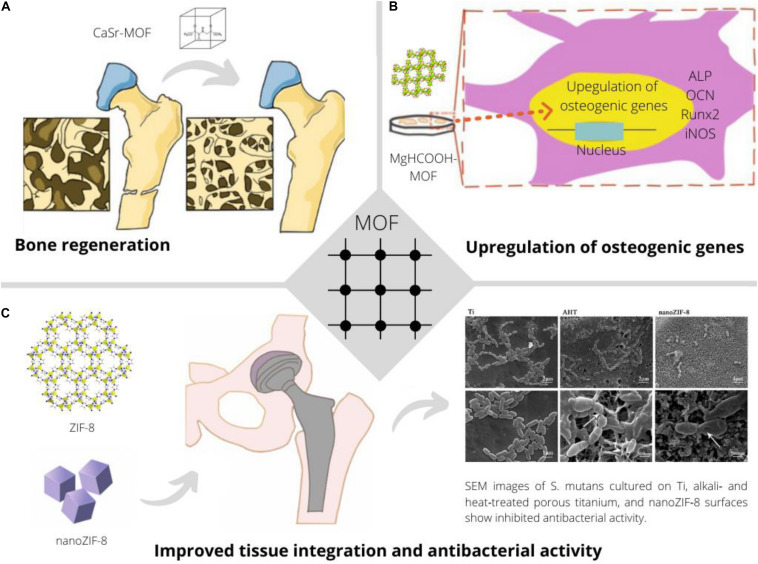
The synthesis of Metal-organic Frameworks (MOFs) and their evaluation for various applications is one of the largest research areas within materials sciences and chemistry. Here, the use of MOFs in biomaterials and implants is summarized as narrative review addressing primarely the Tissue Engineering and Regenerative Medicine (TERM) community. Focus is given on MOFs as bioactive component to aid tissue engineering and to augment clinically established or future therapies in regenerative medicine. A summary of synthesis methods suitable for TERM laboratories and key properties of MOFs relevant to biomaterials is provided. The use of MOFs is categorized according to their targeted organ (bone, cardio-vascular, skin and nervous tissue) and whether the MOFs are used as intrinsically bioactive material or as drug delivery vehicle. Further distinction between and studies provides a clear assessment of literature on the current progress of MOF based biomaterials. Although the present review is narrative in nature, systematic literature analysis has been performed, allowing a concise overview of this emerging research direction till the point of writing. While a number of excellent studies have been published, future studies will need to clearly highlight the safety and added value of MOFs compared to established materials for clinical TERM applications. The scope of the present review is clearly delimited from the general 'biomedical application' of MOFs that focuses mainly on drug delivery or diagnostic applications not involving aspects of tissue healing or better implant integration.
金属有机框架材料(MOFs)的合成及其在各种应用中的评估是材料科学和化学领域最大的研究领域之一。在此,作为一篇叙述性综述,总结了MOFs在生物材料和植入物中的应用,主要面向组织工程与再生医学(TERM)领域。重点关注MOFs作为生物活性成分在辅助组织工程以及增强再生医学中已确立的临床治疗方法或未来治疗手段方面的作用。提供了适合TERM实验室的合成方法总结以及与生物材料相关的MOFs关键特性。根据MOFs的靶向器官(骨、心血管、皮肤和神经组织)以及它们是作为固有生物活性材料还是药物递送载体来使用,对MOFs的应用进行了分类。 研究与 研究之间的进一步区分,对基于MOF的生物材料当前进展的文献进行了清晰评估。尽管本综述本质上是叙述性的,但已进行了系统的文献分析,从而能够对这一新兴研究方向直至撰写本文时的情况进行简要概述。虽然已经发表了许多优秀的研究,但未来的研究需要明确突出MOFs相对于临床TERM应用中已确立材料的安全性和附加值。本综述的范围与MOFs的一般“生物医学应用”有明显区别,后者主要侧重于药物递送或诊断应用,而不涉及组织愈合或更好的植入物整合等方面。