Espinoza Josh L, Dupont Chris L, O'Rourke Aubrie, Beyhan Sinem, Morales Pavel, Spoering Amy, Meyer Kirsten J, Chan Agnes P, Choi Yongwook, Nierman William C, Lewis Kim, Nelson Karen E
J. Craig Venter Institute, La Jolla, CA, United States of America.
Department of Applied Sciences, Durban University of Technology, Durban, South Africa.
PLoS Comput Biol. 2021 Mar 29;17(3):e1008857. doi: 10.1371/journal.pcbi.1008857. eCollection 2021 Mar.
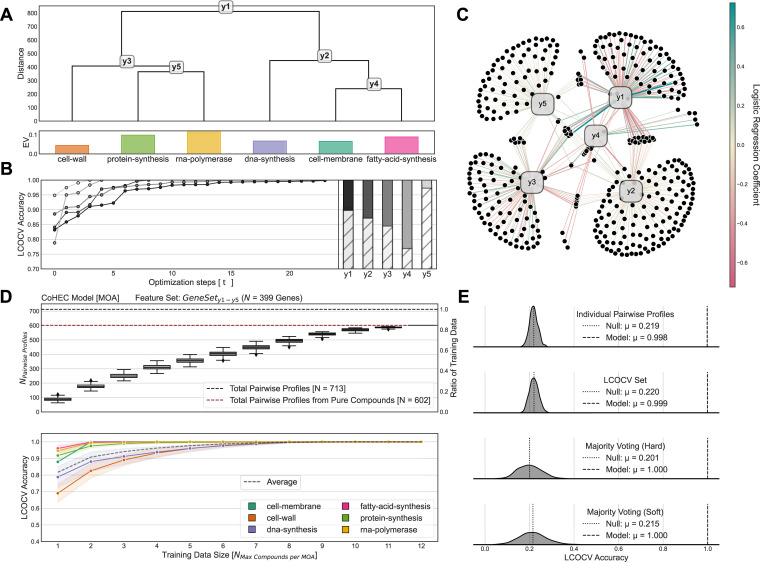
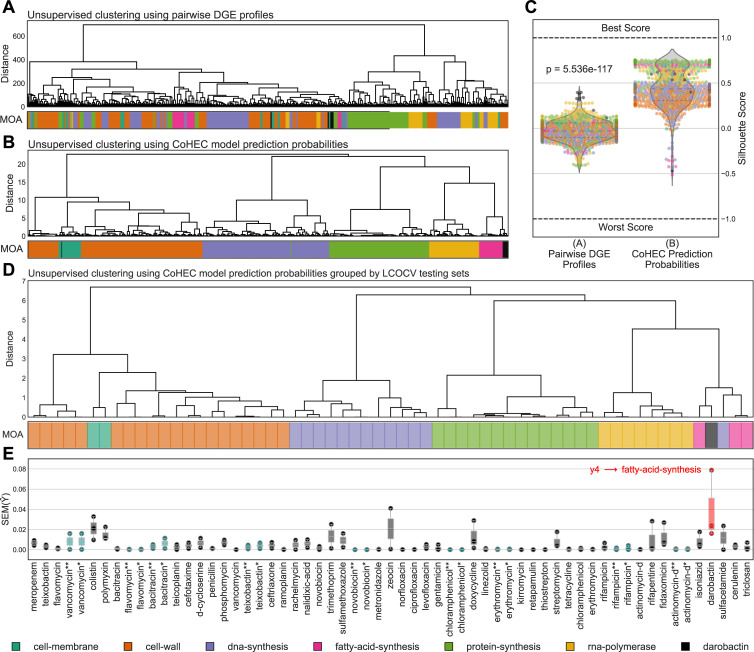
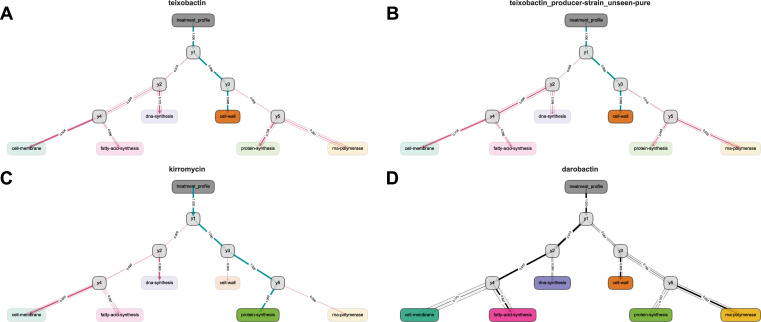
To better combat the expansion of antibiotic resistance in pathogens, new compounds, particularly those with novel mechanisms-of-action [MOA], represent a major research priority in biomedical science. However, rediscovery of known antibiotics demonstrates a need for approaches that accurately identify potential novelty with higher throughput and reduced labor. Here we describe an explainable artificial intelligence classification methodology that emphasizes prediction performance and human interpretability by using a Hierarchical Ensemble of Classifiers model optimized with a novel feature selection algorithm called Clairvoyance; collectively referred to as a CoHEC model. We evaluated our methods using whole transcriptome responses from Escherichia coli challenged with 41 known antibiotics and 9 crude extracts while depositing 122 transcriptomes unique to this study. Our CoHEC model can properly predict the primary MOA of previously unobserved compounds in both purified forms and crude extracts at an accuracy above 99%, while also correctly identifying darobactin, a newly discovered antibiotic, as having a novel MOA. In addition, we deploy our methods on a recent E. coli transcriptomics dataset from a different strain and a Mycobacterium smegmatis metabolomics timeseries dataset showcasing exceptionally high performance; improving upon the performance metrics of the original publications. We not only provide insight into the biological interpretation of our model but also that the concept of MOA is a non-discrete heuristic with diverse effects for different compounds within the same MOA, suggesting substantial antibiotic diversity awaiting discovery within existing MOA.
为了更好地对抗病原体中抗生素耐药性的扩展,新化合物,特别是那些具有新型作用机制(MOA)的化合物,是生物医学科学的一个主要研究重点。然而,已知抗生素的重新发现表明,需要有能够以更高通量和更低人力准确识别潜在新颖性的方法。在此,我们描述了一种可解释的人工智能分类方法,该方法通过使用一种名为“透视法”的新型特征选择算法优化的分层分类器集成模型来强调预测性能和人类可解释性;统称为CoHEC模型。我们使用来自用41种已知抗生素和9种粗提物处理的大肠杆菌的全转录组反应来评估我们的方法,同时存入了本研究独有的122个转录组。我们的CoHEC模型能够以高于99%的准确率正确预测纯化形式和粗提物中先前未观察到的化合物的主要作用机制,同时还能正确识别新发现的抗生素达罗巴汀具有新型作用机制。此外,我们将我们的方法应用于来自不同菌株的最近大肠杆菌转录组学数据集和耻垢分枝杆菌代谢组学时间序列数据集,展示了卓越的性能;改进了原始出版物的性能指标。我们不仅深入了解了我们模型的生物学解释,还了解到作用机制的概念是一种非离散的启发式方法,对同一作用机制内的不同化合物有不同的影响,这表明在现有作用机制内仍有大量抗生素多样性有待发现。