Faculty of Medicine, Université Laval, Institute Universitaire de Cardiologie et de Pneumologie de Québec (IUCPQ), Québec, Quebec City, Canada.
High Altitude Pulmonary and Pathology Institute (HAPPI-IPPA), La Paz, Bolivia.
PLoS One. 2021 Mar 29;16(3):e0237294. doi: 10.1371/journal.pone.0237294. eCollection 2021.
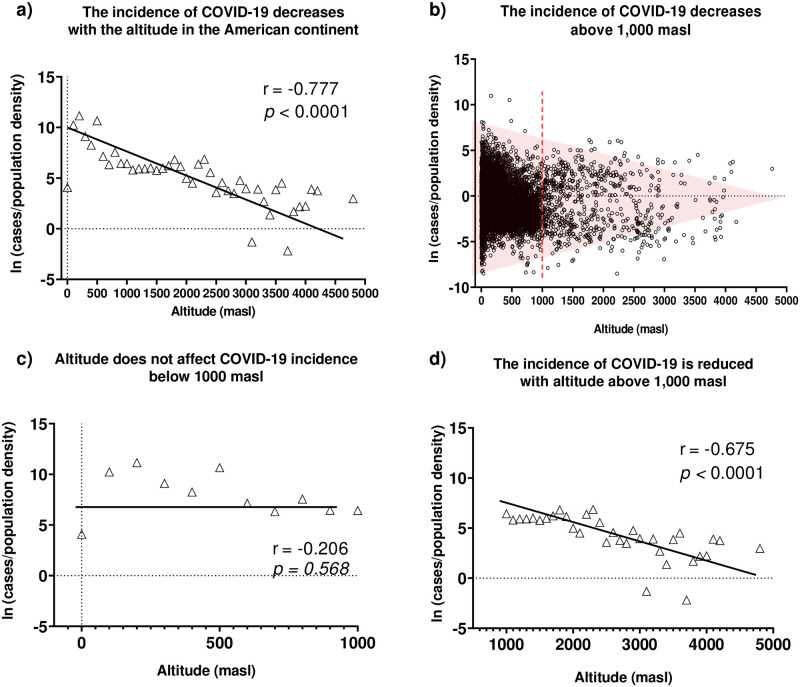
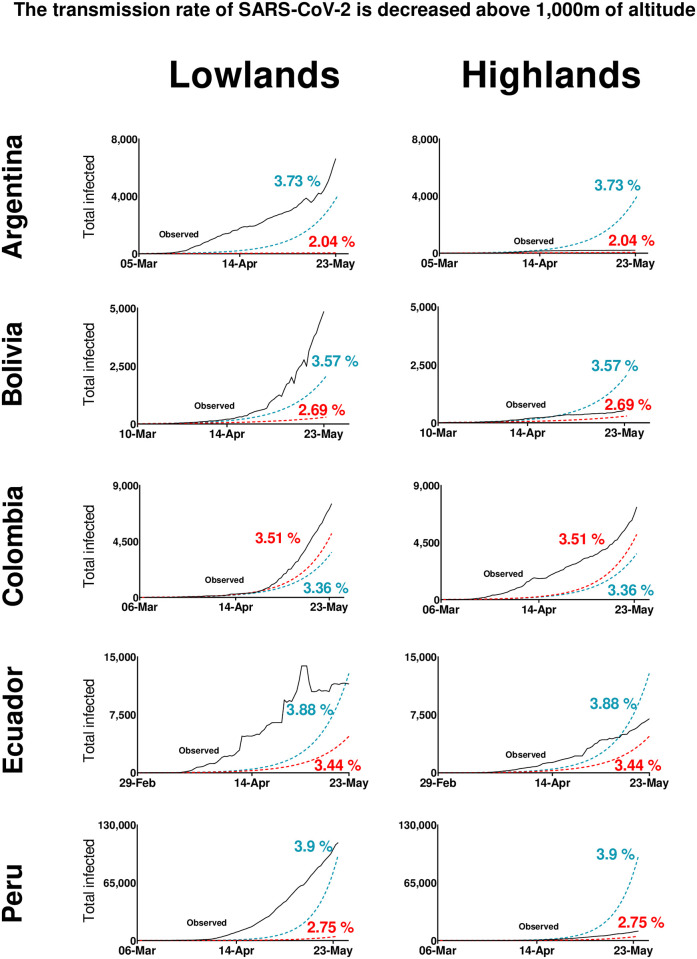
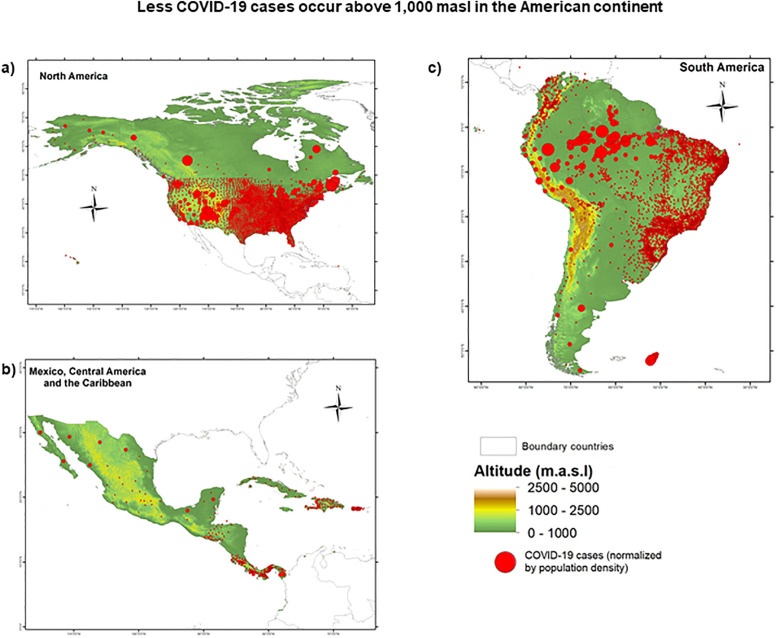
The coronavirus disease 2019 (COVID-19) outbreak in North, Central, and South America has become the epicenter of the current pandemic. We have suggested previously that the infection rate of this virus might be lower in people living at high altitude (over 2,500 m) compared to that in the lowlands. Based on data from official sources, we performed a new epidemiological analysis of the development of the pandemic in 23 countries on the American continent as of May 23, 2020. Our results confirm our previous finding, further showing that the incidence of COVID-19 on the American continent decreases significantly starting at 1,000 m above sea level (masl). Moreover, epidemiological modeling indicates that the virus transmission rate is lower in the highlands (>1,000 masl) than in the lowlands (<1,000 masl). Finally, evaluating the differences in the recovery percentage of patients, the death-to-case ratio, and the theoretical fraction of undiagnosed cases, we found that the severity of COVID-19 is also decreased above 1,000 m. We conclude that the impact of the COVID-19 decreases significantly with altitude.
2019 年冠状病毒病(COVID-19)在北美洲、中美洲和南美洲的爆发已成为当前大流行的中心。我们之前曾提出,与低海拔地区相比,生活在高海拔地区(海拔 2500 米以上)的人感染该病毒的比率可能较低。根据官方来源的数据,我们对截至 2020 年 5 月 23 日在美洲大陆的 23 个国家的大流行发展进行了新的流行病学分析。我们的结果证实了我们之前的发现,进一步表明 COVID-19 在美洲大陆的发病率从海拔 1000 米以上开始显著下降。此外,流行病学模型表明,高海拔地区(>1000 米)的病毒传播率低于低海拔地区(<1000 米)。最后,评估患者康复率、病死率和未确诊病例理论分数的差异,我们发现 COVID-19 的严重程度也在海拔 1000 米以上有所降低。我们得出结论,COVID-19 的影响随海拔高度显著降低。