Institute of Sport Sciences, The Jerzy Kukuczka Academy of Physical Education in Katowice, ul. Mikolowska 72a, 40-065, Katowice, Poland.
Faculty of Physical Education, Gdansk University of Physical Education and Sport, 80-336, Gdansk, Poland.
J Int Soc Sports Nutr. 2021 Mar 30;18(1):25. doi: 10.1186/s12970-021-00421-9.
The main goal of this study was to assess the acute effects of 3 and 6 mg of caffeine intake per kg of body mass (b.m.) on maximal strength and strength-endurance in women habituated to caffeine.
Twenty-one healthy resistance-trained female students (23.0 ± 0.9 years, body mass: 59.0 ± 6.6 kg), with a daily caffeine intake of 5.8 ± 2.6 mg/kg/b.m. participated in a randomized, crossover, double-blind design. Each participant performed three experimental sessions after ingesting either a placebo (PLAC) or 3 mg/kg/b.m. (CAF-3) and 6 mg/kg/b.m. (CAF-6) of caffeine. In each experimental session, the participants underwent a 1RM test and a strength-endurance test at 50 %1RM in the bench press exercise. Maximal load was measured in the 1RM test and the time under tension, number of preformed repetitions, power output and bar velocity were registered in the strength-endurance test.
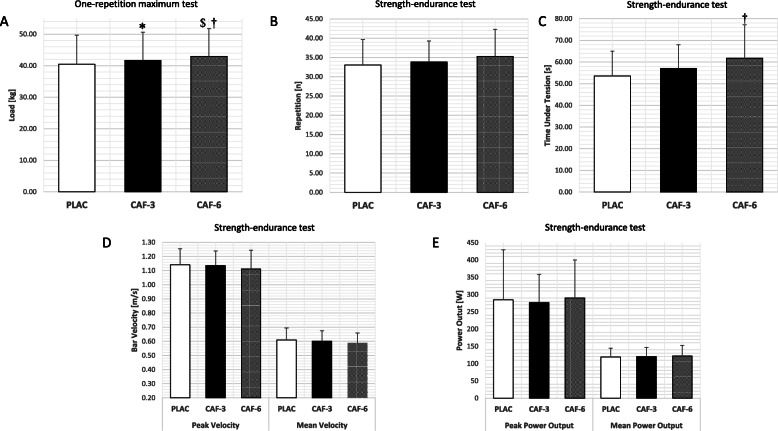
The one-way ANOVA showed a main effect of caffeine on 1RM bench press performance (F = 14.74; p < 0.01). In comparison to the PLAC (40.48 ± 9.21 kg), CAF-3 (41.68 ± 8.98 kg; p = 0.01) and CAF-6 (42.98 ± 8.79 kg; p < 0.01) increased 1RM bench press test results. There was also a significant increase in 1RM for CAF-6 when compared to CAF-3 (p < 0.01). There was a main effect of caffeine on time under tension during the strength-endurance test (F = 13.09; p < 0.01). In comparison to the PLAC (53.52 ± 11.44 s), CAF-6 (61.76 ± 15.39 s; p < 0.01) significantly increased the time under tension during the maximal strength-endurance test.
An acute dose of 3-to-6 mg/kg/b.m. of caffeine improves maximum strength. However, these doses of caffeine had minimal ergogenic effect on strength-endurance performance in women habituated to caffeine.
本研究的主要目的是评估摄入 3 至 6 毫克/公斤体重(b.m.)的咖啡因对习惯咖啡因的女性的最大力量和力量耐力的急性影响。
21 名健康的抗阻训练女学生(23.0±0.9 岁,体重:59.0±6.6kg),每日咖啡因摄入量为 5.8±2.6mg/kg/b.m.,参与了一项随机、交叉、双盲设计的研究。每个参与者在摄入安慰剂(PLAC)或 3 毫克/公斤/体重(CAF-3)和 6 毫克/公斤/体重(CAF-6)的咖啡因后,进行了三次实验。在每次实验中,参与者在卧推运动中进行了 1RM 测试和 50%1RM 的力量耐力测试。最大负荷在 1RM 测试中测量,在力量耐力测试中测量张力下的时间、完成的重复次数、功率输出和杆速度。
单向方差分析显示咖啡因对卧推 1RM 表现有主要影响(F=14.74;p<0.01)。与 PLAC(40.48±9.21kg)相比,CAF-3(41.68±8.98kg;p=0.01)和 CAF-6(42.98±8.79kg;p<0.01)增加了 1RM 卧推测试结果。与 CAF-3 相比,CAF-6 的 1RM 也有显著增加(p<0.01)。咖啡因对力量耐力测试中的张力下时间有主要影响(F=13.09;p<0.01)。与 PLAC(53.52±11.44s)相比,CAF-6(61.76±15.39s;p<0.01)显著增加了最大力量耐力测试中的张力下时间。
摄入 3 至 6 毫克/公斤体重的咖啡因可提高最大力量。然而,这些剂量的咖啡因对习惯咖啡因的女性的力量耐力表现几乎没有促进作用。