Sean N. Parker Center for Allergy and Asthma Research, Stanford, CA, USA.
Human Immune Monitoring Center, Institute for Immunity, Transplantation, and Infection, Stanford University School of Medicine, Stanford, CA, USA.
Allergy. 2021 Sep;76(9):2809-2826. doi: 10.1111/all.14833. Epub 2021 May 29.
Multifood oral immunotherapy (mOIT) with adjunctive anti-IgE (omalizumab, XOLAIR ) treatment affords safe, effective, and rapid desensitization to multiple foods, although the specific immune mechanisms mediating this desensitization remain to be fully elucidated.
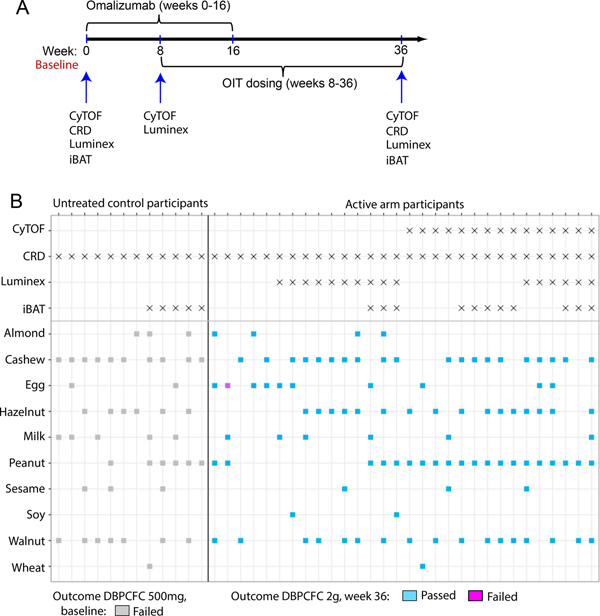
Participants in our phase 2 mOIT trial (NCT02643862) received omalizumab from baseline to week 16 and mOIT from week 8 to week 36. We compared the immune profile of PBMCs and plasma taken at baseline, week 8, and week 36 using high-dimensional mass cytometry, component-resolved diagnostics, the indirect basophil activation test, and Luminex.
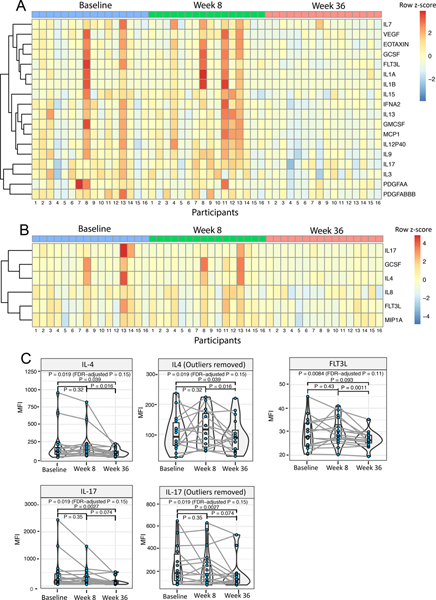
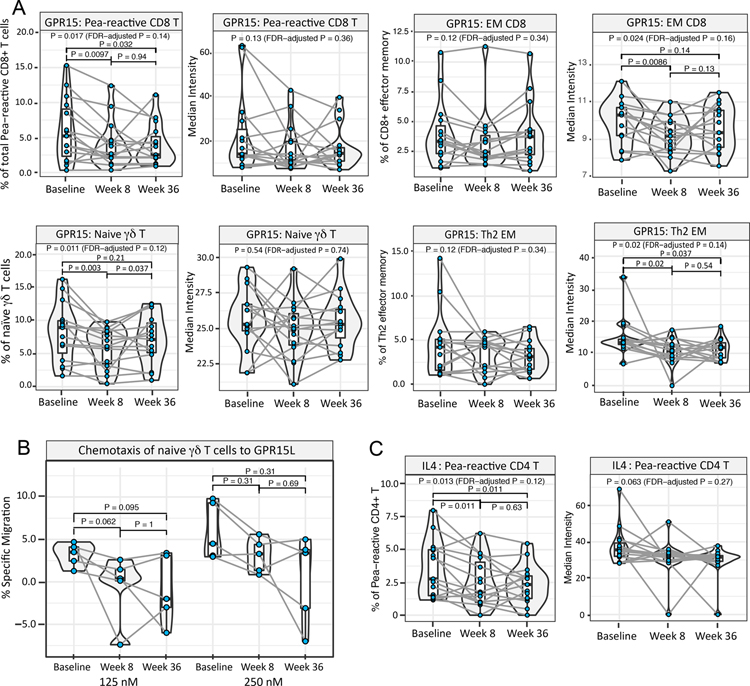
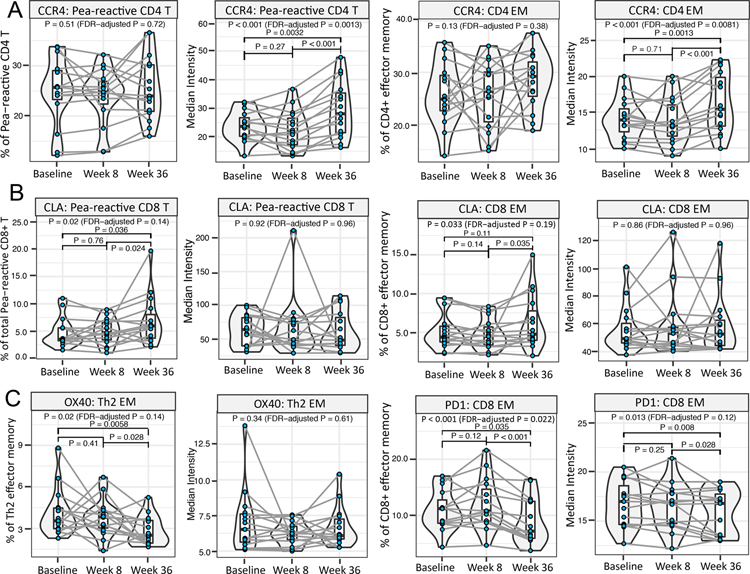
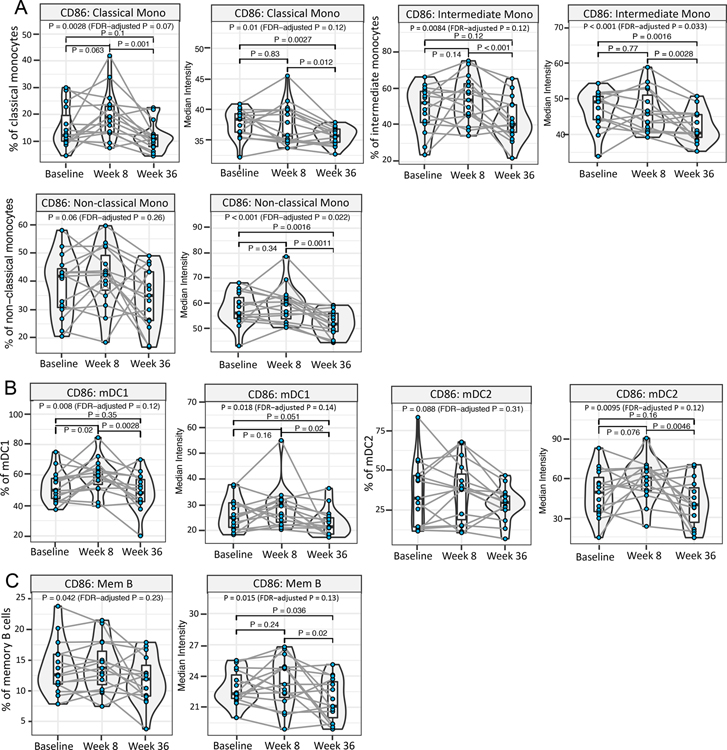
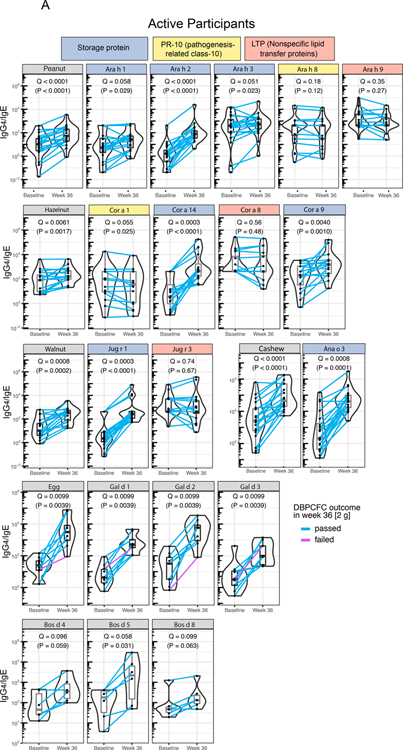
We found (i) decreased frequency of IL-4 peanut-reactive CD4 T cells and a marked downregulation of GPR15 expression and CXCR3 frequency among γδ and CD8 T-cell subsets at week 8 during the initial, omalizumab-alone induction phase; (ii) significant upregulation of the skin-homing receptor CCR4 in peanut-reactive CD4 T and Th2 effector memory (EM) cells and of cutaneous lymphocyte-associated antigen (CLA) in peanut-reactive CD8 T and CD8 EM cells; (iii) downregulation of CD86 expression among antigen-presenting cell subsets; and (iv) reduction in pro-inflammatory cytokines, notably IL-17, at week 36 post-OIT. We also observed significant attenuation of the Th2 phenotype post-OIT, defined by downregulation of IL-4 peanut-reactive T cells and OX40 in Th2EM cells, increased allergen component-specific IgG4/IgE ratio, and decreased allergen-driven activation of indirectly sensitized basophils.
This exploratory study provides novel comprehensive insight into the immune underpinnings of desensitization through omalizumab-facilitated mOIT. Moreover, this study provides encouraging results to support the complex immune changes that can be induced by OIT.
多食物口服免疫治疗(mOIT)联合抗 IgE(奥马珠单抗,XOLAIR)治疗可安全、有效、快速脱敏多种食物,尽管介导这种脱敏的具体免疫机制仍有待充分阐明。
我们的 2 期 mOIT 试验(NCT02643862)参与者从基线到第 16 周接受奥马珠单抗治疗,从第 8 周到第 36 周接受 mOIT 治疗。我们使用高维质谱细胞术、成分解析诊断、间接嗜碱性粒细胞激活试验和 Luminex 比较了基线、第 8 周和第 36 周采集的 PBMC 和血浆的免疫谱。
我们发现(i)在初始的奥马珠单抗单独诱导阶段第 8 周,IL-4 花生反应性 CD4 T 细胞的频率降低,γδ 和 CD8 T 细胞亚群中 GPR15 表达和 CXCR3 频率明显下调;(ii)花生反应性 CD4 T 和 Th2 效应记忆(EM)细胞中皮肤归巢受体 CCR4 和花生反应性 CD8 T 和 CD8 EM 细胞中皮肤淋巴细胞相关抗原(CLA)显著上调;(iii)抗原呈递细胞亚群中 CD86 表达下调;(iv)OIT 后第 36 周促炎细胞因子,尤其是 IL-17 减少。我们还观察到 OIT 后 Th2 表型显著减弱,定义为 IL-4 花生反应性 T 细胞和 Th2EM 细胞中 OX40 下调、过敏原成分特异性 IgG4/IgE 比值增加和间接致敏嗜碱性粒细胞被过敏原激活减少。
这项探索性研究提供了关于奥马珠单抗促进的 mOIT 脱敏的免疫基础的新的综合见解。此外,该研究提供了令人鼓舞的结果,支持 OIT 可诱导的复杂免疫变化。