Private practice, Helsinki, Finland.
Department of Surgery (incl. Physiatry), Institute of Clinical Medicine, University of Eastern Finland, Kuopio, Finland.
BMC Neurol. 2021 Mar 31;21(1):141. doi: 10.1186/s12883-021-02151-6.
Central Sensitization (CS) involves dysfunction in neurophysiological mechanisms that increase neuronal responses to both noxious and non-noxious stimuli in the central nervous system. The Central Sensitization Inventory (CSI) is considered the leading patient-reported outcome measure for assessing CS-related symptoms. The aim of this study was to translate and cross-culturally adapt the CSI into Finnish (CSI-FI) and to evaluate its psychometric properties.
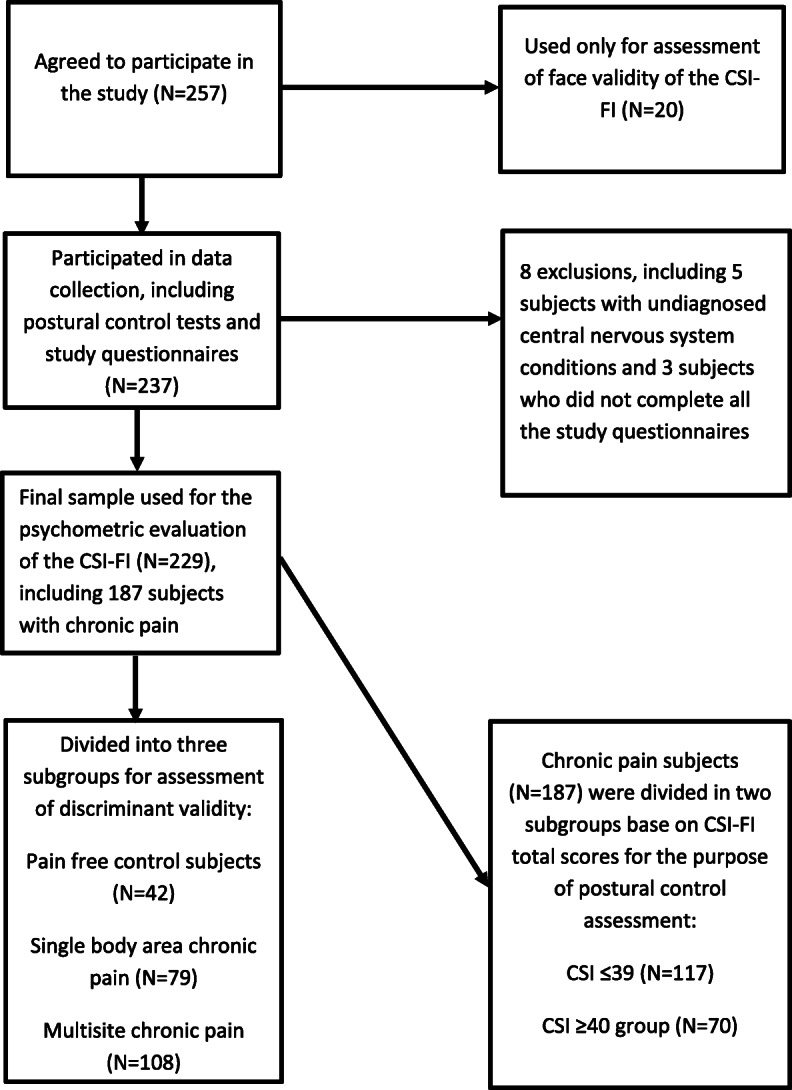
Translation and cross-cultural validation of the CSI was conducted according to established guidelines. The validation sample was 229 subjects, including 42 pain free controls and 187 subjects with chronic musculoskeletal pain. The CSI-FI was evaluated for internal consistency, test-retest reliability, exploratory factor analysis with maximum likelihood extraction, relationship with subject-reported outcome measures [Tampa scale of kinesiophobia (TSK), the Depression scale (DEPS), 5-level EQ-5D version (EQ-5 L-5D), Roland-Morris Disability Questionnaire (RMDQ), and Pain and Sleep Questionnaire Three-Item Index (PSQ-3)], pain history, subjective symptoms of dizziness, and CS-related diagnoses on CSI part B. Furthermore, we studied the ability of the CSI-FI to distinguish pain free controls, subjects with chronic pain in a single body area, and subjects with multisite chronic pain. In addition, we studied the relationship of CSI-FI scores with postural control on a force plate.
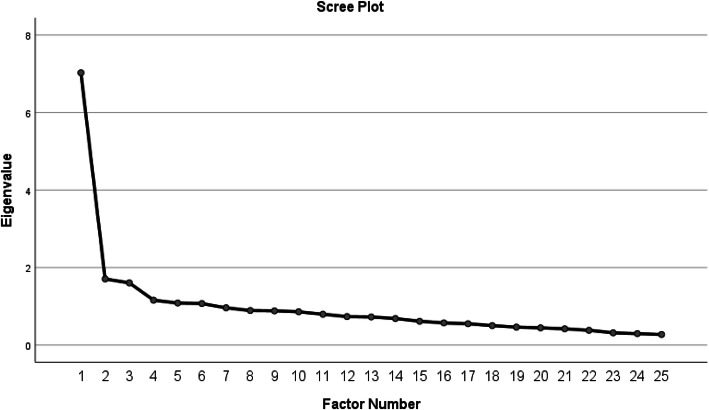
The CSI-FI demonstrated good internal consistency (0.884) and excellent test-retest reliability (0.933) with a 7 ± 1 day gap between test administrations. Exploratory factor analysis with maximum likelihood extraction yielded a one factor solution. Fair to good correlations were found between the CSI-FI and the TSK, DEPS, EQ-5 L-5D, RMDQ, and PSQ-3. Subjective symptoms of dizziness correlated better with CSI-FI scores than any of the CS-related diagnoses on CSI part B. Total CSI-FI scores successfully distinguished between pain free controls, subjects with chronic pain in a single body area, and subjects with multisite chronic pain. The multisite pain group reported significantly more dizziness symptoms than the other two groups. Force plate measurements showed no relationship between postural control and CSI-FI scores.
The CSI-FI translation was successfully cross-culturally adapted and validated into Finnish. CSI-FI psychometric properties and scores were all in acceptable levels and in line with previous CSI validations. The CSI-FI appears to be a valid and reliable instrument for assessing CS-related symptomology in Finnish-speaking populations.
中枢敏化(CS)涉及神经生理机制的功能障碍,这些机制会增加中枢神经系统对有害和无害刺激的神经元反应。中枢敏化量表(CSI)被认为是评估 CS 相关症状的主要患者报告结局测量工具。本研究的目的是将 CSI 翻译成芬兰语(CSI-FI)并进行跨文化验证,并评估其心理测量特性。
根据既定指南对 CSI 进行翻译和跨文化验证。验证样本包括 229 名受试者,其中 42 名无疼痛对照者和 187 名慢性肌肉骨骼疼痛患者。CSI-FI 的内部一致性、重测信度、最大似然提取的探索性因子分析、与受试者报告结局测量工具(运动恐惧量表(TSK)、抑郁量表(DEPS)、五水平 EQ-5D 版本(EQ-5D-L5D)、罗伦兹-莫里斯残疾问卷(RMDQ)和疼痛与睡眠问卷三项指数(PSQ-3))、疼痛史、头晕主观症状以及 CSI 部分 B 的 CS 相关诊断之间的关系进行了评估。此外,我们还研究了 CSI-FI 区分无疼痛对照者、单部位慢性疼痛患者和多部位慢性疼痛患者的能力。此外,我们还研究了 CSI-FI 评分与力板上姿势控制之间的关系。
CSI-FI 显示出良好的内部一致性(0.884)和极好的重测信度(0.933),两次测试之间间隔 7±1 天。最大似然提取的探索性因子分析产生了一个单因素解决方案。CSI-FI 与 TSK、DEPS、EQ-5D-L5D、RMDQ 和 PSQ-3 之间存在良好到中度的相关性。头晕的主观症状与 CSI-FI 评分的相关性优于 CSI 部分 B 的任何 CS 相关诊断。CSI-FI 总分成功区分了无疼痛对照者、单部位慢性疼痛患者和多部位慢性疼痛患者。多部位疼痛组报告的头晕症状明显多于其他两组。力板测量显示,姿势控制与 CSI-FI 评分之间没有关系。
CSI-FI 的翻译成功地跨文化适应并验证为芬兰语。CSI-FI 的心理测量特性和分数均处于可接受水平,与之前的 CSI 验证结果一致。CSI-FI 似乎是一种评估芬兰语人群 CS 相关症状的有效且可靠的工具。