Universidade Estadual Paulista, Faculdade de Ciências Farmacêuticas, Departamento de Análises Clínicas, Laboratório de Micologia Clínica, Araraquara, SP, Brasil.
Universidade Federal de Mato Grosso do Sul, Faculdade de Ciências Farmacêuticas, Alimentos e Nutrição, Campo Grande, MS, Brasil.
Mem Inst Oswaldo Cruz. 2021 Mar 26;116:e200592. doi: 10.1590/0074-02760200592. eCollection 2021.
Paracoccidioidomycosis (PCM) is a systemic mycosis with high prevalence in Latin America that is caused by thermodimorphic fungal species of the Paracoccidioides genus.
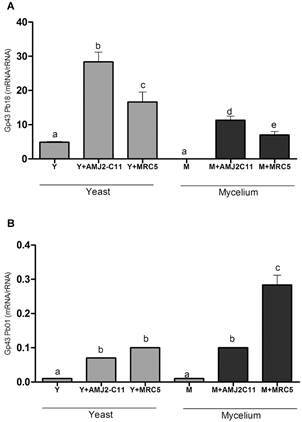
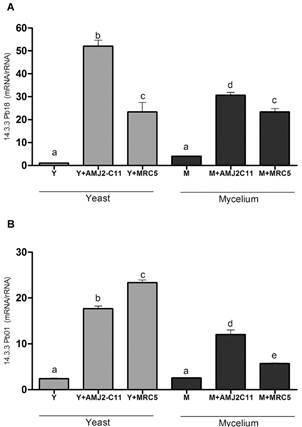
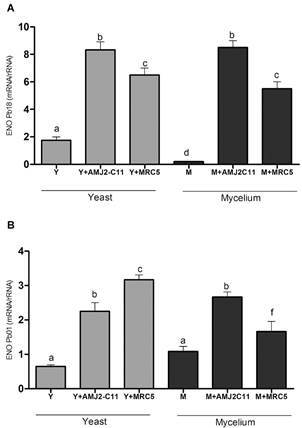
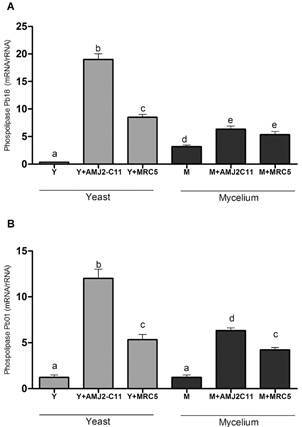
In this study, we used quantitative polymerase chain reaction (qPCR) to investigate the expression of genes related to the virulence of Paracoccidioides brasiliensis (Pb18) and P. lutzii (Pb01) strains in their mycelial (M) and yeast (Y) forms after contact with alveolar macrophages (AMJ2-C11 cell line) and fibroblasts (MRC-5 cell line).
The selected genes were those coding for 43 kDa glycoprotein (gp43), enolase, glyceraldehyde-3-phosphate dehydrogenase (GAPDH), 14-3-3 protein (30 kDa), phospholipase, and aspartyl protease.
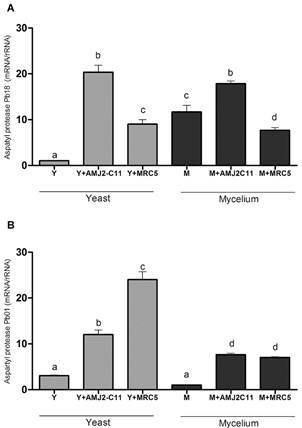
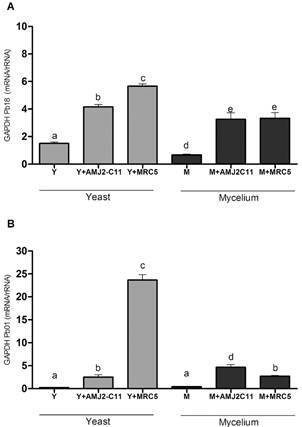
In the Pb18 M form, the aspartyl protease gene showed the highest expression among all genes tested, both before and after infection of host cells. In the Pb18 Y form after macrophage infection, the 14-3-3 gene showed the highest expression among all genes tested, followed by the phospholipase and gp43 genes, and their expression was 50-fold, 10-fold, and 6-fold higher, respectively, than that in the M form. After fibroblast infection with the Pb18 Y form, the 14-3-3 gene showed the highest expression, followed by the phospholipase and aspartyl protease genes, and their expression was 25-fold, 10-fold, and 10-fold higher, respectively, than that in the M form. Enolase and aspartyl protease genes were expressed upon infection of both cell lines. After macrophage infection with the Pb01 Y form, the 14-3-3 gene showed the highest expression, followed by the phospholipase and aspartyl protease genes, and their expression was 18-fold, 12.5-fold, and 6-fold higher, respectively, than that in the M form.
In conclusion, the data show that the expression of the genes analysed may be upregulated upon fungus-host interaction. Therefore, these genes may be involved in the pathogenesis of paracoccidioidomycosis.
球孢子菌病(PCM)是一种在拉丁美洲流行率较高的系统性真菌病,由热双相真菌属的球孢子菌属引起。
本研究采用定量聚合酶链反应(qPCR)检测巴西球孢子菌(Pb18)和秘鲁球孢子菌(Pb01)菌株的菌丝(M)和酵母(Y)形式在与肺泡巨噬细胞(AMJ2-C11 细胞系)和成纤维细胞(MRC-5 细胞系)接触后的毒力相关基因表达。
选择编码 43 kDa 糖蛋白(gp43)、烯醇酶、甘油醛-3-磷酸脱氢酶(GAPDH)、14-3-3 蛋白(30 kDa)、磷脂酶和天冬氨酸蛋白酶的基因。
在 Pb18 M 形式中,天冬氨酸蛋白酶基因在感染宿主细胞前后所有测试基因中表达最高。在巨噬细胞感染后的 Pb18 Y 形式中,14-3-3 基因在所有测试基因中表达最高,其次是磷脂酶和 gp43 基因,其表达分别比 M 形式高 50 倍、10 倍和 6 倍。在 Pb18 Y 形式的成纤维细胞感染后,14-3-3 基因表达最高,其次是磷脂酶和天冬氨酸蛋白酶基因,其表达分别比 M 形式高 25 倍、10 倍和 10 倍。烯醇酶和天冬氨酸蛋白酶基因在两种细胞系感染时均有表达。在巨噬细胞感染 Pb01 Y 形式后,14-3-3 基因表达最高,其次是磷脂酶和天冬氨酸蛋白酶基因,其表达分别比 M 形式高 18 倍、12.5 倍和 6 倍。
总之,数据表明,真菌与宿主相互作用时,分析基因的表达可能上调。因此,这些基因可能参与球孢子菌病的发病机制。