Nadim Giti, Laursen Christian B, Pietersen Pia I, Wittrock Daniel, Sørensen Michael K, Nielsen Lars B, Rasmussen Claus-Henrik, Christensen Helle Marie, Helmerik Simon, Jørgensen Gitte, Titlestad Ingrid L, Lassen Annmarie T, Mikkelsen Søren
Emergency Medicine Research Unit, Odense University Hospital, Odense, Denmark.
Department of Clinical Research, Odense Respiratory Research Unit (ODIN), University of Southern Denmark, Odense, Denmark.
BMC Health Serv Res. 2021 Mar 31;21(1):290. doi: 10.1186/s12913-021-06305-7.
Crowding of the emergency departments is an increasing problem. Many patients with an exacerbation of chronic obstructive pulmonary disease (COPD) are often treated in the emergency departments for a very short period before discharged to their homes. It is possible that this treatment could take place in the patients' homes with sufficient diagnostics supporting the treatment. In an effort to keep the diagnostics and treatment of some of these patients in their homes and thus to reduce the patient load at the emergency departments, we implemented a prehospital treat-and-release strategy based on ultrasonography and blood testing performed by emergency medical technicians (EMT) or paramedics (PM) in patients with acute exacerbation of COPD.
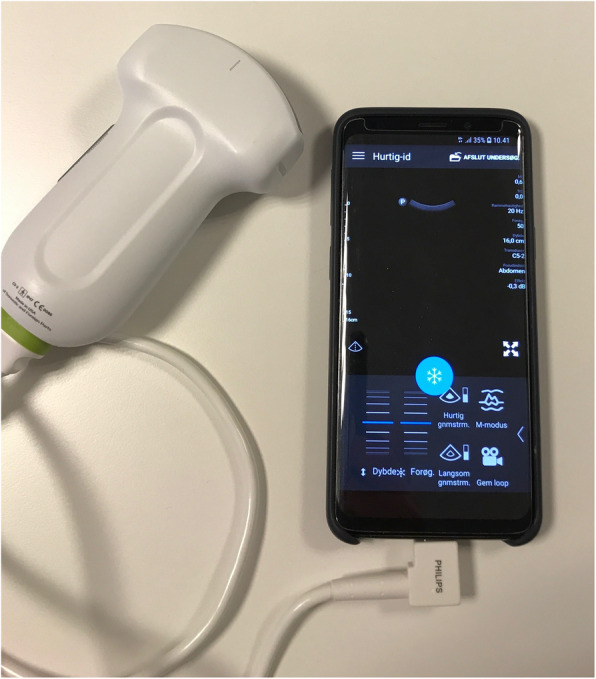
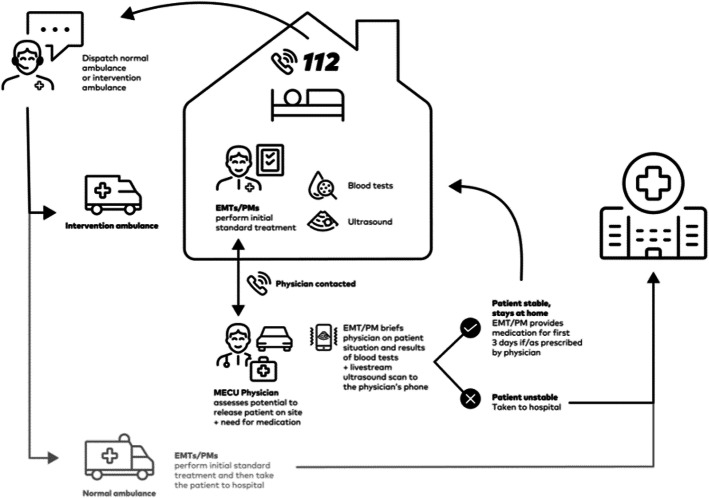
EMTs and PMs were enrolled in a six-hour educational program covering ultrasonography of the lungs and point of care blood tests. During the seasonal peak of COPD exacerbations (October 2018 - May 2019) all patients who were treated by the ambulance crews for respiratory insufficiency were screened in the ambulances. If the patient had uncomplicated COPD not requiring immediate transport to the hospital, ultrasonographic examination of the lungs, measurements of C-reactive protein and venous blood gases analyses were performed. The response to the initial treatment and the results obtained were discussed via telemedical consultation with a prehospital anaesthesiologist who then decided to either release the patient at the scene or to have the patient transported to the hospital. The primary outcome was strategy feasibility.
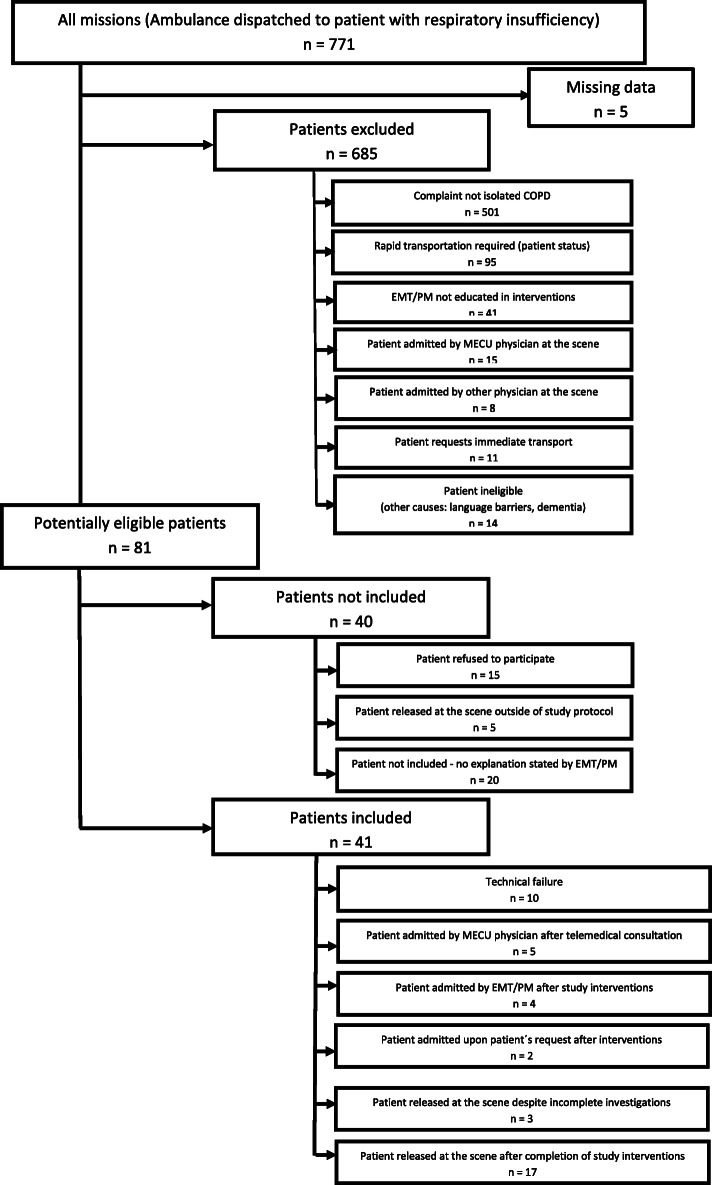
We included 100 EMTs and PMs in the study. During the study period, 771 patients with respiratory insufficiency were screened. Uncomplicated COPD was rare as only 41patients were treated according to the treat-and-release strategy. Twenty of these patients (49%) were released at the scene. In further ten patients, technical problems were encountered hindering release at the scene.
In a few selected patients with suspected acute exacerbations of COPD, it was technically and organisationally feasible for EMTs and PMs to perform prehospital POCT-ultrasound and laboratory testing and release the patients following treatment. None of the patients released at the scene requested a secondary ambulance within the first 48 h following the intervention.
急诊科拥挤是一个日益严重的问题。许多慢性阻塞性肺疾病(COPD)急性加重患者在急诊科接受的治疗时间往往很短,然后就被送回家中。如果有足够的诊断支持治疗,这种治疗有可能在患者家中进行。为了让部分此类患者在家中接受诊断和治疗,从而减轻急诊科的患者负担,我们实施了一种院前治疗并出院策略,该策略基于急诊医疗技术员(EMT)或护理人员(PM)对COPD急性加重患者进行的超声检查和血液检测。
EMT和PM参加了一个为期六小时的教育项目,内容涵盖肺部超声检查和即时检验血液检测。在COPD急性加重的季节性高峰期(2018年10月至2019年5月),救护人员治疗的所有呼吸功能不全患者均在救护车上接受筛查。如果患者患有无需立即送往医院的单纯性COPD,则进行肺部超声检查、C反应蛋白测量和静脉血气分析。通过与院前麻醉医生的远程医疗会诊讨论初始治疗的反应和获得的结果,然后由其决定是在现场让患者出院还是将患者送往医院。主要结果是该策略的可行性。
我们纳入了100名EMT和PM参与研究。在研究期间,筛查了771例呼吸功能不全患者。单纯性COPD很少见,只有41例患者按照治疗并出院策略接受治疗。其中20例患者(49%)在现场出院。另有10例患者遇到技术问题,阻碍了在现场出院。
对于少数疑似COPD急性加重的选定患者,EMT和PM进行院前即时检验超声和实验室检测并在治疗后让患者出院在技术和组织上是可行的。在干预后的头48小时内,没有一名在现场出院的患者要求再次呼叫救护车。