Department of Functional Biology, University of Oviedo, C/Julian Claveria S/N, 33006, Oviedo, Spain.
Department of Natural Sciences, School of Science and Computing, Marine and Freshwater Research Centre, Galway-Mayo Institute of Technology, Dublin Road, Galway, H91 T8NW, Ireland.
Sci Rep. 2021 Mar 31;11(1):7224. doi: 10.1038/s41598-021-86731-z.
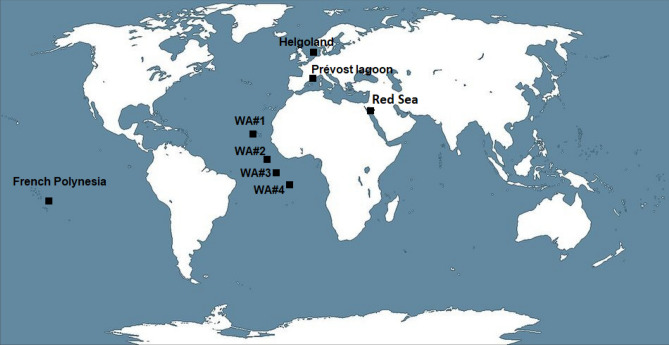
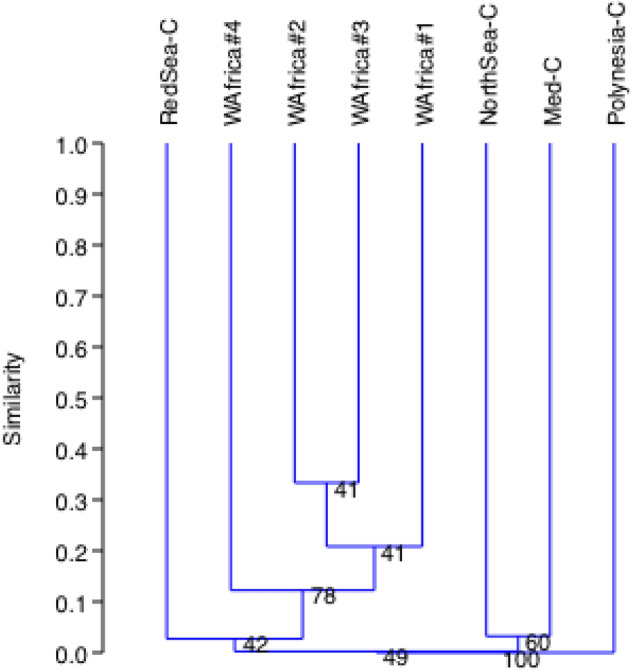
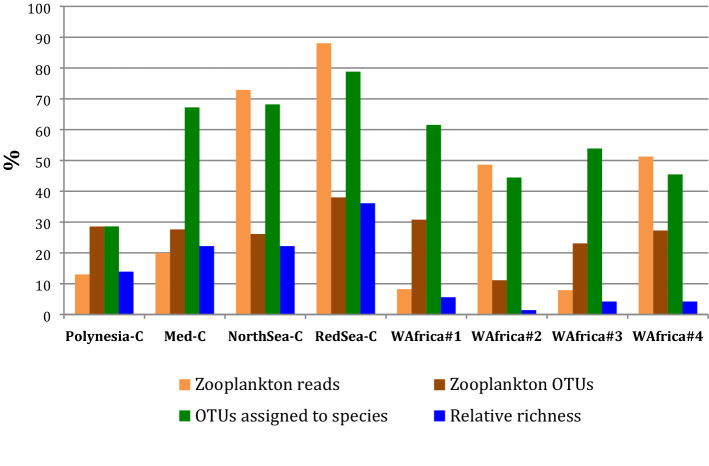
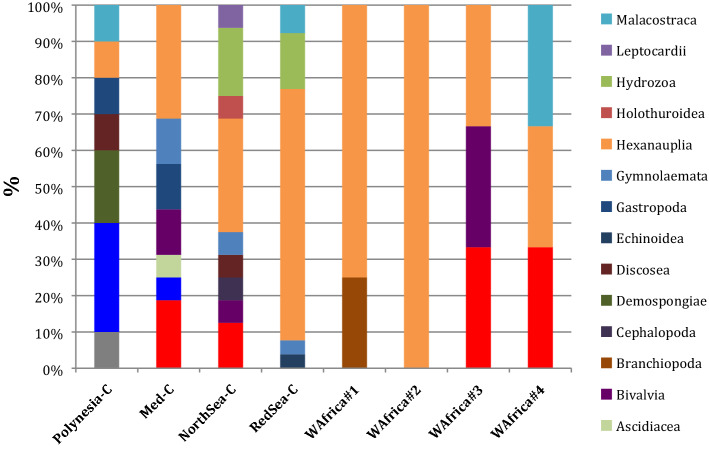
Zooplankton community inventories are the basis of fisheries management for containing fish larvae and their preys; however, the visual identification of early-stage larvae (the "missing biomass") is difficult and laborious. Here, eDNA metabarcoding was employed to detect zooplankton species of interest for fisheries from open and coastal waters. High-Throughput sequencing (HTS) from environmental samples using small water volumes has been proposed to detect species of interest whose DNA is the most abundant. We analyzed 6-L water samples taken from subtropical and tropical waters using Cytochrome oxidase I (COI) gene as metabarcode. In the open ocean, several commercial fish larvae and invertebrate species important in fish diet were found from metabarcodes and confirmed from individual barcoding. Comparing Atlantic, Mediterranean, Red Sea, and Pacific samples we found a lower taxonomic depth of OTU assignments in samples from tropical waters than in those from temperate ones, suggesting large gaps in reference databases for those areas; thus a higher effort of zooplankton barcoding in tropical oceans is highly recommended. This and similar simplified sampling protocols could be applied in early detection of species important for fisheries.
浮游动物群落名录是渔业管理的基础,可以控制鱼类幼体及其猎物的数量。然而,早期幼虫(“缺失生物量”)的肉眼识别既困难又费力。在这里,我们采用环境 DNA(eDNA)宏条形码技术来检测渔业感兴趣的浮游动物物种,这些物种来自开阔水域和沿海水域。通过使用小体积的水进行高通量测序(HTS),可以检测到丰度最高的目标物种的 DNA。我们使用细胞色素氧化酶 I(COI)基因作为宏条形码,分析了取自亚热带和热带水域的 6 升水样。在开阔海域中,我们从宏条形码中发现了一些商业鱼类幼体和鱼类食物中重要的无脊椎动物物种,并通过个体条形码进行了确认。通过比较大西洋、地中海、红海和太平洋的样本,我们发现热带水域样本的 OTU 分配的分类深度低于温带水域,这表明这些地区的参考数据库存在较大的差距;因此,强烈建议在热带海洋中加大浮游动物条形码的工作力度。这种和类似的简化采样方案可用于早期检测渔业中重要的物种。