Department of Psychiatry and Behavioral Sciences, University of Minnesota, Minneapolis, MN, USA.
Institute for Health Informatics, University of Minnesota, Minneapolis, MN, USA.
Commun Biol. 2021 Mar 31;4(1):435. doi: 10.1038/s42003-021-01955-z.
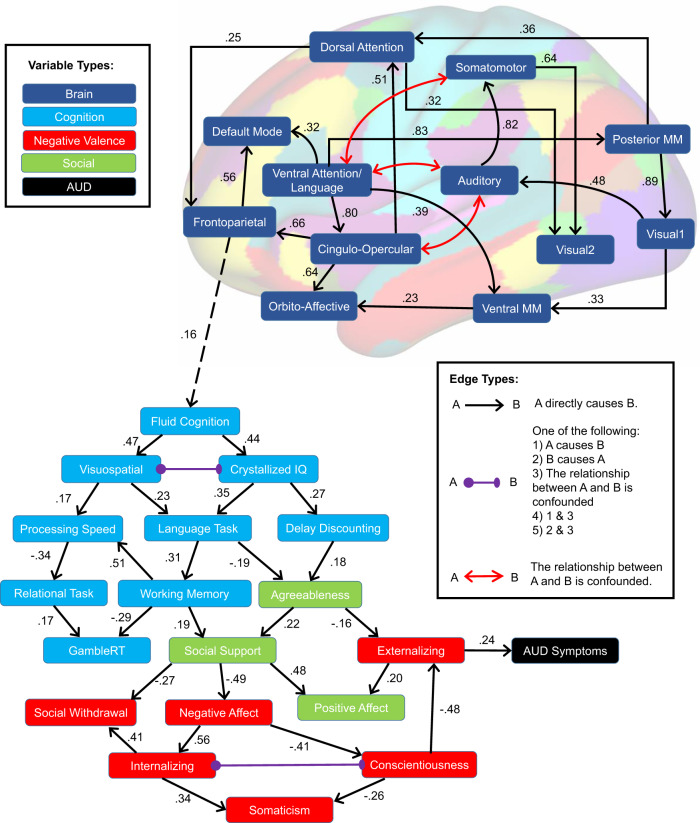
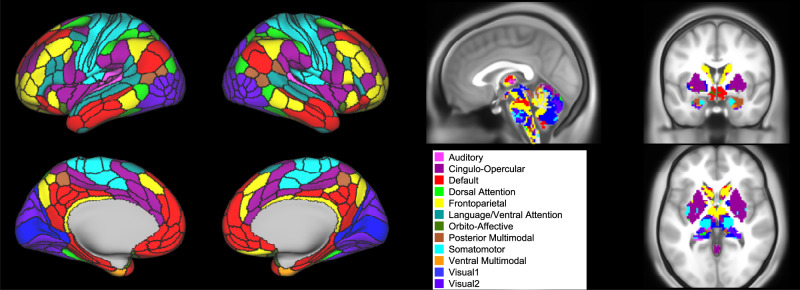
Alcohol use disorder (AUD) has high prevalence and adverse societal impacts, but our understanding of the factors driving AUD is hampered by a lack of studies that describe the complex neurobehavioral mechanisms driving AUD. We analyzed causal pathways to AUD severity using Causal Discovery Analysis (CDA) with data from the Human Connectome Project (HCP; n = 926 [54% female], 22% AUD [37% female]). We applied exploratory factor analysis to parse the wide HCP phenotypic space (100 measures) into 18 underlying domains, and we assessed functional connectivity within 12 resting-state brain networks. We then employed data-driven CDA to generate a causal model relating phenotypic factors, fMRI network connectivity, and AUD symptom severity, which highlighted a limited set of causes of AUD. The model proposed a hierarchy with causal influence propagating from brain connectivity to cognition (fluid/crystalized cognition, language/math ability, & working memory) to social (agreeableness/social support) to affective/psychiatric function (negative affect, low conscientiousness/attention, externalizing symptoms) and ultimately AUD severity. Our data-driven model confirmed hypothesized influences of cognitive and affective factors on AUD, while underscoring that addiction models need to be expanded to highlight the importance of social factors, amongst others.
酒精使用障碍(AUD)的患病率较高,对社会有不良影响,但由于缺乏描述驱动 AUD 的复杂神经行为机制的研究,我们对驱动 AUD 的因素的理解受到了阻碍。我们使用因果发现分析(CDA)分析了 AUD 严重程度的因果途径,该分析的数据来自人类连接组计划(HCP;n=926 [54%为女性],22%为 AUD [37%为女性])。我们应用探索性因子分析将 HCP 广泛的表型空间(100 项指标)解析为 18 个潜在领域,并评估了 12 个静息状态大脑网络中的功能连接。然后,我们采用数据驱动的 CDA 生成了一个与表型因素、fMRI 网络连接和 AUD 症状严重程度相关的因果模型,该模型突出了 AUD 的有限原因。该模型提出了一个层次结构,因果影响从大脑连接传播到认知(流体/晶体认知、语言/数学能力和工作记忆)、社会(和蔼可亲/社会支持)、情感/精神功能(消极情绪、低责任心/注意力、外化症状),最终影响 AUD 严重程度。我们的数据驱动模型证实了认知和情感因素对 AUD 的假设影响,同时强调需要扩展成瘾模型,以突出社会因素等的重要性。