Department of Psychology and Neuroscience, University of North Carolina, Chapel Hill, NC 27599, USA; Bowles Center for Alcohol Studies, University of North Carolina, Chapel Hill, NC 27599, USA; Biomedical Research Imaging Center, University of North Carolina, Chapel Hill, NC 27599, USA.
Bowles Center for Alcohol Studies, University of North Carolina, Chapel Hill, NC 27599, USA; Department of Psychiatry, University of North Carolina, Chapel Hill, NC, 27599, USA.
Neuroimage Clin. 2021;32:102801. doi: 10.1016/j.nicl.2021.102801. Epub 2021 Aug 24.
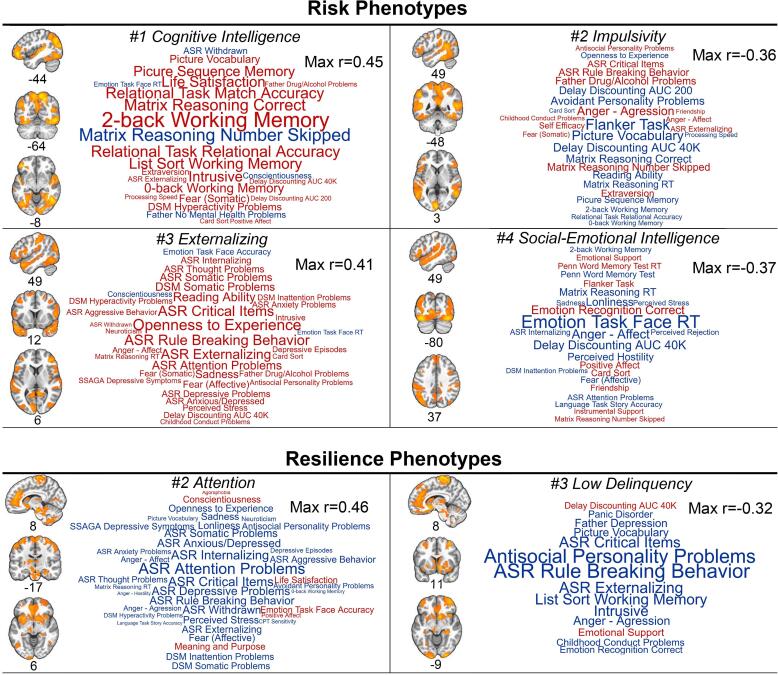
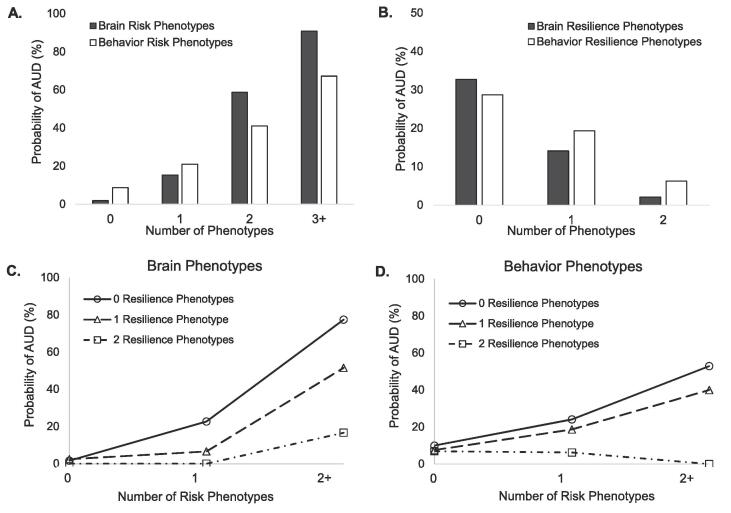
A family history of alcoholism (FH) increases risk for alcohol use disorder (AUD), yet many at-risk individuals never develop alcohol use problems. FH is associated with intermediate levels of risk phenotypes, whereas distinct, compensatory brain changes likely promote resilience. Although several cognitive, behavioral, and personality factors have been associated with AUD, the relative contributions of these processes and their neural underpinnings to risk or resilience processes remains less clear. We examined whole-brain resting-state functional connectivity (FC) and behavioral metrics from 841 young adults from the Human Connectome Project, including healthy controls, individuals with AUD, and their unaffected siblings. First, we identified functional connections in which unaffected siblings were intermediate between controls and AUD, indicating AUD risk, and those in which siblings diverged, indicating resilience. Canonical correlations relating brain risk and resilience FC to behavioral patterns revealed AUD risk and resilience phenotypes. Risk phenotypes primarily implicated frontal-parietal networks corresponding with executive function, impulsivity, externalizing behaviors, and social-emotional intelligence. Conversely, resilience-related phenotypes were underpinned by networks of medial prefrontal, striatal, temporal, brainstem and cerebellar connectivity, which associated with high trait attention and low antisocial behavior. Additionally, we calculated "polyphenotypic" risk and resilience scores, to investigate how the relative load of risk and resilience phenotypes influenced the probability of an AUD diagnosis. Polyphenotypic scores predicted AUD in a dose-dependent manner. Moreover, resilience phenotypes interacted with risk phenotypes, reducing their effects. The hypothesis-generating results revealed interpretable AUD-related phenotypes and offer brain-informed targets for developing more effective interventions.
家族酗酒史(FH)会增加酗酒障碍(AUD)的风险,但许多高危个体从未出现过饮酒问题。FH 与中间水平的风险表型相关,而独特的、代偿性的大脑变化可能促进了韧性。尽管已经有几个认知、行为和人格因素与 AUD 相关,但这些过程及其神经基础对风险或韧性过程的相对贡献仍不明确。我们研究了来自人类连接体计划的 841 名年轻成年人的全脑静息状态功能连接(FC)和行为指标,包括健康对照、AUD 患者及其未受影响的兄弟姐妹。首先,我们确定了未受影响的兄弟姐妹在控制组和 AUD 组之间处于中间状态的功能连接,表明存在 AUD 风险,以及那些兄弟姐妹之间存在差异的功能连接,表明存在韧性。将大脑风险和韧性 FC 与行为模式相关联的典型相关分析揭示了 AUD 风险和韧性表型。风险表型主要涉及与执行功能、冲动、外化行为和社会情感智力相对应的额顶叶网络。相反,与韧性相关的表型是由内侧前额叶、纹状体、颞叶、脑干和小脑连接的网络支持的,与高特质注意力和低反社会行为有关。此外,我们计算了“多表型”风险和韧性评分,以研究风险和韧性表型的相对负荷如何影响 AUD 诊断的可能性。多表型评分以剂量依赖的方式预测 AUD。此外,韧性表型与风险表型相互作用,降低了它们的影响。这些产生假说的结果揭示了可解释的 AUD 相关表型,并为开发更有效的干预措施提供了基于大脑的目标。