Department of Medical Endocrinology and Metabolism, Rigshospitalet, Copenhagen University Hospital, Copenhagen, Denmark.
Department of Clinical Medicine, Faculty of Health and Medical Sciences, University of Copenhagen, Copenhagen, Denmark.
Front Endocrinol (Lausanne). 2021 Mar 12;12:641560. doi: 10.3389/fendo.2021.641560. eCollection 2021.
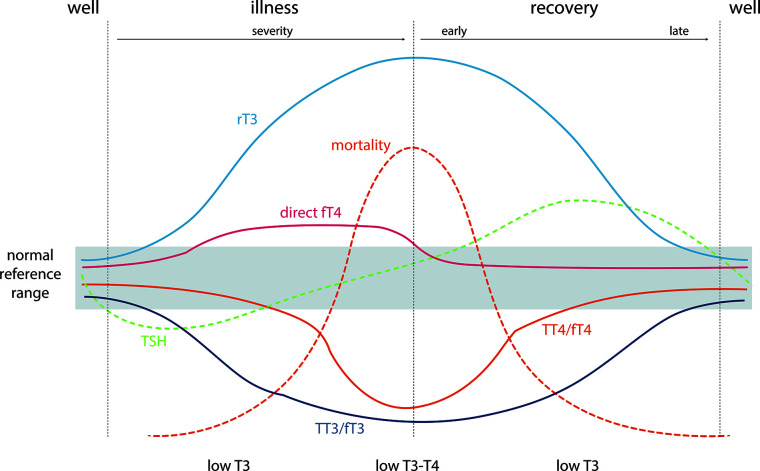
Levothyroxine (L-T4) treatment of overt hypothyroidism can be more challenging in elderly compared to young patients. The elderly population is growing, and increasing incidence and prevalence of hypothyroidism with age are observed globally. Elderly people have more comorbidities compared to young patients, complicating correct diagnosis and management of hypothyroidism. Most importantly, cardiovascular complications compromise the usual start dosage and upward titration of L-T4 due to higher risk of decompensating cardiac ischemia and -function. It therefore takes more effort and care from the clinician, and the maintenance dose may have to be lower in order to avoid a cardiac incidence. On the other hand, L-T4 has a beneficial effect on cardiac function by increasing performance. The clinical challenge should not prevent treating with L-T4 should the patient develop e.g., cardiac ischemia. The endocrinologist is obliged to collaborate with the cardiologist on prophylactic cardiac measures by invasive cardiac surgery or medical therapy against cardiac ischemic angina. This usually allows subsequent successful treatment. Management of mild (subclinical) hypothyroidism is even more complex. Prevalent comorbidities in the elderly complicate correct diagnosis, since many concomitant morbidities can result in non-thyroidal illness, resembling mild hypothyroidism both clinically and biochemically. The diagnosis is further complicated as methods for measuring thyroid function (thyrotropin and thyroxine) vary immensely according to methodology and background population. It is thus imperative to ensure a correct diagnosis by etiology (e.g., autoimmunity) before deciding to treat. Even then, there is controversy regarding whether or not treatment of such mild forms of hypothyroidism in elderly will improve mortality, morbidity, and quality of life. This should be studied in large cohorts of patients in long-term placebo-controlled trials with clinically relevant outcomes. Other cases of hypothyroidism, e.g., medications, iodine overload or hypothalamus-pituitary-hypothyroidism, each pose specific challenges to management of hypothyroidism; these cases are also more frequent in the elderly. Finally, adherence to treatment is generally challenging. This is also the case in elderly patients, which may necessitate measuring thyroid hormones at individually tailored intervals, which is important to avoid over-treatment with increased risk of cardiac morbidity and mortality, osteoporosis, cognitive dysfunction, and muscle deficiency.
左甲状腺素(L-T4)治疗显性甲状腺功能减退症在老年人中比在年轻患者中更具挑战性。老年人口在增长,全球范围内观察到甲状腺功能减退症的发病率和患病率随着年龄的增长而增加。与年轻患者相比,老年人的合并症更多,这使得甲状腺功能减退症的正确诊断和管理变得复杂。最重要的是,心血管并发症使左甲状腺素的常规起始剂量和递增剂量复杂化,因为心脏缺血和功能代偿的风险更高。因此,临床医生需要付出更多的努力和关注,维持剂量可能需要降低,以避免心脏事件的发生。另一方面,左甲状腺素通过增加心功能来产生有益的作用。如果患者出现例如心脏缺血,临床医生不应因为担心发生心脏事件而避免用左甲状腺素进行治疗。内分泌学家有义务与心脏病专家合作,通过侵入性心脏手术或针对心脏缺血性心绞痛的药物治疗来预防心脏措施。这通常可以允许随后的成功治疗。轻度(亚临床)甲状腺功能减退症的管理甚至更加复杂。老年人中普遍存在的合并症使正确诊断变得复杂,因为许多并存的疾病都会导致非甲状腺疾病,在临床上和生化上都类似于轻度甲状腺功能减退症。由于测量甲状腺功能(促甲状腺激素和甲状腺素)的方法根据方法学和背景人群差异很大,因此诊断更加复杂。因此,在决定治疗之前,通过病因(例如自身免疫)确保正确诊断至关重要。即便如此,对于治疗老年人群中这些轻度甲状腺功能减退症是否会改善死亡率、发病率和生活质量,仍存在争议。这应该在具有临床相关结局的大型患者队列的长期安慰剂对照试验中进行研究。其他类型的甲状腺功能减退症,例如药物、碘过量或下丘脑-垂体-甲状腺功能减退症,每种疾病都对甲状腺功能减退症的管理提出了具体挑战;这些情况在老年人中也更为常见。最后,治疗的依从性通常是具有挑战性的。老年患者也是如此,这可能需要根据个体情况量身定制间隔测量甲状腺激素,这对于避免过度治疗、降低心脏发病率和死亡率、骨质疏松症、认知功能障碍和肌肉缺陷的风险非常重要。