State Key Laboratory for Diagnosis and Treatment of Infectious Diseases, The First Affiliated Hospital, Zhejiang University School of Medicine, 79 Qingchun Rd, Hangzhou City 310003, China.
National Clinical Research Center for Infectious Diseases, 79 Qingchun Rd, Hangzhou City 310003, China.
Biomed Res Int. 2021 Mar 18;2021:6627562. doi: 10.1155/2021/6627562. eCollection 2021.
The optimal tool for predicting the survival of renal cell carcinoma (RCC) patients with lung metastases remains controversial.
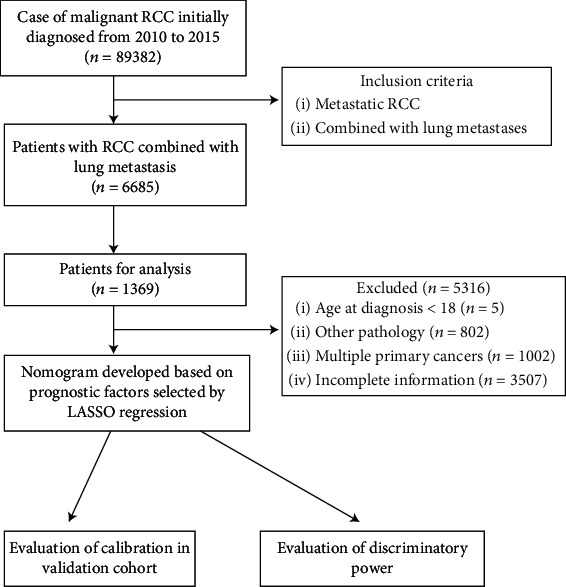
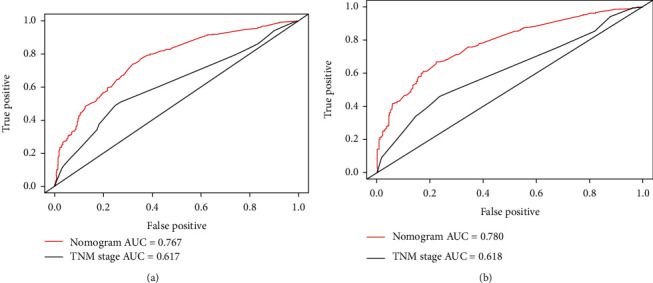
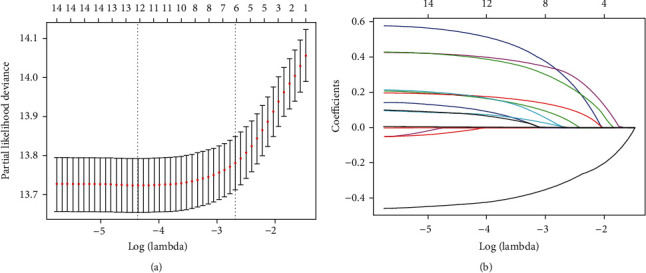
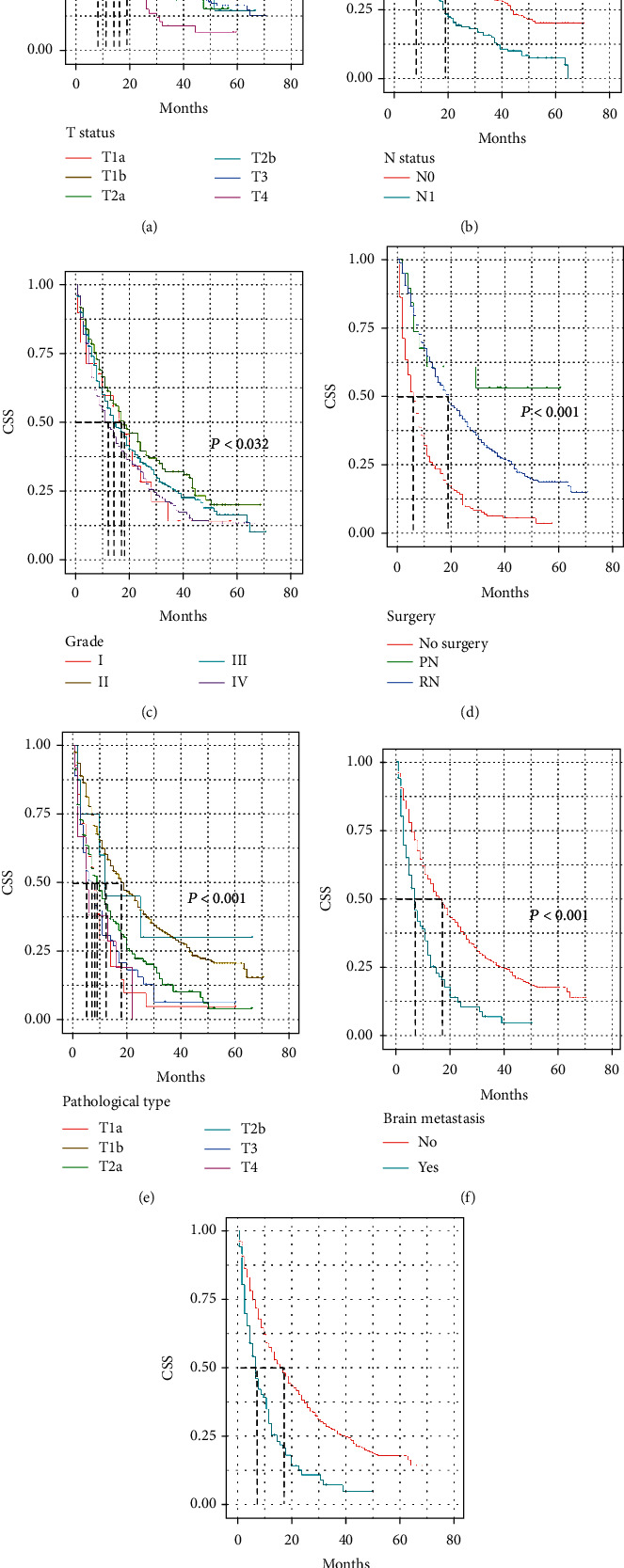
We selected patients diagnosed with RCC and lung metastases, from 2010 to 2015, from the Surveillance, Epidemiology, and End Results (SEER) database. After the selection of inclusion criteria and exclusion criterion, the rest of the patients were incorporated into model analysis. Least absolute shrinkage and selection operator (LASSO) regression was used to select the most important features for construction of a nomogram predicting cancer-specific survival. A calibration plot and the concordance index (-index) were used to estimate nomogram efficacy in a validation cohort. The association between important factors selected by LASSO regression, and prognosis was assessed by the Kaplan-Meier (KM) survival curve. The receiver operating characteristic (ROC) curves were drawn to compare sensitivity and specificity between the nomogram we built and the TNM stage-based model.
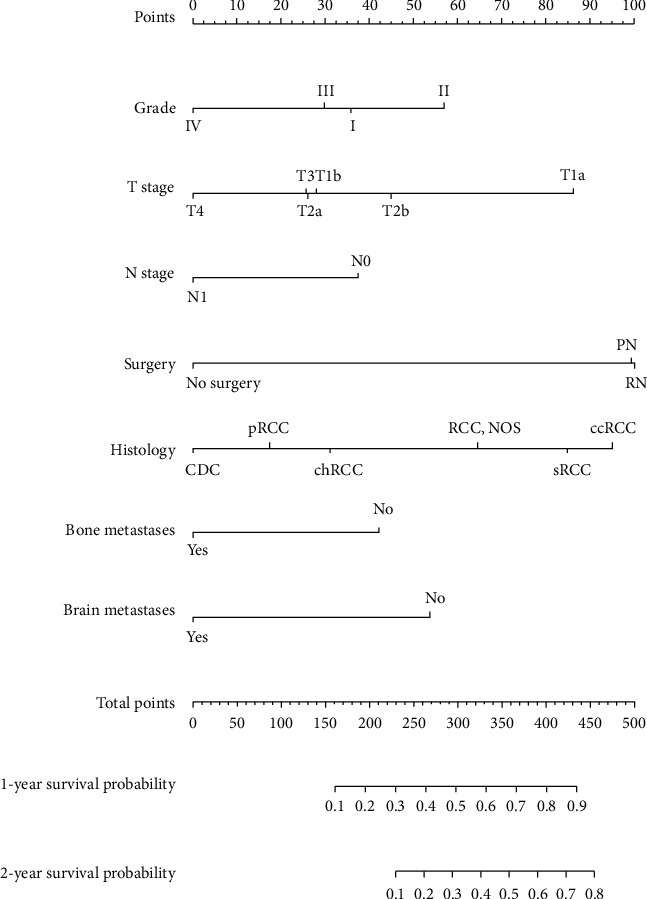
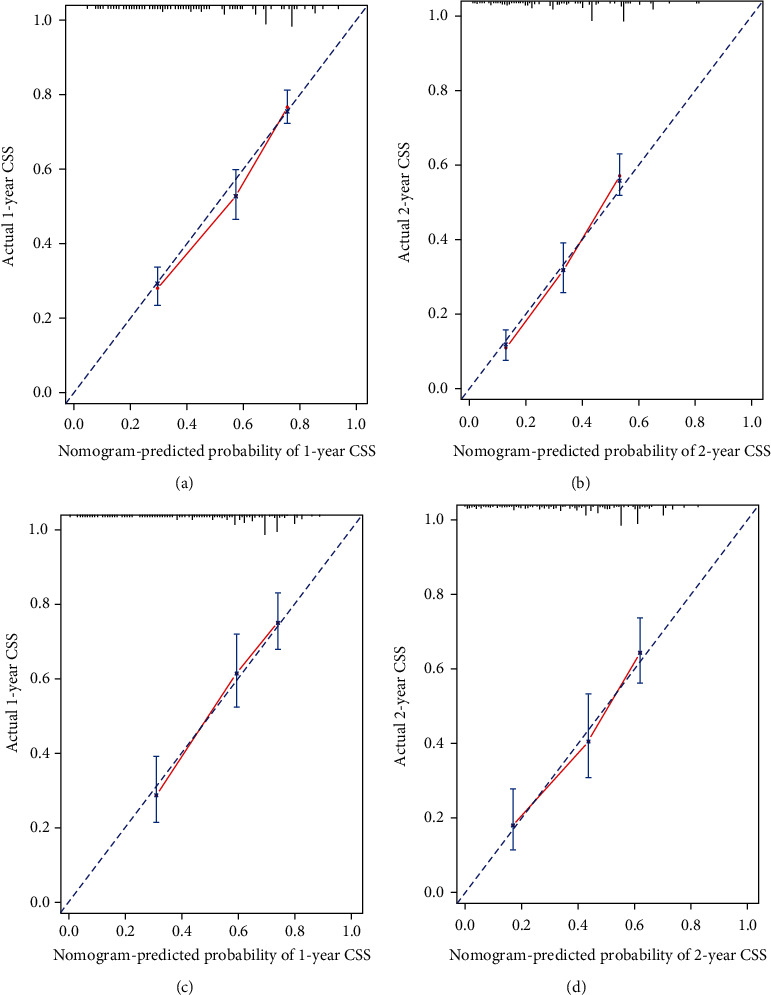
A total of 1,369 patients met the inclusion criteria, but not the exclusion criteria. The LASSO regression model reduced 15 features to seven potential predictors of survival, including tumor grade, the extent of surgery, N and T status, histological profile, and brain and bone metastasis status. Such features had good discrimination in the KM survival curves. The nomogram showed excellent discriminatory power (-index, 0.71; 95% confidence interval: 0.70 to 0.72) and good calibration in terms of both 1- and 2-year cancer-specific survival. The nomogram showed great discriminatory power (-index 0.68) and adequate calibration when applied to the validation cohort. The areas under the curve (AUCs) of nomogram were 0.767 and 0.780, respectively, and the AUCs of TNM stage were 0.617 and 0.618 at 1 and 2 years, respectively.
Our nomogram might play a major role in predicting the cancer-specific survival of RCC patients with lung metastases.
预测肾细胞癌(RCC)伴肺转移患者生存的最佳工具仍存在争议。
我们从监测、流行病学和最终结果(SEER)数据库中选择了 2010 年至 2015 年期间被诊断为 RCC 伴肺转移的患者。在选择纳入标准和排除标准后,其余患者被纳入模型分析。最小绝对收缩和选择算子(LASSO)回归用于选择构建预测癌症特异性生存的列线图的最重要特征。校准图和一致性指数(-index)用于验证队列中估计列线图的疗效。通过 Kaplan-Meier(KM)生存曲线评估 LASSO 回归选择的重要因素与预后的关系。绘制受试者工作特征(ROC)曲线比较我们构建的列线图和基于 TNM 分期的模型的敏感性和特异性。
共有 1369 例患者符合纳入标准,但不符合排除标准。LASSO 回归模型将 15 个特征简化为 7 个生存的潜在预测因子,包括肿瘤分级、手术范围、N 和 T 状态、组织学特征以及脑和骨转移状态。这些特征在 KM 生存曲线中具有良好的区分能力。列线图显示出优异的区分能力(-index,0.71;95%置信区间:0.70 至 0.72)和 1 年和 2 年癌症特异性生存的良好校准。在验证队列中,该列线图具有很好的判别能力(-index 0.68)和适当的校准。该列线图的曲线下面积(AUCs)分别为 0.767 和 0.780,TNM 分期的 AUCs 分别为 0.617 和 0.618,分别在 1 年和 2 年。
我们的列线图可能在预测 RCC 伴肺转移患者的癌症特异性生存方面发挥重要作用。