Joint Laboratory for Translational Cancer Research of Chinese Medicine of the Ministry of Education of the People's Republic of China, International Institute for Translational Chinese Medicine, Guangzhou University of Chinese Medicine, Guangzhou, Guangdong, China.
Shunde Hospital of Guangzhou University of Chinese Medicine, Guangzhou University of Chinese Medicine, Foshan, Guangdong, China.
PLoS One. 2021 Apr 1;16(4):e0249276. doi: 10.1371/journal.pone.0249276. eCollection 2021.
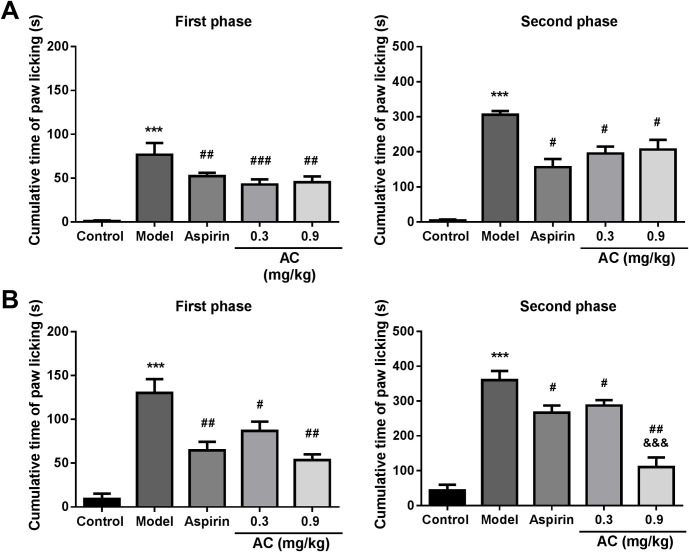
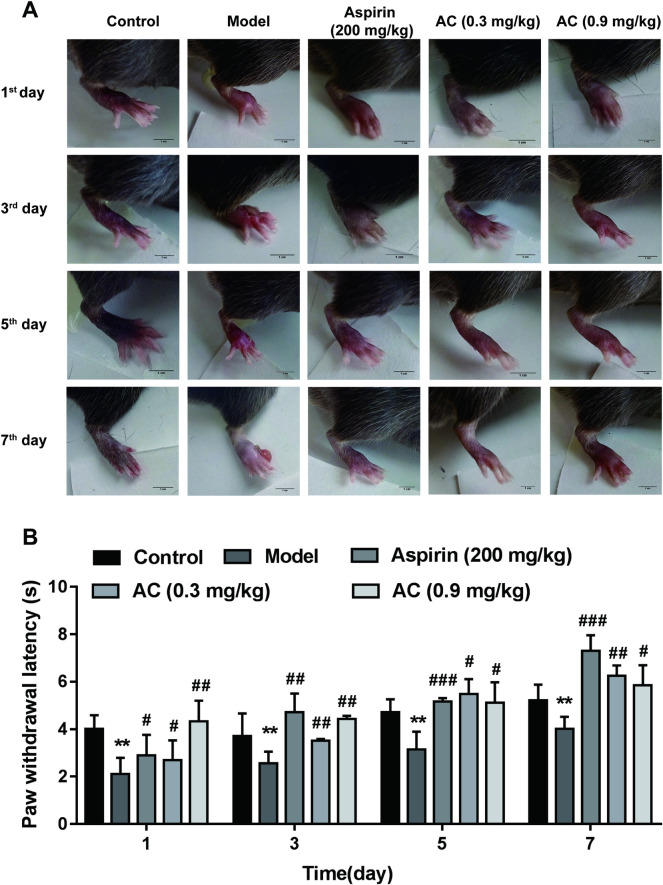
Aconitine (AC) is the primary bioactive and secondary metabolite alkaloidin of Aconitum species which is accounted for more than 60% of the total diester-diterpenoid alkaloids in Aconite. To evaluate the analgesic effects of AC, 4 different pain models including hot plate assay, acetic acid writhing assay, formalin and CFA induced pain models were adopted in this study. In hot plate experiment, AC treatment at concentration of 0.3 mg/kg and 0.9 mg/kg improved the pain thresholds of mice similar to the positive drug aspirin at the concentration of 200 mg/kg (17.12% and 20.27% VS 19.21%). In acetic acid writhing experiment, AC significantly reduced the number of mice writhing events caused by acetic acid, and the inhibition rates were 68% and 76%. These results demonstrated that AC treatment revealed significant analgesic effects in both acute thermal stimulus pain model and chemically-induced visceral pain model. The biphasic nociceptive responses induced by formalin were significantly inhibited after AC treatment for 1h or 2h. The inhibition rates were 33.23% and 20.25% of AC treatment for 1h at 0.3 mg/kg and 0.9 mg/kg in phase I. In phase II, the inhibition rates of AC and aspirin were 36.08%, 32.48% and 48.82% respectively, which means AC showed similar analgesic effect to non-steroidal anti-inflammatory compounds. In the chronic CFA-induced nociception model, AC treatment also improved mice pain threshold to 131.33% at 0.3 mg/kg, which was similar to aspirin group (152.03%). Above all, our results verified that AC had obviously analgesic effects in different mice pain models.
乌头碱(AC)是乌头属植物的主要生物活性和次生代谢生物碱,占乌头总二酯二萜生物碱的 60%以上。为了评估 AC 的镇痛作用,本研究采用了 4 种不同的疼痛模型,包括热板试验、醋酸扭体试验、福尔马林和 CFA 诱导的疼痛模型。在热板试验中,AC 以 0.3mg/kg 和 0.9mg/kg 的浓度处理,其痛阈提高程度与阳性药物阿司匹林(200mg/kg)相似(17.12%和 20.27%VS 19.21%)。在醋酸扭体试验中,AC 显著减少了由醋酸引起的小鼠扭体次数,抑制率分别为 68%和 76%。这些结果表明,AC 处理在急性热刺激疼痛模型和化学诱导内脏疼痛模型中均显示出显著的镇痛作用。福尔马林诱导的双相伤害性反应在 AC 处理 1h 或 2h 后明显受到抑制。AC 在 0.3mg/kg 和 0.9mg/kg 浓度下,1h 时的抑制率分别为 33.23%和 20.25%,在第 I 相;在第 II 相,AC 和阿司匹林的抑制率分别为 36.08%、32.48%和 48.82%,这意味着 AC 表现出与非甾体抗炎化合物相似的镇痛作用。在慢性 CFA 诱导的伤害性感受模型中,AC 处理也将小鼠的疼痛阈值提高到 0.3mg/kg 时的 131.33%,与阿司匹林组(152.03%)相似。总之,我们的结果验证了 AC 在不同的小鼠疼痛模型中具有明显的镇痛作用。