Focused research unit for Molecular Diagnostic and Clinical Research (MOK), IRS-Center Sonderjylland, Hospital of Southern Jutland, Kresten Philipsens Vej 15 F, 6200, Aabenraa, Denmark.
Department of Public Health, Research Unit for Epidemiology, Aarhus University, Aarhus, Denmark.
BMC Public Health. 2021 Apr 1;21(1):634. doi: 10.1186/s12889-021-10492-7.
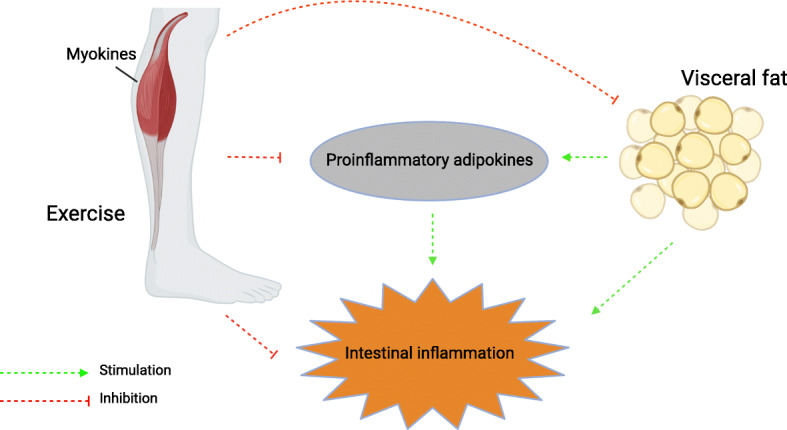
Inflammatory bowel diseases (IBDs) are diseases of the immune system that share some genetic and lifestyle-related predisposing factors. Increasing incidences have been reported in all age groups. Based on experimental studies suggesting a role of physical activity on intestinal inflammation, this study aimed to investigate the association between leisure time physical activity and the risk of IBD in older adults.
The study is a prospective cohort study using Danish registry data and questionnaire data from the Danish "Diet, Cancer and Health" cohort. The outcome IBD was defined as having at least two main diagnoses of Crohn's disease or ulcerative colitis registered in the National Patient Registry from the period between December 1993 and May 1997 with an average follow-up of 25 years. Cox proportional hazard models were used to estimate hazard-ratios for IBD onset associated with being physically active and with levels of the metabolic equivalent of task (MET) hours/week of physical activity and hours/week spent on six types of physical activity. All analyses were adjusted for potential confounders. Furthermore, the analyses were stratified according to age-group, occupational physical activity, smoking, BMI and work status to test for effect modification.
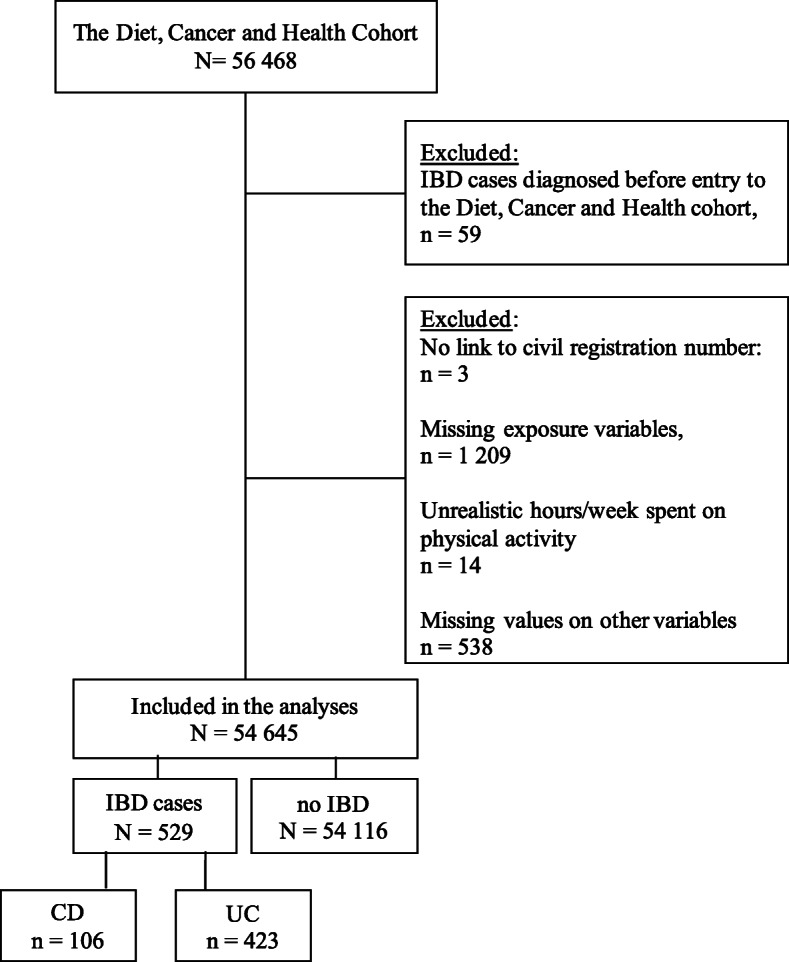
In total, 54,645 men and women aged between 50 and 64 years were included, and of which there were 529 cases. When comparing physically active with inactive participants measured by MET hours/week there was no statistically significant difference in risk of IBD (0.89 [0.13; 6.27]), regardless of how participation was measured. Results did not indicate any dose-response effect when comparing quartile groups of MET hours/week (HR = 0.97 [0.76; 1.22], HR = 0.82 [0.64; 1.05] and HR = 0.83 [0.65; 1.07] or whether five of the six types of activities were compared with the lowest quartile as reference. For do-it-yourself-work, the third quartile of hours/week was associated with a higher risk of IBD compared to the second quartile of hours/week (HR = 1.44 [1.10; 1.90]. No effect modification was found.
There was no association between physical activity and risk of IBD when comparing physically active with inactive participants. Neither did the results indicate any dose-response effect when comparing quartile groups of MET hours/week with the lowest quartile as reference. Do-it-yourself work, however, appeared to be associated with a higher risk of IBD when comparing the third quartile with the second quartile of hours/week. The study has clinical relevance by its contribution to the explanatory field of the causes of IBD. However, the study has some limitations, and further research is needed to clarify associations between physical activity and risk of IBD.
炎症性肠病(IBD)是一种免疫系统疾病,具有一些遗传和与生活方式相关的易患因素。所有年龄段的发病率都有所增加。基于实验研究表明体力活动对肠道炎症有作用,本研究旨在调查老年人休闲时间体力活动与 IBD 风险之间的关联。
该研究是一项使用丹麦登记数据和丹麦“饮食、癌症和健康”队列的问卷调查数据的前瞻性队列研究。IBD 的结局定义为自 1993 年 12 月至 1997 年 5 月期间在国家患者登记处至少有两次主要的克罗恩病或溃疡性结肠炎诊断,并平均随访 25 年。使用 Cox 比例风险模型估计与体力活动相关的 IBD 发病风险比以及代谢当量(MET)小时/周的体力活动水平和每周进行六种体力活动的小时数。所有分析均针对潜在的混杂因素进行了调整。此外,根据年龄组、职业体力活动、吸烟、BMI 和工作状态进行分层分析,以检验效应修饰。
共纳入 54645 名年龄在 50-64 岁之间的男性和女性,其中有 529 例病例。当通过 MET 小时/周比较活跃和不活跃的参与者时,IBD 的风险没有统计学意义上的差异(0.89 [0.13; 6.27]),无论如何测量参与情况。当通过 MET 小时/周的四分位组比较时,没有发现任何剂量反应效应(HR=0.97 [0.76; 1.22]、HR=0.82 [0.64; 1.05]和 HR=0.83 [0.65; 1.07]),也没有比较五种活动类型中的每一种与最低四分位组作为参考。对于自己动手做的工作,与第二四分位组相比,第三四分位组的工作小时/周与 IBD 的风险较高相关(HR=1.44 [1.10; 1.90])。未发现效应修饰。
在比较活跃和不活跃的参与者时,体力活动与 IBD 风险之间没有关联。当通过 MET 小时/周的四分位组与最低四分位组比较时,结果也没有表明任何剂量反应效应。然而,与第二四分位组相比,第三四分位组的 DIY 工作似乎与 IBD 的风险较高相关。该研究通过对 IBD 病因的解释领域做出贡献,具有临床意义。然而,该研究存在一些局限性,需要进一步研究以阐明体力活动与 IBD 风险之间的关联。