Jung Da Hyun, Huh Cheal Wung, Lee Sang Kil, Park Jun Chul, Shin Sung Kwan, Lee Yong Chan
Department of Internal Medicine, Severance Hospital, Yonsei University College of Medicine, Seoul, Korea.
Department of Internal Medicine, Yongin Severance Hospital, Yonsei University College of Medicine, Seoul, Korea.
J Neurogastroenterol Motil. 2021 Apr 30;27(2):165-175. doi: 10.5056/jnm20161.
BACKGROUND/AIMS: Prokinetics can be used for treating patients with gastroesophageal reflux disease (GERD), who exhibit suboptimal response to proton pump inhibitor (PPI) treatment. We conducted a systematic review to assess the potential benefits of combination treatment with PPI plus prokinetics in GERD.
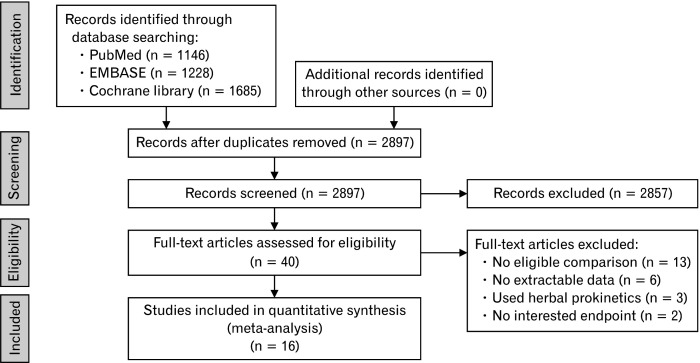
We searched PubMed, the Cochrane Library, and EMBASE for publications regarding randomized controlled trials comparing combination treatment of PPI plus prokinetics to PPI monotherapy with respect to global symptom improvement in GERD (until February 2020). The primary outcome was an absence or global symptom improvement in GERD. Adverse events and quality of life (QoL) scores were evaluated as secondary outcomes using a random effects model. Quality of evidence was rated using Grading of Recommendations, Assessment, Development, and Evaluation (GRADE).
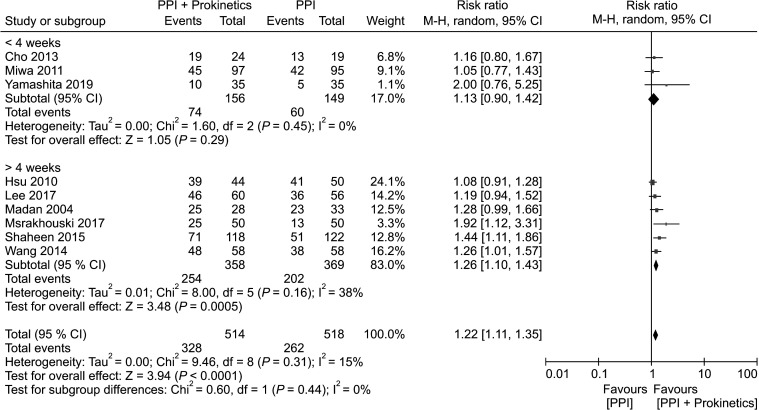
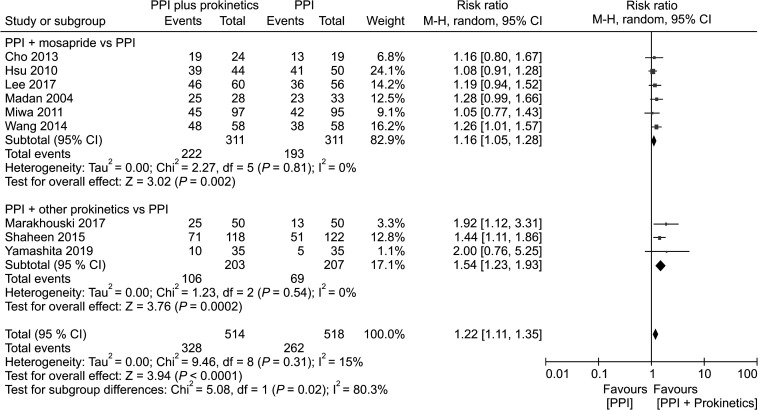
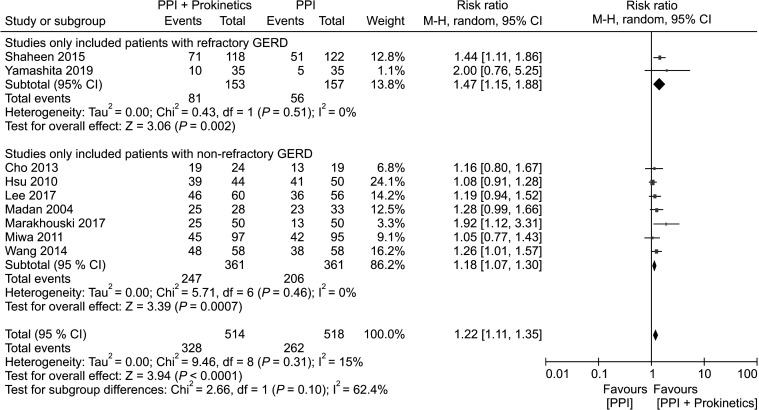
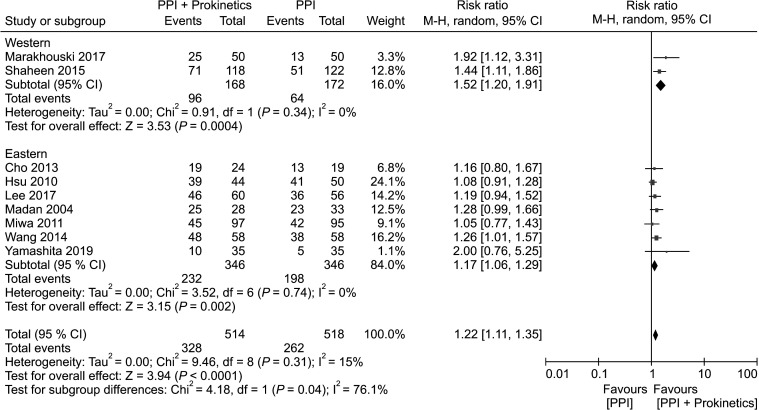
This meta-analysis included 16 studies involving 1446 participants (719 in the PPI plus prokinetics group and 727 in the PPI monotherapy group). The PPI plus prokinetics treatment resulted in a significant reduction in global symptoms of GERD regardless of the prokinetic type, refractoriness, and ethnicity. Additionally, treatment with PPI plus prokinetics for at least 4 weeks was found to be more beneficial than PPI monotherapy with respect to global symptom improvement. However, the QoL scores were not improved with PPI plus prokinetics treatment. Adverse events observed in response to PPI plus prokinetics treatment did not differ from those observed with PPI monotherapy.
Combination of prokinetics with PPI treatment is more effective than PPI alone in GERD patients. Further high-quality trials with large sample sizes are needed to verify the effects based on prokinetic type.
背景/目的:促动力药可用于治疗对质子泵抑制剂(PPI)治疗反应欠佳的胃食管反流病(GERD)患者。我们进行了一项系统评价,以评估PPI联合促动力药治疗GERD的潜在益处。
我们检索了PubMed、Cochrane图书馆和EMBASE,查找关于比较PPI联合促动力药与PPI单药治疗对GERD整体症状改善情况的随机对照试验的出版物(截至2020年2月)。主要结局是GERD症状消失或整体改善。使用随机效应模型将不良事件和生活质量(QoL)评分作为次要结局进行评估。证据质量使用推荐分级、评估、制定与评价(GRADE)进行评级。
该荟萃分析纳入了16项研究,涉及1446名参与者(PPI联合促动力药组719名,PPI单药治疗组727名)。无论促动力药类型、难治性和种族如何,PPI联合促动力药治疗均使GERD的整体症状显著减轻。此外,发现PPI联合促动力药治疗至少4周在整体症状改善方面比PPI单药治疗更有益。然而,PPI联合促动力药治疗并未改善QoL评分。PPI联合促动力药治疗观察到的不良事件与PPI单药治疗观察到的不良事件无差异。
在GERD患者中,促动力药与PPI联合治疗比单独使用PPI更有效。需要进一步开展大样本量的高质量试验,以验证基于促动力药类型的疗效。