Rodebaugh Thomas L, Frumkin Madelyn R, Reiersen Angela M, Lenze Eric J, Avidan Michael S, Miller J Philip, Piccirillo Jay F, Zorumski Charles F, Mattar Caline
Department of Psychological and Brain Sciences, Washington University in St Louis, St Louis, Missouri, USA.
Department of Psychiatry, Washington University School of Medicine (WUSM), St Louis, Missouri, USA.
Open Forum Infect Dis. 2021 Mar 1;8(3):ofab090. doi: 10.1093/ofid/ofab090. eCollection 2021 Mar.
The symptoms of coronavirus disease 2019 (COVID-19) appear to be heterogenous, and the typical course of these symptoms is unknown. Our objectives were to characterize the common trajectories of COVID-19 symptoms and to assess how symptom course predicts other symptom changes as well as clinical deterioration.
One hundred sixty-two participants with acute COVID-19 responded to surveys up to 31 times for up to 17 days. Several statistical methods were used to characterize the temporal dynamics of these symptoms. Because 9 participants showed clinical deterioration, we explored whether these participants showed any differences in symptom profiles.
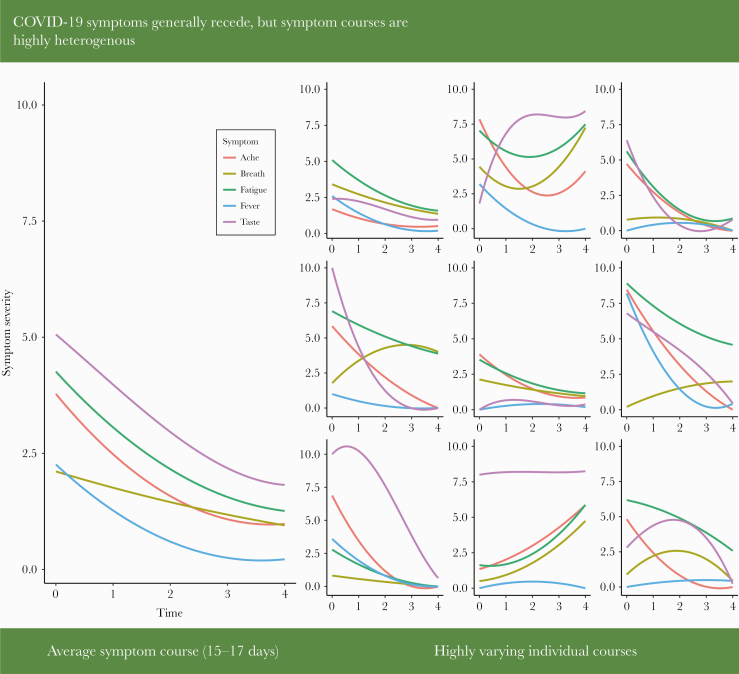
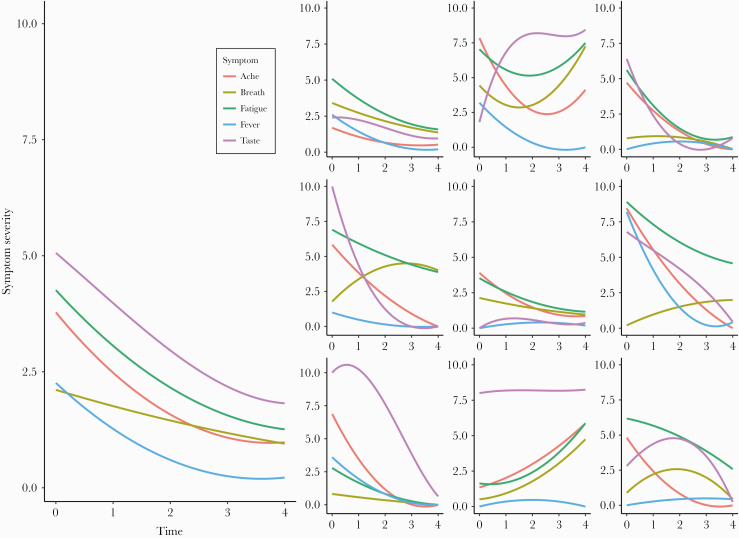
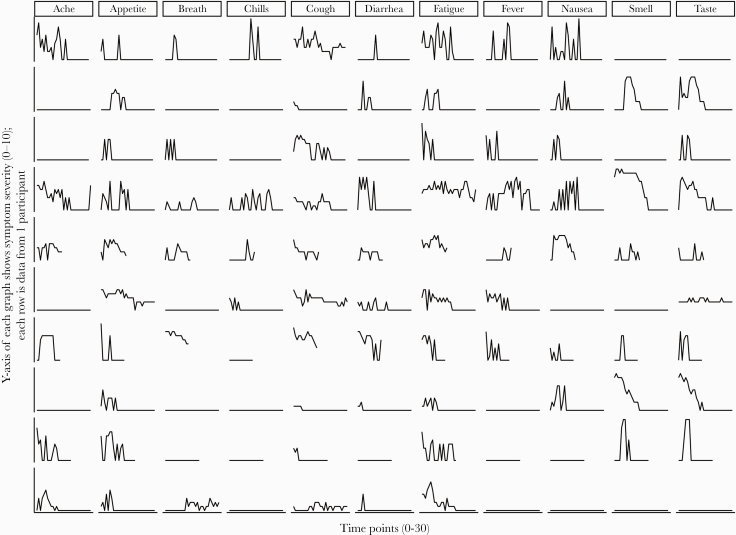
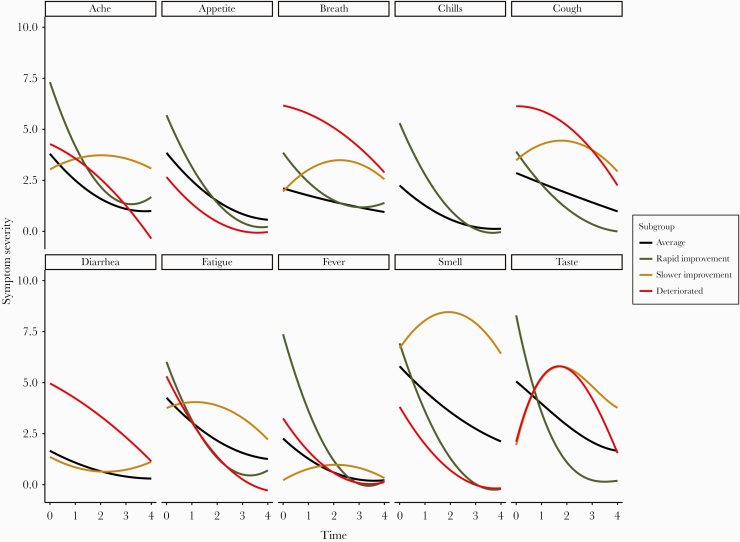
Trajectories varied greatly between individuals, with many having persistently severe symptoms or developing new symptoms several days after being diagnosed. A typical trajectory was for a symptom to improve at a decremental rate, with most symptoms still persisting to some degree at the end of the reporting period. The pattern of symptoms over time suggested a fluctuating course for many patients. Participants who showed clinical deterioration were more likely to present with higher reports of severity of cough and diarrhea.
The course of symptoms during the initial weeks of COVID-19 is highly heterogeneous and is neither predictable nor easily characterized using typical survey methods. This has implications for clinical care and early-treatment clinical trials. Additional research is needed to determine whether the decelerating improvement pattern seen in our data is related to the phenomenon of patients reporting long-term symptoms and whether higher symptoms of diarrhea in early illness presages deterioration.
2019冠状病毒病(COVID-19)的症状表现似乎具有异质性,且这些症状的典型病程尚不清楚。我们的目标是描述COVID-19症状的常见轨迹,并评估症状病程如何预测其他症状变化以及临床恶化情况。
162名急性COVID-19患者接受了调查,调查最多进行31次,为期最长17天。使用了几种统计方法来描述这些症状的时间动态变化。由于9名患者出现了临床恶化,我们探讨了这些患者在症状特征上是否存在差异。
个体之间的症状轨迹差异很大,许多人在被诊断后数天内症状持续严重或出现新症状。典型的轨迹是症状以递减的速率改善,在报告期结束时大多数症状仍在一定程度上持续存在。随着时间推移的症状模式表明许多患者的病程呈波动状。出现临床恶化的患者更有可能报告咳嗽和腹泻的严重程度较高。
COVID-19最初几周的症状病程高度异质,使用典型的调查方法既无法预测也难以描述。这对临床护理和早期治疗临床试验具有重要意义。需要进一步研究以确定我们数据中看到的症状改善减速模式是否与患者报告长期症状的现象有关,以及疾病早期较高的腹泻症状是否预示着病情恶化。