Wilmer Eye Institute, Johns Hopkins University School of Medicine, Baltimore, Maryland.
Massachusetts Eye and Ear Infirmary, Harvard Medical School, Boston, Massachusetts.
Ophthalmology. 2021 Oct;128(10):1417-1425. doi: 10.1016/j.ophtha.2021.03.032. Epub 2021 Mar 30.
To determine the effect of transitioning from Swedish Interactive Thresholding Algorithm (SITA) Standard to SITA Faster on visual field (VF) performance in glaucomatous eyes with a broad spectrum of disease severity undergoing longitudinal VF testing in a real-world clinical setting.
Retrospective, longitudinal study.
A total of 421 patients (766 eyes) with manifest or suspect glaucoma followed at a single institution.
Each included eye received the following sequence of VF examinations during routine clinical care: (1) SITA Standard, (2) SITA Standard, and (3) SITA Faster (mean time between tests = 13.9 months). Intra-eye comparisons were made between the first 2 VFs (Standard-Standard sequence) and the last 2 VFs (Standard-Faster sequence). The primary dependent variable was the difference in mean deviation (MD) between the second and first VF of the sequence (ΔMD, calculated as MD - MD. The primary independent variable was the VF sequence (Standard-Standard or Standard-Faster). Linear mixed-effects models were used to study the effect of testing sequence on ΔMD, adjusting for confounders including time between VFs and change in false-positive (FP) errors. Results were stratified to understand the effect of glaucoma severity on the relationship between testing sequence and ΔMD.
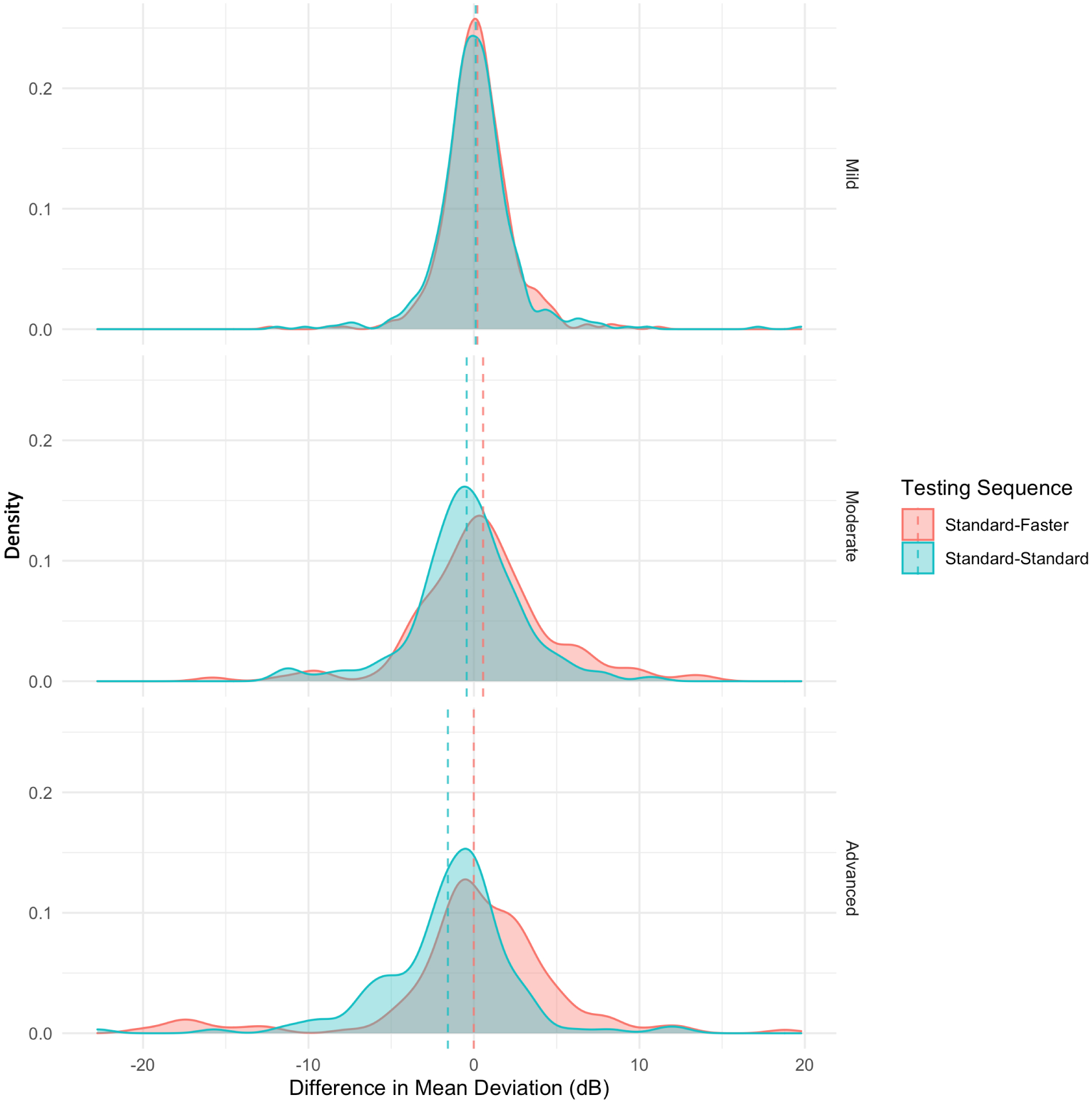
The difference in ΔMD between Standard-Standard and Standard-Faster sequence by mild, moderate, and advanced disease severity.
In eyes with mild or suspect glaucoma, there was no significant difference in ΔMD between Standard-Faster and Standard-Standard sequences (-0.23 decibels [dB]; 95% confidence interval [CI], -0.60 to 0.15 dB). However, the Standard-Faster sequence was associated with a 0.87 dB (95% CI, 0.18-1.57 dB) improvement in ΔMD compared with the Standard-Standard sequence in eyes with moderate glaucoma and a 1.49 dB (95% CI, 0.79-2.19 dB) improvement in ΔMD in eyes with advanced glaucoma.
Converting to SITA Faster in eyes that were previously followed with SITA Standard led to similar VF performance in mild glaucoma but resulted in higher MD values in moderate and advanced glaucoma. For patients with moderate or severe glaucoma, this may conceal disease progression when transitioning testing strategies.
在真实临床环境中对患有广泛疾病严重程度的青光眼患者进行纵向视野 (VF) 测试,确定从瑞典交互式阈值算法 (SITA) 标准过渡到 SITA 更快对 VF 性能的影响。
回顾性、纵向研究。
在一家机构接受随访的共 421 名患者 (766 只眼),患有显性或可疑青光眼。
在常规临床护理中,每只纳入的眼睛接受以下 VF 检查序列:(1) SITA 标准,(2) SITA 标准,和 (3) SITA 更快 (两次测试之间的平均时间为 13.9 个月)。对每个序列中的前 2 个 VF (标准-标准序列)和后 2 个 VF (标准-更快序列)进行眼内比较。主要因变量是序列中第 2 个 VF 与第 1 个 VF 之间平均偏差 (MD) 的差异 (MD 计算为 MD - MD)。主要自变量是 VF 序列 (标准-标准或标准-更快)。线性混合效应模型用于研究测试序列对 MD 差异的影响,调整了包括两次 VF 之间的时间和假阳性 (FP) 错误变化在内的混杂因素。结果分层以了解青光眼严重程度对测试序列和 MD 差异之间关系的影响。
轻度、中度和重度疾病严重程度下标准-更快和标准-标准序列之间的 MD 差异。
在轻度或疑似青光眼的眼中,标准-更快和标准-标准序列之间的 MD 差异无统计学意义 (-0.23 分贝 [dB];95%置信区间 [CI],-0.60 至 0.15 dB)。然而,与标准-标准序列相比,在中度青光眼患者中,标准-更快序列与 0.87 dB (95%CI,0.18-1.57 dB) 的 MD 改善相关,在重度青光眼患者中与 1.49 dB (95%CI,0.79-2.19 dB) 的 MD 改善相关。
将之前用 SITA 标准随访的眼睛转换为 SITA 更快,在轻度青光眼患者中会导致类似的 VF 表现,但在中度和重度青光眼患者中会导致更高的 MD 值。对于中度或重度青光眼患者,当转换测试策略时,这可能会掩盖疾病进展。