Faculty of Medicine, Transilvania University of Brașov, 500036 Brașov, Romania.
Faculty of Psychology and Education Sciences, Transilvania University of Brașov, Str. N. Bălcescu 56, 500368 Brașov, Romania.
Int J Environ Res Public Health. 2021 Mar 6;18(5):2654. doi: 10.3390/ijerph18052654.
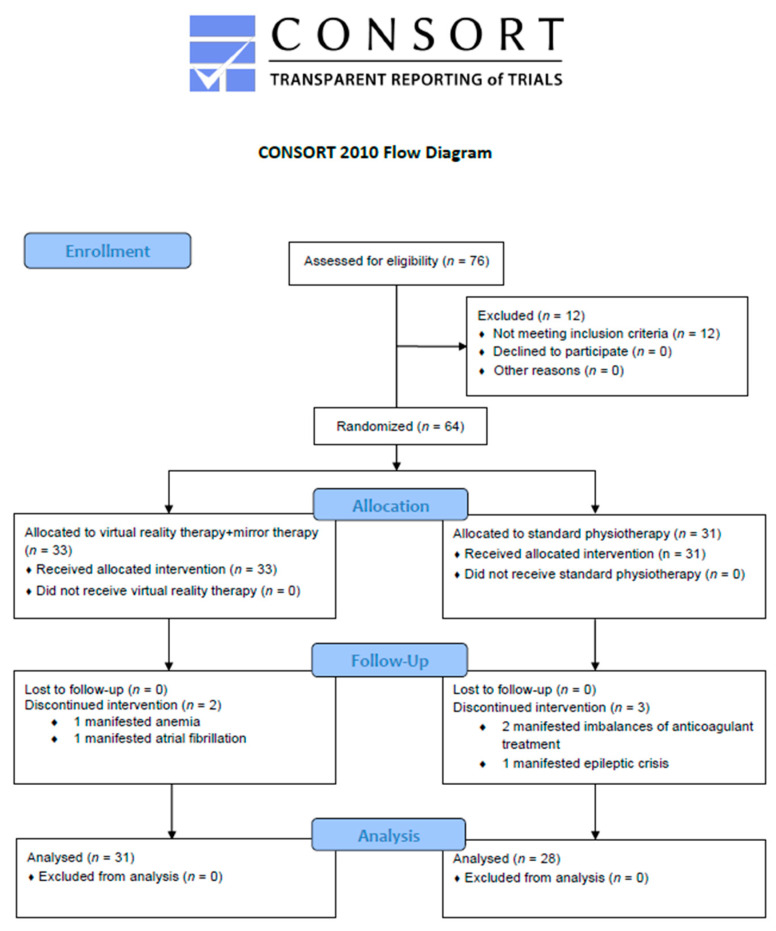
More innovative technologies are used worldwide in patient's rehabilitation after stroke, as it represents a significant cause of disability. The majority of the studies use a single type of therapy in therapeutic protocols. We aimed to identify if the association of virtual reality (VR) therapy and mirror therapy (MT) exercises have better outcomes in lower extremity rehabilitation in post-stroke patients compared to standard physiotherapy. Fifty-nine inpatients from 76 initially identified were included in the research. One experimental group ( = 31) received VR therapy and MT, while the control group ( = 28) received standard physiotherapy. Each group performed seventy minutes of therapy per day for ten days. Statistical analysis was performed with nonparametric tests. Wilcoxon Signed-Rank test showed that both groups registered significant differences between pre-and post-therapy clinical status for the range of motion and muscle strength ( < 0.001 and Cohen's d between 0.324 and 0.645). Motor Fugl Meyer Lower Extremity Assessment also suggested significant differences pre-and post-therapy for both groups ( < 0.05 and Cohen's d 0.254 for the control group and 0.685 for the experimental group). Mann-Whitney results suggested that VR and MT as a therapeutic intervention have better outcomes than standard physiotherapy in range of motion ( < 0.05, Cohen's d 0.693), muscle strength ( < 0.05, Cohen's d 0.924), lower extremity functionality ( < 0.05, Cohen's d 0.984) and postural balance ( < 0.05, Cohen's d 0.936). Our research suggests that VR therapy associated with MT may successfully substitute classic physiotherapy in lower extremity rehabilitation after stroke.
更多创新技术被用于世界各地的中风后患者康复,因为中风是导致残疾的主要原因之一。大多数研究在治疗方案中仅使用单一类型的治疗。我们旨在确定虚拟现实 (VR) 治疗与镜像治疗 (MT) 联合使用与标准物理治疗相比,是否能在中风后患者的下肢康复中获得更好的效果。最初确定的 76 名住院患者中有 59 名被纳入研究。实验组(n=31)接受 VR 治疗和 MT,对照组(n=28)接受标准物理治疗。两组每天进行 70 分钟的治疗,共进行 10 天。采用非参数检验进行统计分析。Wilcoxon 符号秩检验显示,两组治疗前后临床状态的运动范围和肌肉力量均有显著差异(<0.001,Cohen's d 值在 0.324 至 0.645 之间)。Fugl-Meyer 下肢运动评估也表明,两组治疗前后均有显著差异(<0.05,对照组的 Cohen's d 值为 0.254,实验组为 0.685)。Mann-Whitney 结果表明,VR 和 MT 作为治疗干预措施,在运动范围(<0.05,Cohen's d 值为 0.693)、肌肉力量(<0.05,Cohen's d 值为 0.924)、下肢功能(<0.05,Cohen's d 值为 0.984)和姿势平衡(<0.05,Cohen's d 值为 0.936)方面的效果优于标准物理治疗。我们的研究表明,VR 治疗与 MT 联合使用可能成功替代中风后下肢康复的经典物理治疗。