Absar Nurul, Abedin Jainal, Rahman Md Mashiur, Miah Moazzem Hossain, Siddique Naziba, Kamal Masud, Chowdhury Mantazul Islam, Sulieman Abdelmoneim Adam Mohamed, Faruque Mohammad Rashed Iqbal, Khandaker Mayeen Uddin, Bradley David Andrew, Alsubaie Abdullah
Department of Computer Science and Engineering, BGC Trust University Bangladesh, Chittagong 4381, Bangladesh.
Hughes Network Systems, 11717 Exploration Lane, Germantown, MD 20876, USA.
Life (Basel). 2021 Mar 27;11(4):282. doi: 10.3390/life11040282.
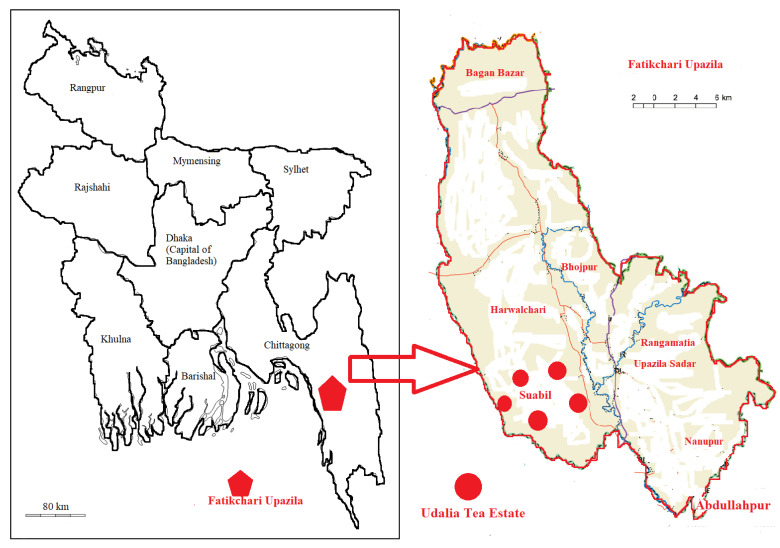
Considering the probable health risks due to radioactivity input via drinking tea, the concentrations of Ra, Th,K and Cs radionuclides in the soil and the corresponding tea leaves of a large tea plantation were measured using high purity germanium (HPGe) γ-ray spectrometry. Different layers of soil and fresh tea leaf samples were collected from the Udalia Tea Estate (UTE) in the Fatickchari area of Chittagong, Bangladesh. The mean concentrations (in Bq/kg) of radionuclides in the studied soil samples were found to be 34 ± 9 to 45 ± 3 for Ra, 50 ± 13 to 63 ± 5 for Th, 245 ± 30 to 635 ± 35 for K and 3 ± 1 to 10 ± 1 for Cs, while the respective values in the corresponding tea leaf samples were 3.6 ± 0.7 to 5.7 ± 1.0, 2.4 ± 0.5 to 5.8 ± 0.9, 132 ± 25 to 258 ± 29 and <0.4. The mean transfer factors for Ra, Th and K from soil to tea leaves were calculated to be 0.12, 0.08 and 0.46, respectively, the complete range being 1.1 × 10 to 1.0, in accordance with IAEA values. Additionally, the most popularly consumed tea brands available in the Bangladeshi market were also analyzed and, with the exception of K, were found to have similar concentrations to the fresh tea leaves collected from the UTE. The committed effective dose via the consumption of tea was estimated to be low in comparison with the United Nations Scientific Committee on the Effects of Atomic Radiation (UNSCEAR) reference ingestion dose limit of 290 μSv/y. Current indicative tea consumption of 4 g/day/person shows an insignificant radiological risk to public health, while cumulative dietary exposures may not be entirely negligible, because the UNSCEAR reference dose limit is derived from total dietary exposures. This study suggests a periodic monitoring of radiation levels in tea leaves in seeking to ensure the safety of human health.
考虑到通过饮茶摄入放射性物质可能带来的健康风险,使用高纯锗(HPGe)γ射线能谱仪测量了一个大型茶园土壤及相应茶叶中镭、钍、钾和铯放射性核素的浓度。从孟加拉国吉大港区法蒂克查里地区的乌达利亚茶园(UTE)采集了不同土层的土壤和新鲜茶叶样本。研究的土壤样本中放射性核素的平均浓度(单位:Bq/kg)为:镭34±9至45±3、钍50±13至63±5、钾245±30至635±35、铯3±1至10±1,而相应茶叶样本中的浓度分别为3.6±0.7至5.7±1.0、2.4±0.5至5.8±0.9、132±25至258±29以及<0.4。根据国际原子能机构(IAEA)的值,计算得出镭、钍和钾从土壤到茶叶的平均转移因子分别为0.12、0.08和0.46,完整范围为1.1×10至1.0。此外,还对孟加拉国市场上最受欢迎的消费茶品牌进行了分析,发现除钾外,其浓度与从UTE采集的新鲜茶叶相似。与联合国原子辐射影响科学委员会(UNSCEAR)290μSv/y的参考摄入剂量限值相比,通过饮茶摄入的待积有效剂量估计较低。目前每人每天4克的指示性茶叶消费量对公众健康的放射性风险不显著,而累积膳食暴露可能并非完全可以忽略不计,因为UNSCEAR参考剂量限值源自总膳食暴露。本研究建议定期监测茶叶中的辐射水平,以确保人类健康安全。