Peng Yao, Nie Yuqiang, Yu Jun, Wong Chi Chun
Department of Gastroenterology, Guangzhou First People's Hospital, Guangzhou Medical University, Guangzhou 510180, China.
Department of Gastroenterology, The Second Affiliated Hospital, Medical School, South China University of Technology, Guangzhou 510180, China.
Metabolites. 2021 Mar 10;11(3):159. doi: 10.3390/metabo11030159.
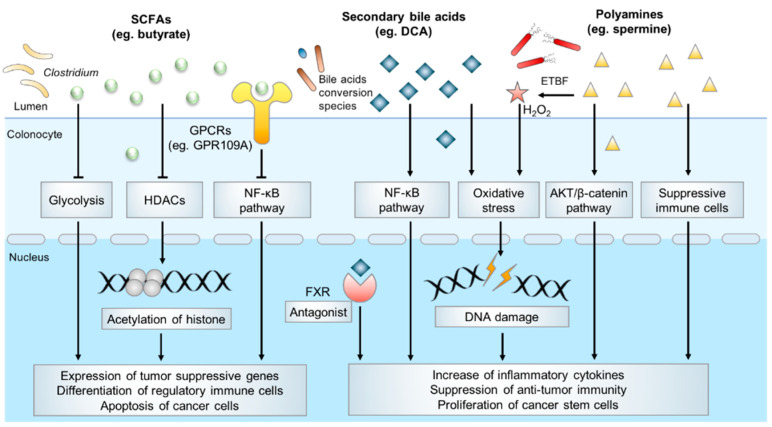
Colorectal cancer (CRC) is one of the leading cancers that cause cancer-related deaths worldwide. The gut microbiota has been proved to show relevance with colorectal tumorigenesis through microbial metabolites. By decomposing various dietary residues in the intestinal tract, gut microbiota harvest energy and produce a variety of metabolites to affect the host physiology. However, some of these metabolites are oncogenic factors for CRC. With the advent of metabolomics technology, studies profiling microbiota-derived metabolites have greatly accelerated the progress in our understanding of the host-microbiota metabolism interactions in CRC. In this review, we briefly summarize the present metabolomics techniques in microbial metabolites researches and the mechanisms of microbial metabolites in CRC pathogenesis, furthermore, we discuss the potential clinical applications of microbial metabolites in cancer diagnosis and treatment.
结直肠癌(CRC)是全球导致癌症相关死亡的主要癌症之一。肠道微生物群已被证明通过微生物代谢产物与结直肠癌的发生有关。通过分解肠道中的各种饮食残渣,肠道微生物群获取能量并产生多种代谢产物来影响宿主生理。然而,其中一些代谢产物是结直肠癌的致癌因素。随着代谢组学技术的出现,对微生物衍生代谢产物进行分析的研究极大地加速了我们对结直肠癌中宿主-微生物群代谢相互作用的理解。在这篇综述中,我们简要总结了目前微生物代谢产物研究中的代谢组学技术以及微生物代谢产物在结直肠癌发病机制中的作用机制,此外,我们还讨论了微生物代谢产物在癌症诊断和治疗中的潜在临床应用。