Sintsova Oksana, Gladkikh Irina, Monastyrnaya Margarita, Tabakmakher Valentin, Yurchenko Ekaterina, Menchinskaya Ekaterina, Pislyagin Evgeny, Andreev Yaroslav, Kozlov Sergey, Peigneur Steve, Tytgat Jan, Aminin Dmitry, Kozlovskaya Emma, Leychenko Elena
G.B. Elyakov Pacific Institute of Bioorganic Chemistry, Far Eastern Branch, Russian Academy of Sciences, 159 Pr. 100 let Vladivostoku, 690022 Vladivostok, Russia.
Shemyakin-Ovchinnikov Institute of Bioorganic Chemistry, Russian Academy of Sciences, ul. Miklukho-Maklaya 16/10, 117997 Moscow, Russia.
Biomedicines. 2021 Mar 10;9(3):283. doi: 10.3390/biomedicines9030283.
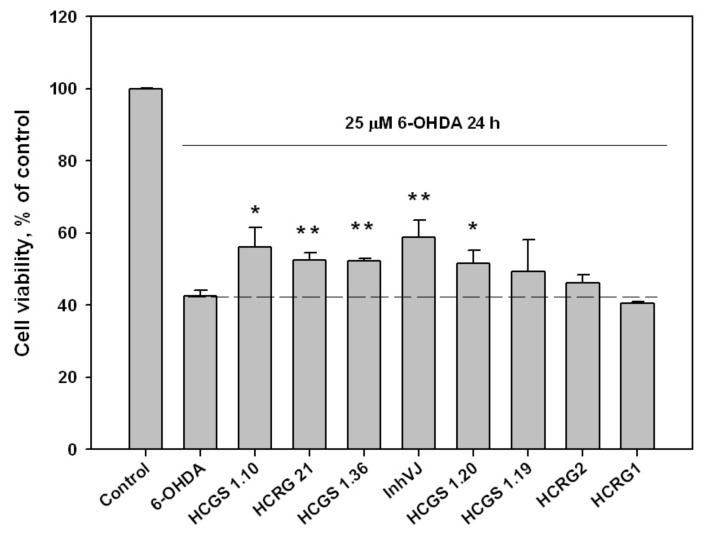
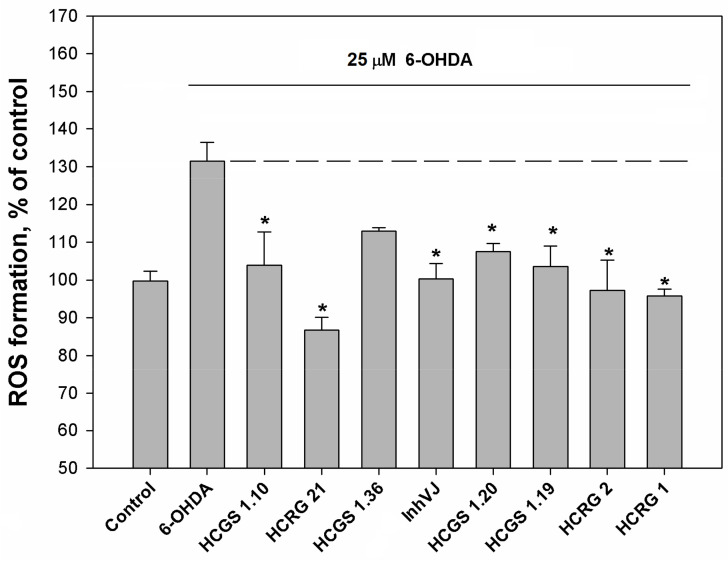
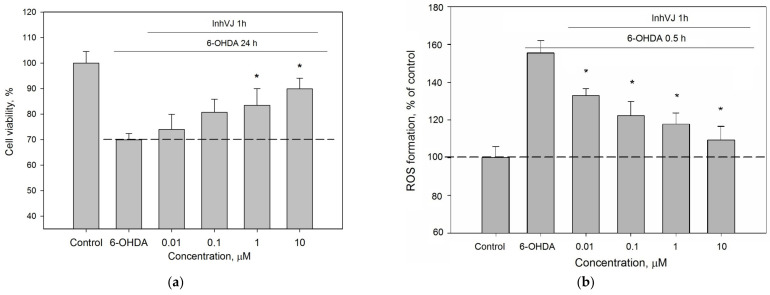
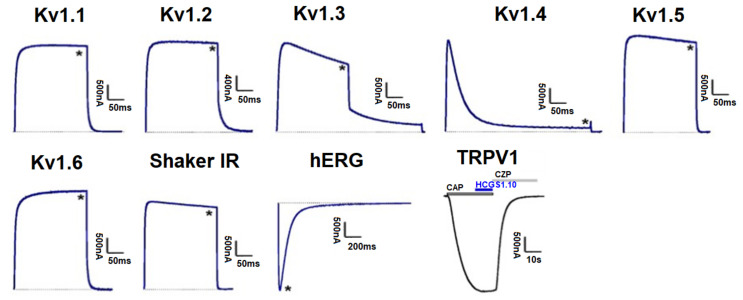
Kunitz-type peptides from venomous animals have been known to inhibit different proteinases and also to modulate ion channels and receptors, demonstrating analgesic, anti-inflammatory, anti-histamine and many other biological activities. At present, there is evidence of their neuroprotective effects. We have studied eight Kunitz-type peptides of the sea anemone to find molecules with cytoprotective activity in the 6-OHDA-induced neurotoxicity model on neuroblastoma Neuro-2a cells. It has been shown that only five peptides significantly increase the viability of neuronal cells treated with 6-OHDA. The TRPV1 channel blocker, HCRG21, has revealed the neuroprotective effect that could be indirect evidence of TRPV1 involvement in the disorders associated with neurodegeneration. The pre-incubation of Neuro-2a cells with HCRG21 followed by 6-OHDA treatment has resulted in a prominent reduction in ROS production compared the untreated cells. It is possible that the observed effect is due to the ability of the peptide act as an efficient free-radical scavenger. One more leader peptide, InhVJ, has shown a neuroprotective activity and has been studied at concentrations of 0.01-10.0 µM. The target of InhVJ is still unknown, but it was the best of all eight homologous peptides in an absolute cell viability increment on 38% of the control in the 6-OHDA-induced neurotoxicity model. The targets of the other three active peptides remain unknown.
已知来自有毒动物的库尼茨型肽可抑制不同的蛋白酶,还能调节离子通道和受体,表现出镇痛、抗炎、抗组胺及许多其他生物活性。目前,有证据表明它们具有神经保护作用。我们研究了海葵的八种库尼茨型肽,以在6-羟基多巴胺诱导的神经母细胞瘤Neuro-2a细胞神经毒性模型中寻找具有细胞保护活性的分子。结果表明,只有五种肽能显著提高经6-羟基多巴胺处理的神经元细胞的活力。TRPV1通道阻滞剂HCRG21显示出神经保护作用,这可能是TRPV1参与神经退行性疾病相关紊乱的间接证据。Neuro-2a细胞先用HCRG21预孵育,然后进行6-羟基多巴胺处理,与未处理的细胞相比,活性氧的产生显著减少。观察到的这种效应可能是由于该肽具有高效清除自由基的能力。另一种前导肽InhVJ也显示出神经保护活性,并在0.01-10.0 µM的浓度下进行了研究。InhVJ的作用靶点仍然未知,但在6-羟基多巴胺诱导的神经毒性模型中,它是所有八种同源肽中使细胞绝对活力增加至对照的38%效果最好的。其他三种活性肽的作用靶点仍不清楚。