Population, Policy and Practice Research and Teaching Department, UCL Great Ormond Street Institute of Child Health, University College London, London WC1N 1EH, UK.
National Centre for Social Research, London EC1V 0AX, UK.
Nutrients. 2021 Mar 10;13(3):900. doi: 10.3390/nu13030900.
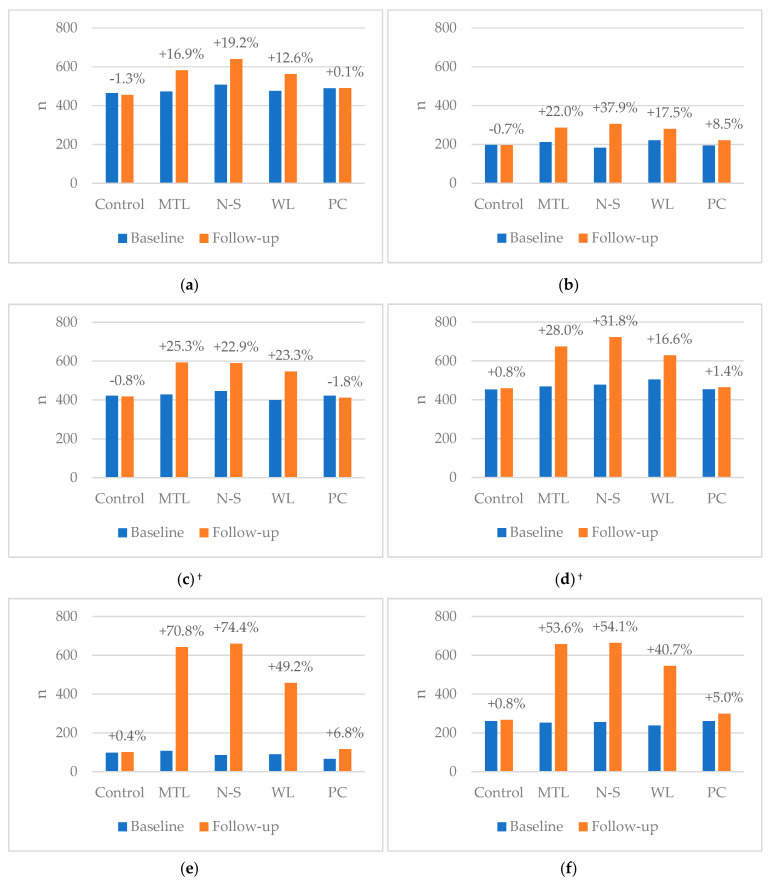
Front of pack food labels (FOPLs) provide accessible nutritional information to guide consumer choice. Using an online experiment with a large representative British sample, we aimed to examine whether FOPLs improve participants' ability to identify the healthiness of foods and drinks. The primary aim was to compare ability to rank between FOPL groups and a no label control. Adults (≥18 years), recruited from the NatCen panel, were randomised to one of five experimental groups (Multiple Traffic Light, MTL; Nutri-Score, N-S; Warning Label, WL; Positive Choice tick, PC; no label control). Stratification variables were year of recruitment to panel, sex, age, government office region, and household income. Packaging images were created for three versions, varying in healthiness, of six food and drink products (pizza, drinks, cakes, crisps, yoghurts, breakfast cereals). Participants were asked to rank the three product images in order of healthiness. Ranking was completed on a single occasion and comprised a baseline measure (with no FOPL), and a follow-up measure including the FOPL as per each participant's experimental group. The primary outcome was the ability to accurately rank product healthiness (all products ranked correctly vs. any incorrect). In 2020, 4504 participants had complete data and were included in the analysis. The probability of correct ranking at follow-up, and improving between baseline and follow-up, was significantly greater across all products for the N-S, MTL and WL groups, compared to control. This was seen for only some of the products for the PC group. The largest effects were seen for N-S, followed by MTL. These analyses were adjusted for stratification variables, ethnicity, education, household composition, food shopping responsibility, and current FOPL use. Exploratory analyses showed a tendency for participants with higher compared to lower education to rank products more accurately. Conclusions: All FOPLs were effective at improving participants' ability to correctly rank products according to healthiness in this large representative British sample, with the largest effects seen for N-S, followed by MTL.
译文:
食品标签:为消费者选择提供便捷的营养信息。本研究采用在线实验的方式,对英国大样本进行了研究,旨在检验食品标签是否能提高参与者识别食品和饮料健康度的能力。本研究的主要目的是比较食品标签组与无标签对照组在排名能力上的差异。从 NatCen 小组中招募年龄在 18 岁及以上的成年人,将他们随机分配到五个实验组(多色信号灯、营养评分、警告标签、正面选择标记、无标签对照)。分层变量包括小组招募年份、性别、年龄、政府办公区和家庭收入。为六种食品和饮料产品(比萨、饮料、蛋糕、薯片、酸奶、早餐麦片)的三个健康程度版本创建了包装图像。参与者被要求按照健康程度对三张产品图片进行排序。排序是在一次完成的,包括一个基线测量(无食品标签)和一个后续测量,每个参与者根据其所在的实验组显示相应的食品标签。主要结果是准确排序产品健康度的能力(所有产品都正确排序与任何错误排序)。2020 年,4504 名参与者的数据完整,纳入分析。与对照组相比,所有产品中 N-S、MTL 和 WL 组在后续测量中正确排序的概率,以及在基线和后续测量之间的改善,都显著更高。PC 组的一些产品也出现了这种情况。在 N-S 之后,MTL 的效果最大。这些分析调整了分层变量、种族、教育、家庭构成、食品购买责任和当前食品标签使用情况。探索性分析表明,与受教育程度较低的参与者相比,受教育程度较高的参与者更准确地对产品进行排序。结论:在这个具有代表性的英国大样本中,所有食品标签都能有效提高参与者正确识别健康食品的能力,其中 N-S 的效果最大,其次是 MTL。