Andrade Fernanda, Roca-Melendres Maria Mercé, Durán-Lara Esteban F, Rafael Diana, Schwartz Simó
Drug Delivery and Targeting Group, Molecular Biology and Biochemistry Research Centre for Nanomedicine (CIBBIM-Nanomedicine), Vall d'Hebron Institut de Recerca, Universitat Autònoma de Barcelona, 08035 Barcelona, Spain.
Networking Research Centre for Bioengineering, Biomaterials, and Nanomedicine (CIBER-BBN), Instituto de Salud Carlos III, 28029 Madrid, Spain.
Cancers (Basel). 2021 Mar 9;13(5):1164. doi: 10.3390/cancers13051164.
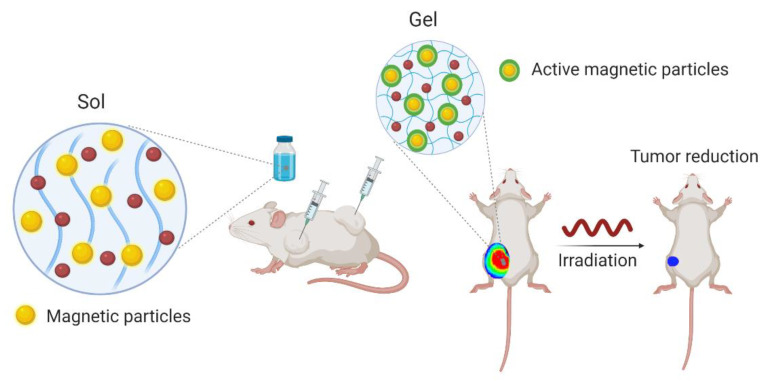
Cancer remains as the second leading cause of death, worldwide. Despite the enormous important advances observed in the last decades, advanced stages of the disease remain incurable. The severe side effects associated to systemic high doses of chemotherapy and the development of drug resistance impairs a safe and efficiency anticancer therapy. Therefore, new formulations are continuously under research and development to improve anticancer drugs therapeutic index through localized delivery at tumor sites. Among a wide range of possibilities, hydrogels have recently gained special attention due to their potential to allow in situ sustained and controlled anticancer drug release. In particular, stimuli-responsive hydrogels which are able to change their physical state from liquid to gel accordingly to external factors such as temperature, pH, light, ionic strength, and magnetic field, among others. Some of these formulations presented promising results for the localized control and treatment of cancer. The present work aims to discuss the main properties and application of stimuli-responsive hydrogels in cancer treatment and summarize the most important advances observed in the last decades focusing on the use of pH-, light-, ionic strength-, and magnetic-responsive hydrogels.
癌症仍然是全球第二大死因。尽管在过去几十年中取得了巨大的重要进展,但该疾病的晚期仍然无法治愈。全身高剂量化疗带来的严重副作用以及耐药性的产生损害了安全有效的抗癌治疗。因此,人们不断研发新的制剂,通过在肿瘤部位进行局部给药来提高抗癌药物的治疗指数。在众多可能性中,水凝胶最近因其能够实现原位持续和可控的抗癌药物释放的潜力而受到特别关注。特别是,刺激响应性水凝胶能够根据温度、pH值、光、离子强度和磁场等外部因素将其物理状态从液体转变为凝胶。其中一些制剂在癌症的局部控制和治疗方面呈现出有前景的结果。本工作旨在讨论刺激响应性水凝胶在癌症治疗中的主要特性和应用,并总结过去几十年中观察到的最重要进展,重点关注pH值、光、离子强度和磁响应性水凝胶的使用。