Luketin Mirko, Mizdrak Maja, Boric-Skaro Dijana, Martinovic Dinko, Tokic Daria, Vilovic Marino, Supe-Domic Daniela, Ticinovic Kurir Tina, Bozic Josko
Department of Nephrology and Dialysis, University Hospital of Split, 21000 Split, Croatia.
Department of Pathophysiology, University of Split School of Medicine, 21000 Split, Croatia.
Biomolecules. 2021 Mar 18;11(3):456. doi: 10.3390/biom11030456.
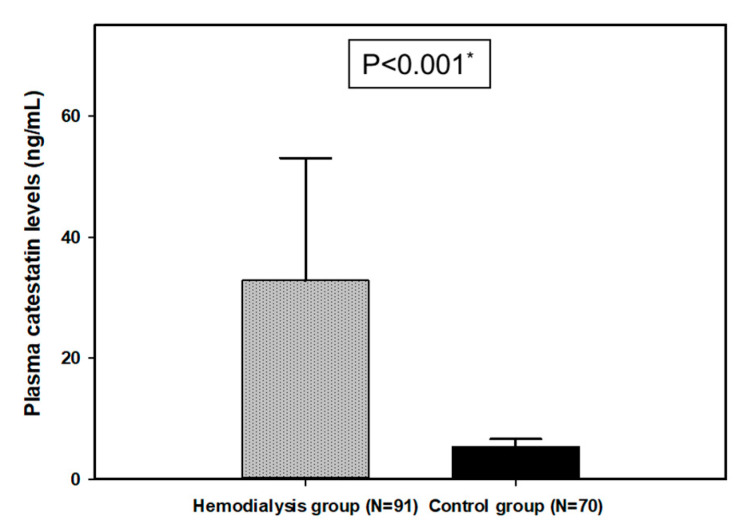
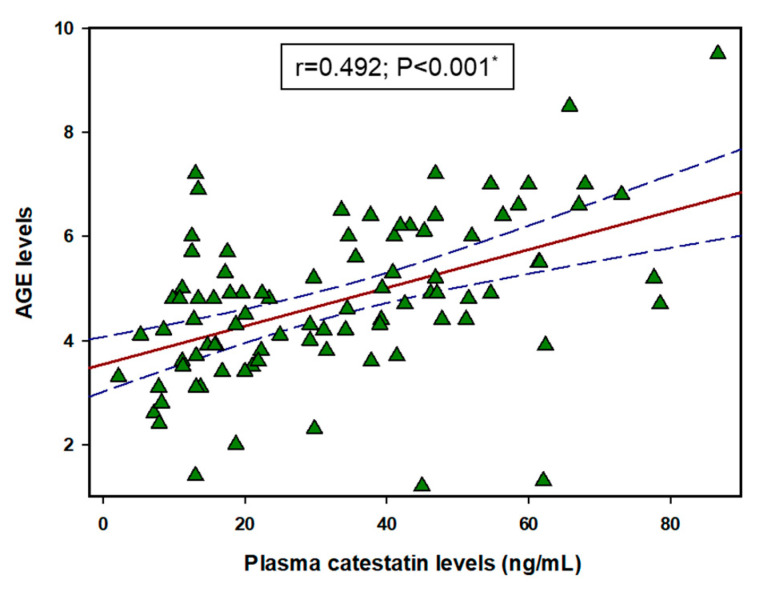
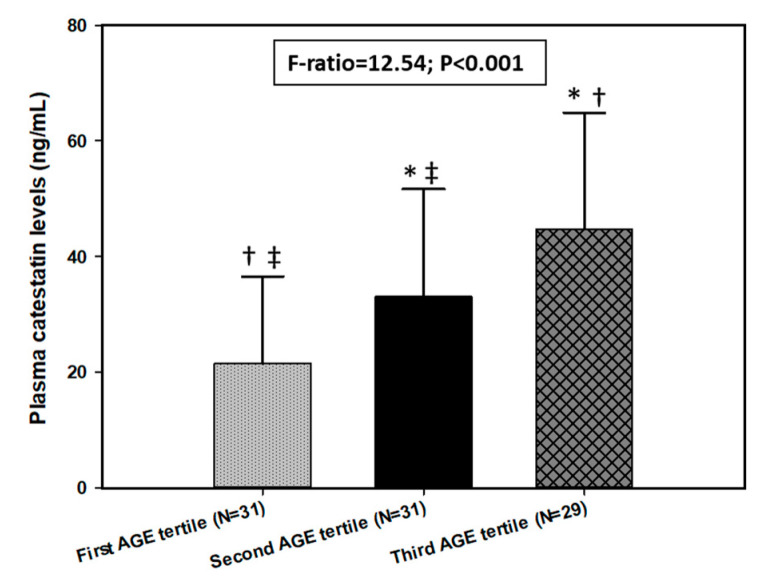
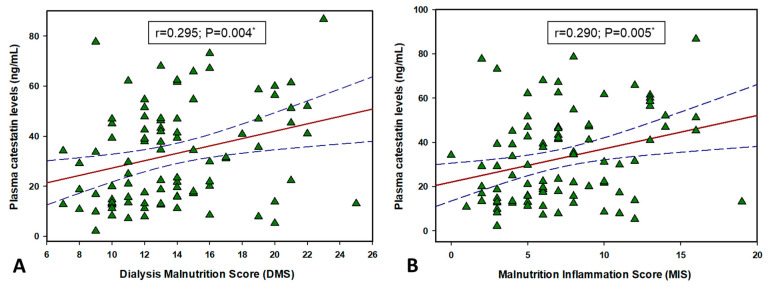
Catestatin (CST) is a pleiotropic peptide involved in cardiovascular protection with its antihypertensive and angiogenic effects. Considering that patients with end-stage renal disease (ESRD) who are undergoing hemodialysis (HD) are associated with higher cardiovascular risk, the aim of this study was to investigate plasma CST levels in HD patients, compare them to healthy controls and evaluate possible CST associations with advanced glycation end products (AGEs) and laboratory, anthropometric and clinical parameters. The study included 91 patients on HD and 70 healthy controls. Plasma CST levels were determined by an enzyme-linked immunosorbent assay in a commercially available diagnostic kit, while AGEs were determined using skin autofluorescence. Plasma CST levels were significantly higher in the HD group compared to the controls (32.85 ± 20.18 vs. 5.39 ± 1.24 ng/mL, < 0.001) and there was a significant positive correlation between CST and AGEs (r = 0.492, < 0.001). Furthermore, there was a significant positive correlation between plasma CST levels with both the Dialysis Malnutrition Score (r = 0.295, = 0.004) and Malnutrition-Inflammation Score (r = 0.290, = 0.005). These results suggest that CST could be playing a role in the complex pathophysiology of ESRD/HD and that it could affect the higher cardiovascular risk of patients on HD.
癌抑素(CST)是一种具有多效性的肽,通过其降压和血管生成作用参与心血管保护。鉴于正在接受血液透析(HD)的终末期肾病(ESRD)患者心血管风险较高,本研究旨在调查HD患者的血浆CST水平,将其与健康对照进行比较,并评估CST与晚期糖基化终产物(AGEs)以及实验室、人体测量和临床参数之间可能存在的关联。该研究纳入了91例接受HD治疗的患者和70例健康对照。使用市售诊断试剂盒通过酶联免疫吸附测定法测定血浆CST水平,而使用皮肤自发荧光测定AGEs。与对照组相比,HD组的血浆CST水平显著更高(32.85±20.18 vs. 5.39±1.24 ng/mL,<0.001),并且CST与AGEs之间存在显著正相关(r = 0.492,<0.001)。此外,血浆CST水平与透析营养不良评分(r = 0.295,= 0.004)和营养不良-炎症评分(r = 0.290,= 0.005)均存在显著正相关。这些结果表明,CST可能在ESRD/HD的复杂病理生理学中发挥作用,并且它可能影响HD患者较高的心血管风险。