Kang Dong Young, Sp Nipin, Lee Jin-Moo, Jang Kyoung-Jin
Department of Pathology, School of Medicine, Institute of Biomedical Science and Technology, Konkuk University, Chungju 27478, Korea.
Pharmacological Research Division, National Institute of Food and Drug Safety Evaluation, Osong Health Technology Administration Complex, Cheongju-si 28159, Korea.
Biomedicines. 2021 Mar 13;9(3):297. doi: 10.3390/biomedicines9030297.
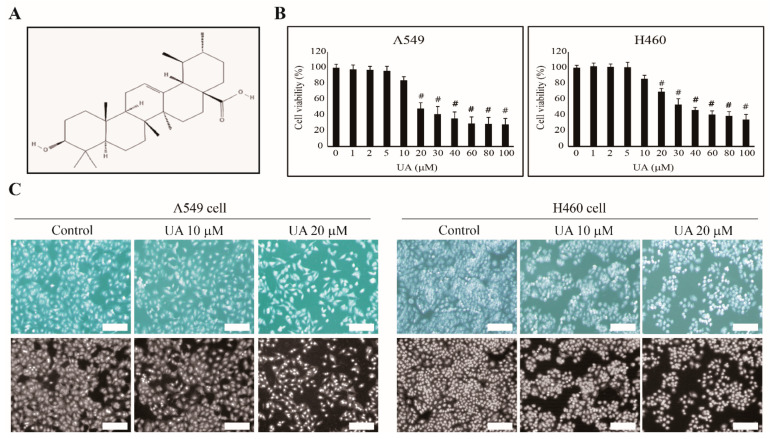
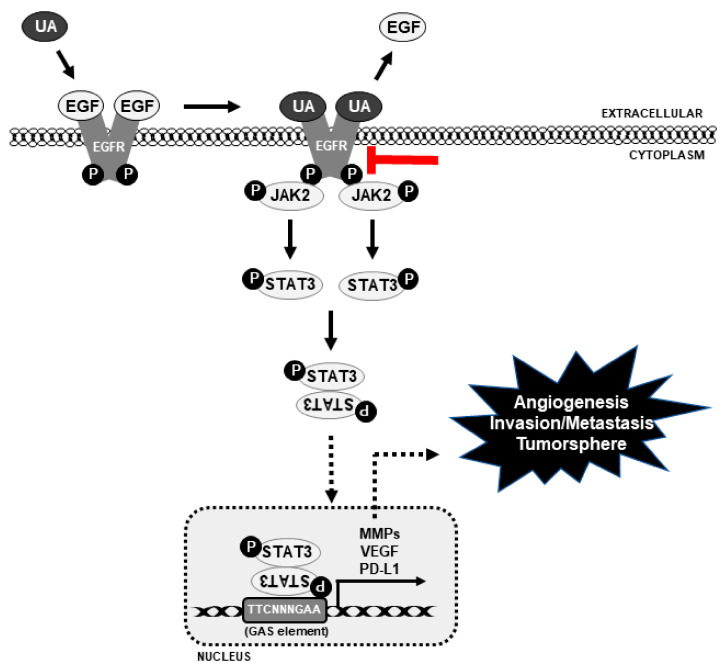
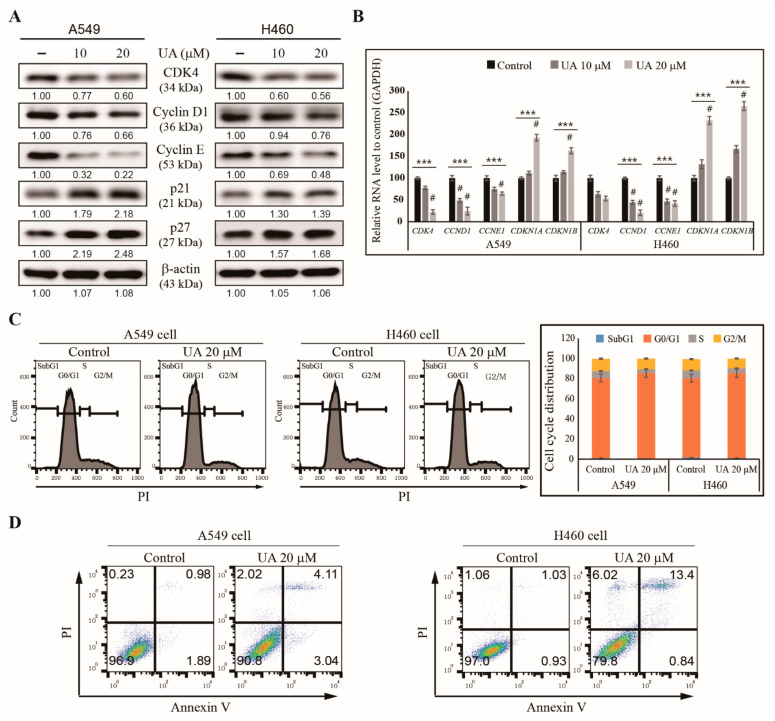
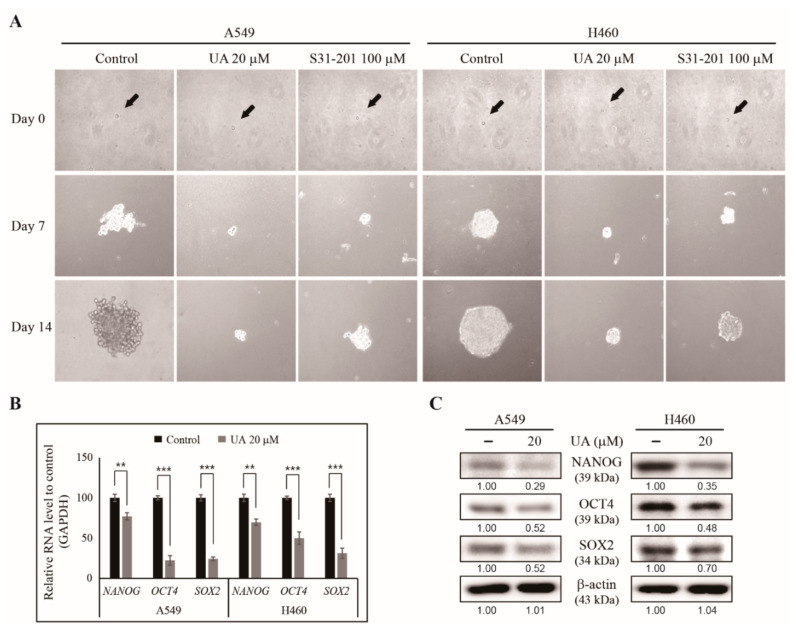
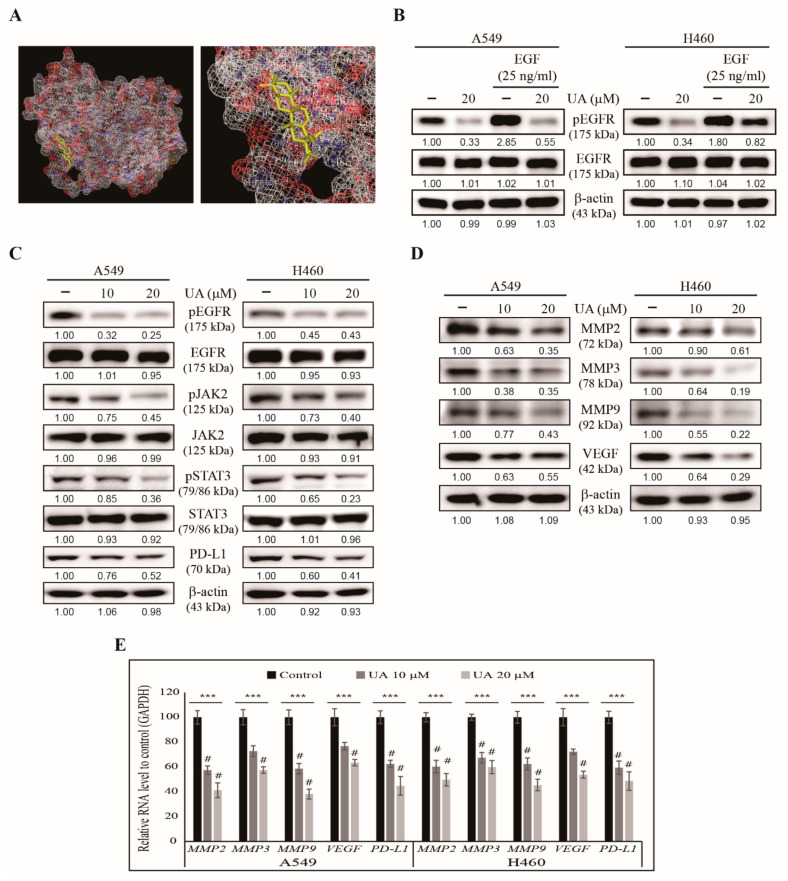
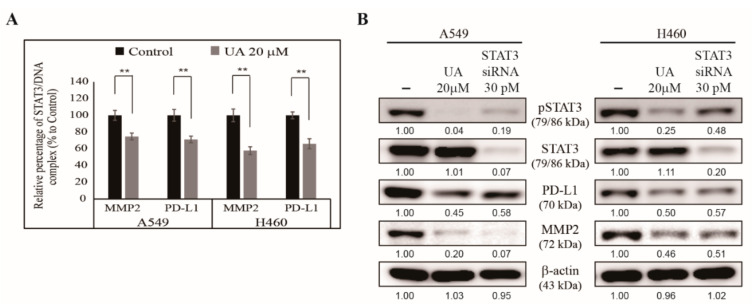
Targeted therapy based on natural compounds is one of the best approaches against non-small cell lung cancer. Ursolic acid (UA), a pentacyclic triterpenoid derived from medicinal herbs, has anticancer activity. Studies on the molecular mechanism underlying UA's anticancer activity are ongoing. Here, we demonstrated UA's anticancer activity and the underlying signaling mechanisms. We used Western blotting and real-time quantitative polymerase chain reaction for molecular signaling analysis. We also used in vitro angiogenesis, wound healing, and invasion assays to study UA's anticancer activity. In addition, we used tumorsphere formation and chromatin immunoprecipitation assays for binding studies. The results showed that UA inhibited the proliferation of A549 and H460 cells in a concentration-dependent manner. UA exerted anticancer effects by inducing G0/G1 cell cycle arrest and apoptosis. It also inhibited tumor angiogenesis, migration, invasion, and tumorsphere formation. The molecular mechanism underlying UA activity involves UA's binding to epidermal growth factor receptor (EGFR), reducing the level of phospho-EGFR, and thus inhibiting the downstream JAK2/STAT3 pathway. Furthermore, UA reduced the expressions of vascular endothelial growth factor (VEGF), metalloproteinases (MMPs) and programmed death ligand-1 (PD-L1), as well as the formation of STAT3/MMP2 and STAT3/PD-L1 complexes. Altogether, UA exhibits anticancer activities by inhibiting MMP2 and PD-L1 expression through EGFR/JAK2/STAT3 signaling.
基于天然化合物的靶向治疗是对抗非小细胞肺癌的最佳方法之一。熊果酸(UA)是一种源自草药的五环三萜类化合物,具有抗癌活性。关于UA抗癌活性的分子机制研究正在进行中。在此,我们证明了UA的抗癌活性及其潜在的信号传导机制。我们使用蛋白质免疫印迹法和实时定量聚合酶链反应进行分子信号分析。我们还使用体外血管生成、伤口愈合和侵袭试验来研究UA的抗癌活性。此外,我们使用肿瘤球形成和染色质免疫沉淀试验进行结合研究。结果表明,UA以浓度依赖性方式抑制A549和H460细胞的增殖。UA通过诱导G0/G1期细胞周期阻滞和凋亡发挥抗癌作用。它还抑制肿瘤血管生成、迁移、侵袭和肿瘤球形成。UA活性的分子机制涉及UA与表皮生长因子受体(EGFR)结合,降低磷酸化EGFR水平,从而抑制下游JAK2/STAT3通路。此外,UA降低了血管内皮生长因子(VEGF)、金属蛋白酶(MMPs)和程序性死亡配体-1(PD-L1)的表达,以及STAT3/MMP2和STAT3/PD-L1复合物的形成。总之,UA通过EGFR/JAK2/STAT3信号通路抑制MMP2和PD-L1表达而表现出抗癌活性。