Fhu Chee Wai, Ali Azhar
Cancer Science Institute of Singapore, National University of Singapore, Singapore 117599, Singapore.
Cancers (Basel). 2021 Mar 25;13(7):1513. doi: 10.3390/cancers13071513.
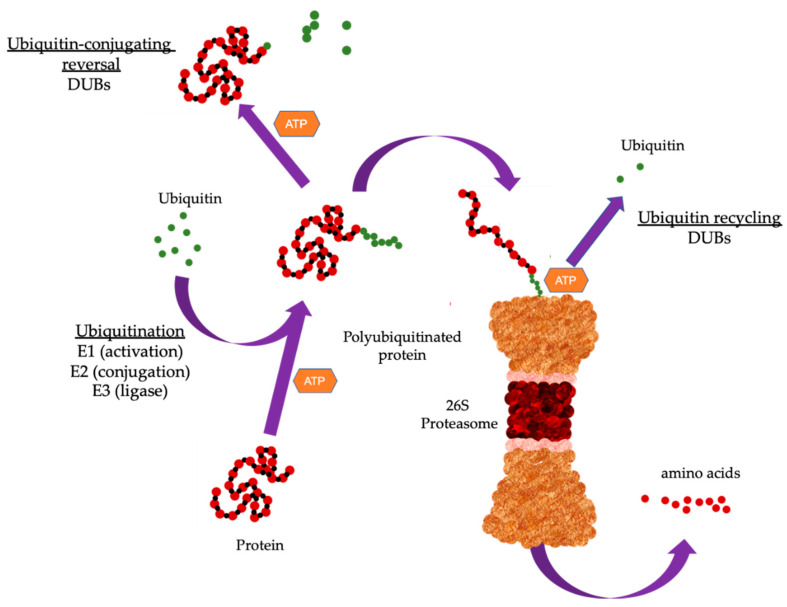
The ubiquitin proteasome system (UPS) governs the non-lysosomal degradation of oxidized, damaged, or misfolded proteins in eukaryotic cells. This process is tightly regulated through the activation and transfer of polyubiquitin chains to target proteins which are then recognized and degraded by the 26S proteasome complex. The role of UPS is crucial in regulating protein levels through degradation to maintain fundamental cellular processes such as growth, division, signal transduction, and stress response. Dysregulation of the UPS, resulting in loss of ability to maintain protein quality through proteolysis, is closely related to the development of various malignancies and tumorigenesis. Here, we provide a comprehensive general overview on the regulation and roles of UPS and discuss functional links of dysregulated UPS in human malignancies. Inhibitors developed against components of the UPS, which include U.S. Food and Drug Administration FDA-approved and those currently undergoing clinical trials, are also presented in this review.
泛素蛋白酶体系统(UPS)负责真核细胞中氧化、受损或错误折叠蛋白质的非溶酶体降解。该过程通过将多聚泛素链激活并转移到靶蛋白上进行严格调控,随后这些靶蛋白被26S蛋白酶体复合物识别并降解。UPS在通过降解调节蛋白质水平以维持诸如生长、分裂、信号转导和应激反应等基本细胞过程中起着至关重要的作用。UPS失调,导致通过蛋白水解维持蛋白质质量的能力丧失,与各种恶性肿瘤的发生和肿瘤形成密切相关。在此,我们全面概述了UPS的调控和作用,并讨论了UPS失调在人类恶性肿瘤中的功能联系。本综述还介绍了针对UPS成分开发的抑制剂,其中包括美国食品药品监督管理局(FDA)批准的以及目前正在进行临床试验的抑制剂。