Department of Clinical and Experimental Medicine, Institute of Legal Medicine, University of Foggia, 71122 Foggia, Italy.
Department of Medical, Surgical and Advanced Technologies "G.F. Ingrassia", Institute of Legal Medicine, University of Catania, 95121 Catania, Italy.
Medicina (Kaunas). 2021 Mar 25;57(4):309. doi: 10.3390/medicina57040309.
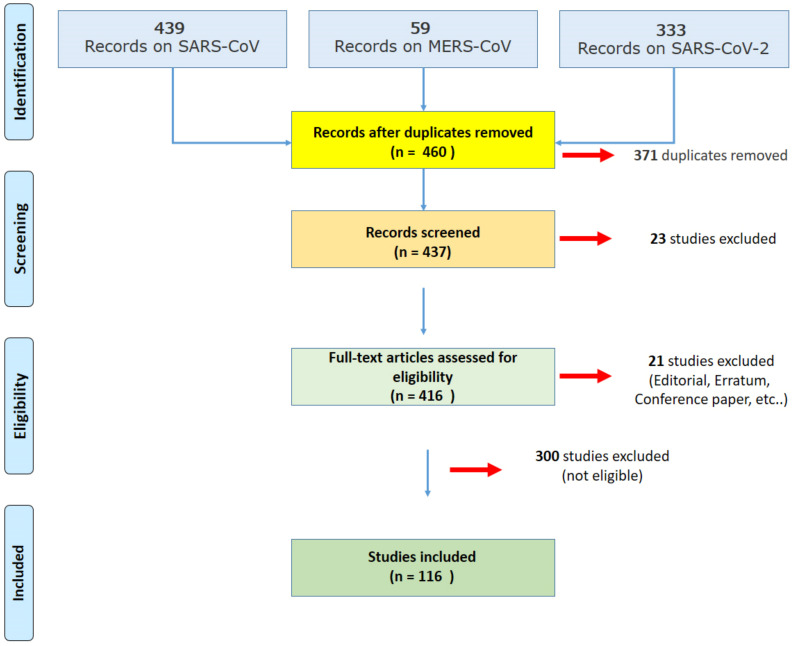
In the last two decades, three unknown pathogens have caused outbreaks, generating severe global health concerns. In 2003, after nucleic acid genotyping, a new virus was named severe acute respiratory syndrome coronavirus (SARS-CoV). After nine years, another coronavirus emerged in the middle east and was named MERS-CoV (Middle East Respiratory Syndrome-Coronavirus). Finally, in December 2019, a new unknown coronavirus was isolated from a cluster of patients and was named SARS-CoV-2 (COVID-19, coronavirus disease 2019). This review aims to propose a complete overview of autopsy in the three coronaviruses over the past two decades, showing its pivotal role in the management of unknown diseases. A total of 116 studies fulfilled the inclusion criteria: 14 studies were collected concerning SARS-CoV (87 autopsy reports, from Asian and American countries), 2 studies for MERS-CoV (2 autopsy reports, from Middle-East Asian countries), and 100 studies on SARS-CoV-2 (930 autopsy reports). Analyzing the data obtained on COVID-19, based on the country criterion, a large number of post-mortem investigation were performed in European countries (580 reports), followed by American countries (251 reports). It is interesting to note that no data were found from the Oceanic countries, maybe because of the minor involvement of the outbreak. In all cases, autopsy provided much information about each unknown coronavirus. Despite advanced technologies in the diagnostic fields, to date, autopsy remains the gold standard method to understand the biological features and the pathogenesis of unknown infections, especially when awareness of a pathogen is restricted and the impact on the healthcare system is substantial. The knowledge gained through this technique may positively influence therapeutic strategies, ultimately reducing mortality.
在过去的二十年中,三种未知病原体引发了疫情爆发,引起了全球严重的健康关注。2003 年,经过核酸基因分型后,一种新病毒被命名为严重急性呼吸综合征冠状病毒(SARS-CoV)。九年后,中东出现了另一种冠状病毒,并被命名为中东呼吸综合征冠状病毒(MERS-CoV)。最后,在 2019 年 12 月,从一组患者中分离出一种新的未知冠状病毒,并被命名为 SARS-CoV-2(COVID-19,2019 年冠状病毒病)。本文旨在全面回顾过去二十年中这三种冠状病毒的尸检情况,展示其在未知疾病管理中的关键作用。共有 116 项研究符合纳入标准:14 项研究涉及 SARS-CoV(来自亚洲和美洲国家的 87 份尸检报告),2 项研究涉及 MERS-CoV(来自中东亚洲国家的 2 份尸检报告),100 项研究涉及 SARS-CoV-2(930 份尸检报告)。根据国家标准分析 COVID-19 获得的数据,欧洲国家进行了大量的尸检调查(580 份报告),其次是美洲国家(251 份报告)。有趣的是,没有发现来自大洋国家的数据,也许是因为疫情涉及较少。在所有情况下,尸检都提供了有关每种未知冠状病毒的大量信息。尽管在诊断领域有了先进的技术,但截至目前,尸检仍然是了解未知感染的生物学特征和发病机制的金标准方法,尤其是当对病原体的认识受到限制且对医疗保健系统的影响很大时。通过这项技术获得的知识可能会对治疗策略产生积极影响,最终降低死亡率。