• 文献检索
  • 文档翻译
  • 深度研究
  • 学术资讯
  • Suppr Zotero 插件Zotero 插件
  • 邀请有礼
  • 套餐&价格
  • 历史记录
应用&插件
Suppr Zotero 插件Zotero 插件浏览器插件Mac 客户端Windows 客户端微信小程序
定价
高级版会员购买积分包购买API积分包
服务
文献检索文档翻译深度研究API 文档MCP 服务
关于我们
关于 Suppr公司介绍联系我们用户协议隐私条款
关注我们

Suppr 超能文献

核心技术专利:CN118964589B侵权必究
粤ICP备2023148730 号-1Suppr @ 2026

文献检索

告别复杂PubMed语法,用中文像聊天一样搜索,搜遍4000万医学文献。AI智能推荐,让科研检索更轻松。

立即免费搜索

文件翻译

保留排版,准确专业,支持PDF/Word/PPT等文件格式,支持 12+语言互译。

免费翻译文档

深度研究

AI帮你快速写综述,25分钟生成高质量综述,智能提取关键信息,辅助科研写作。

立即免费体验

“谷歌医生,我皮肤上这是什么?”——与皮肤问题相关的网络搜索:2004年至2019年谷歌趋势数据

'Dr. Google, What Is That on My Skin?'-Internet Searches Related to Skin Problems: Google Trends Data from 2004 to 2019.

作者信息

Kamiński Mikołaj, Tizek Linda, Zink Alexander

机构信息

Individual Medical Practice, Bogdanowo, 64-600 Oborniki, Poland.

Department of Dermatology and Allergy, School of Medicine, Technical University of Munich, 80802 Munich, Germany.

出版信息

Int J Environ Res Public Health. 2021 Mar 4;18(5):2541. doi: 10.3390/ijerph18052541.

DOI:10.3390/ijerph18052541
PMID:33806391
原文链接:https://pmc.ncbi.nlm.nih.gov/articles/PMC7967401/
Abstract

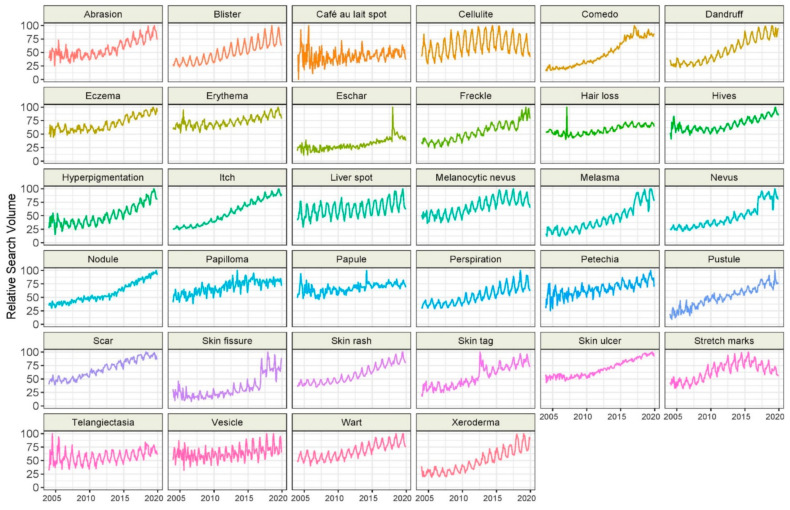
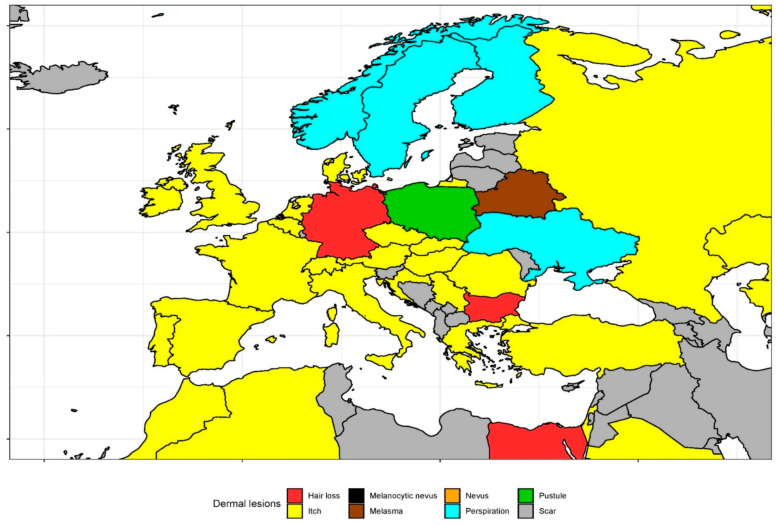
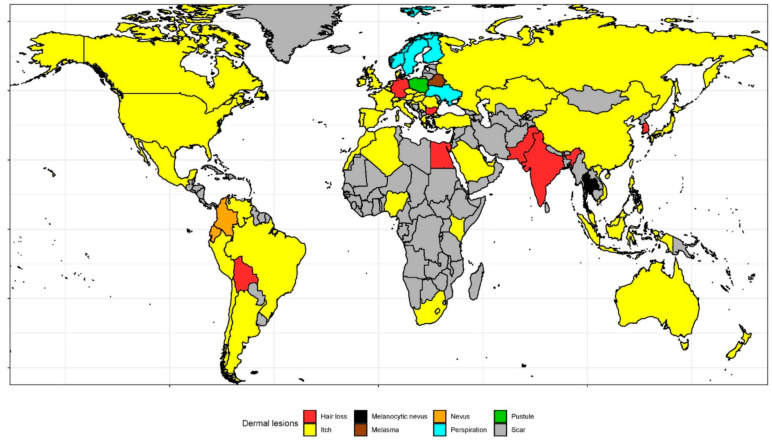
The Internet is a common source of health information as search engines propose websites that should answer users' queries. The study aimed to investigate the search behavior of Google users related to skin clinical signs as well as to analyze their geographical, secular, and seasonal patterns. The data of Google Trends was used to analyze the number of Google searches related to skin problems from January 2004 to December 2019. Thirty-four topics representing dermatologic complaints were identified. The interests of all topics were calculated in proportion to the Relative Search Volume (RSV) of 'Scar'. Geographical patterns as well as secular and seasonal trends were analyzed. Countries with few users who searched for skin problems were excluded from the analysis. Globally, gaining the most attention were 'Itch' proportion to RSV of 'Itch' (2.21), 'Hair loss' (1.56), 'Skin rash' (1.38), 'Perspiration' (1.32), and 'Scar' (1.00). In 42 of the 65 analyzed countries, 'Itch' was the most popular topic, followed by 'Hair loss' ( = 7), and 'Pustule' ( = 6). The RSV of all topics increases over time, with 'Comedo' (5.15 RSV/year), 'Itch' (4.83 RSV/year), and 'Dandruff' (4.66 RSV/year) being the most dynamic ones. For 23 topics, the highest interest was noted during warm months. Considering skin manifestations, Google users are mainly interested in itch, hair loss, and skin rash. An increasing number of individuals worldwide seem to use Google as a source of health information for dermatological clinical signs during the study period.

摘要

互联网是健康信息的常见来源,因为搜索引擎会推荐一些应能回答用户问题的网站。该研究旨在调查谷歌用户与皮肤临床症状相关的搜索行为,并分析其地理、长期和季节性模式。利用谷歌趋势数据来分析2004年1月至2019年12月期间与皮肤问题相关的谷歌搜索次数。确定了代表皮肤病主诉的34个主题。所有主题的关注度均按照“疤痕”的相对搜索量(RSV)进行计算。分析了地理模式以及长期和季节性趋势。搜索皮肤问题的用户较少的国家被排除在分析之外。在全球范围内,最受关注的是“瘙痒”(相对于“瘙痒”的RSV为2.21)、“脱发”(1.56)、“皮疹”(1.38)、“出汗”(1.32)和“疤痕”(1.00)。在65个被分析的国家中,有42个国家“瘙痒”是最热门的主题,其次是“脱发”( = 7)和“脓疱”( = 6)。所有主题的RSV随时间增加,其中“粉刺”(每年5.15 RSV)、“瘙痒”(每年4.83 RSV)和“头皮屑”(每年4.66 RSV)增长最为显著。对于23个主题,在温暖月份关注度最高。考虑到皮肤表现,谷歌用户主要对瘙痒、脱发和皮疹感兴趣。在研究期间,全球似乎有越来越多的人将谷歌作为皮肤病临床症状健康信息的来源。
https://cdn.ncbi.nlm.nih.gov/pmc/blobs/7581/7967401/e799c0ba072c/ijerph-18-02541-g003.jpg
https://cdn.ncbi.nlm.nih.gov/pmc/blobs/7581/7967401/f5a4cf14e06f/ijerph-18-02541-g001.jpg
https://cdn.ncbi.nlm.nih.gov/pmc/blobs/7581/7967401/0167bcad901e/ijerph-18-02541-g002.jpg
https://cdn.ncbi.nlm.nih.gov/pmc/blobs/7581/7967401/e799c0ba072c/ijerph-18-02541-g003.jpg
https://cdn.ncbi.nlm.nih.gov/pmc/blobs/7581/7967401/f5a4cf14e06f/ijerph-18-02541-g001.jpg
https://cdn.ncbi.nlm.nih.gov/pmc/blobs/7581/7967401/0167bcad901e/ijerph-18-02541-g002.jpg
https://cdn.ncbi.nlm.nih.gov/pmc/blobs/7581/7967401/e799c0ba072c/ijerph-18-02541-g003.jpg

相似文献

1
'Dr. Google, What Is That on My Skin?'-Internet Searches Related to Skin Problems: Google Trends Data from 2004 to 2019.“谷歌医生,我皮肤上这是什么?”——与皮肤问题相关的网络搜索:2004年至2019年谷歌趋势数据
Int J Environ Res Public Health. 2021 Mar 4;18(5):2541. doi: 10.3390/ijerph18052541.
2
"Dr. Google, I am in Pain"-Global Internet Searches Associated with Pain: A Retrospective Analysis of Google Trends Data.“谷歌医生,我很疼”-全球互联网与疼痛相关的搜索:谷歌趋势数据的回顾性分析。
Int J Environ Res Public Health. 2020 Feb 4;17(3):954. doi: 10.3390/ijerph17030954.
3
Global and local diet popularity rankings, their secular trends, and seasonal variation in Google Trends data.全球和本地饮食受欢迎程度排名及其长期趋势,以及谷歌趋势数据中的季节性变化。
Nutrition. 2020 Nov-Dec;79-80:110759. doi: 10.1016/j.nut.2020.110759. Epub 2020 Feb 12.
4
'Dr. Google, is caesarean section good for me?' - the global Internet searches associated with mode of birth methods: Retrospective analysis of Google trends data.“谷歌医生,剖宫产对我来说好吗?”- 与分娩方式相关的全球互联网搜索:谷歌趋势数据的回顾性分析。
Midwifery. 2020 Oct;89:102787. doi: 10.1016/j.midw.2020.102787. Epub 2020 Jun 26.
5
Analysis of the interests of Google users on toothache information.谷歌用户对牙痛信息的兴趣分析。
PLoS One. 2017 Oct 19;12(10):e0186059. doi: 10.1371/journal.pone.0186059. eCollection 2017.
6
Google search trends for itch in Europe: a retrospective longitudinal study.谷歌在欧洲的瘙痒搜索趋势:一项回顾性纵向研究。
J Eur Acad Dermatol Venereol. 2021 Jun;35(6):1362-1370. doi: 10.1111/jdv.17077. Epub 2021 Jan 17.
7
The Retrospective Analysis of Google Queries Related to Cardiovascular Diseases Symptoms in the Years 2004-2019.2004年至2019年与心血管疾病症状相关的谷歌搜索查询回顾性分析
Int J Angiol. 2021 Oct 1;31(1):27-33. doi: 10.1055/s-0041-1735203. eCollection 2022 Mar.
8
Global Internet Data on the Interest in Antibiotics and Probiotics Generated by Google Trends.谷歌趋势生成的关于抗生素和益生菌关注度的全球互联网数据。
Antibiotics (Basel). 2019 Sep 12;8(3):147. doi: 10.3390/antibiotics8030147.
9
Understanding Health Communication Through Google Trends and News Coverage for COVID-19: Multinational Study in Eight Countries.通过谷歌趋势和新冠疫情新闻报道理解健康传播:八国跨国研究。
JMIR Public Health Surveill. 2021 Dec 21;7(12):e26644. doi: 10.2196/26644.
10
Popularity of Surgical and Pharmacological Obesity Treatment Methods Searched by Google Users: the Retrospective Analysis of Google Trends Statistics in 2004-2022.谷歌用户搜索的外科和药物肥胖治疗方法的流行度:2004-2022 年谷歌趋势统计数据的回顾性分析。
Obes Surg. 2024 Mar;34(3):882-891. doi: 10.1007/s11695-023-06971-y. Epub 2023 Dec 16.

引用本文的文献

1
Tracking Public Interest in Rare Diseases and Eosinophilic Disorders in Germany: Web Search Analysis.追踪德国公众对罕见病和嗜酸性粒细胞疾病的关注:网络搜索分析
JMIR Infodemiology. 2025 May 26;5:e69040. doi: 10.2196/69040.
2
Utilization of Internet and Social Media by Outpatient Dermatology Patients: A Prospective, Cross-sectional Study.门诊皮肤科患者对互联网和社交媒体的使用情况:一项前瞻性横断面研究。
J Clin Aesthet Dermatol. 2025 Jan;18(1):29-34.
3
Social Media Use in Dermatology in Turkey: Challenges and Tips for Patient Health.土耳其皮肤病学领域社交媒体的使用:对患者健康的挑战与建议

本文引用的文献

1
A New 675 nm Laser Device in the Treatment of Melasma: Results of a Prospective Observational Study.一种用于治疗黄褐斑的新型 675nm 激光设备:前瞻性观察研究结果。
Photobiomodul Photomed Laser Surg. 2020 Sep;38(9):560-564. doi: 10.1089/photob.2020.4850. Epub 2020 Aug 21.
2
Global and local diet popularity rankings, their secular trends, and seasonal variation in Google Trends data.全球和本地饮食受欢迎程度排名及其长期趋势,以及谷歌趋势数据中的季节性变化。
Nutrition. 2020 Nov-Dec;79-80:110759. doi: 10.1016/j.nut.2020.110759. Epub 2020 Feb 12.
3
Psoriasis 2.0: Facebook as a source of disease-related information for patients with psoriasis.
JMIR Dermatol. 2024 Mar 28;7:e51267. doi: 10.2196/51267.
4
Effects of the COVID-19 Pandemic on the Interest of Google Queries in Cancer Screening and Cancers: A Retrospective Study.新冠疫情对谷歌搜索癌症筛查及癌症相关内容兴趣的影响:一项回顾性研究
Cancers (Basel). 2023 Jan 19;15(3):617. doi: 10.3390/cancers15030617.
5
Did the COVID-19 pandemic impact urticaria information-seeking behavior in China? A retrospective longitudinal study.新冠疫情是否影响了中国荨麻疹患者的信息检索行为?一项回顾性纵向研究。
Front Public Health. 2023 Jan 19;11:1098066. doi: 10.3389/fpubh.2023.1098066. eCollection 2023.
6
Seasonal Patterns and Trends in Dermatoses in Poland.波兰皮肤病的季节性模式和趋势。
Int J Environ Res Public Health. 2022 Jul 22;19(15):8934. doi: 10.3390/ijerph19158934.
7
Correlation Between Interest in COVID-19 Hair Loss and COVID-19 Surges: Analysis of Google Trends.对新冠疫情导致脱发的关注度与新冠疫情激增之间的相关性:谷歌趋势分析
JMIR Dermatol. 2022 Apr 27;5(2):e37271. doi: 10.2196/37271. eCollection 2022 Apr-Jun.
8
Global Public Interest and Seasonal Variations in Alzheimer's Disease: Evidence From Google Trends.全球公共利益与阿尔茨海默病的季节性变化:来自谷歌趋势的证据
Front Med (Lausanne). 2021 Dec 10;8:778930. doi: 10.3389/fmed.2021.778930. eCollection 2021.
9
Using Internet Search Queries to Assess Public Awareness of the Healthy Cities Approach: A Case Study in Shenzhen, China.利用互联网搜索查询评估公众对健康城市方法的认识:以中国深圳为例。
Int J Environ Res Public Health. 2021 Apr 17;18(8):4264. doi: 10.3390/ijerph18084264.
银屑病 2.0:Facebook 作为银屑病患者疾病相关信息的来源。
J Dtsch Dermatol Ges. 2020 Jun;18(6):571-581. doi: 10.1111/ddg.14070. Epub 2020 Apr 4.
4
Systematic review of the epidemiology of acne vulgaris.痤疮流行病学的系统评价。
Sci Rep. 2020 Apr 1;10(1):5754. doi: 10.1038/s41598-020-62715-3.
5
Algorithm based smartphone apps to assess risk of skin cancer in adults: systematic review of diagnostic accuracy studies.基于算法的智能手机应用程序评估成年人皮肤癌风险:诊断准确性研究的系统评价。
BMJ. 2020 Feb 10;368:m127. doi: 10.1136/bmj.m127.
6
"Dr. Google, I am in Pain"-Global Internet Searches Associated with Pain: A Retrospective Analysis of Google Trends Data.“谷歌医生,我很疼”-全球互联网与疼痛相关的搜索:谷歌趋势数据的回顾性分析。
Int J Environ Res Public Health. 2020 Feb 4;17(3):954. doi: 10.3390/ijerph17030954.
7
Heartburn-Related Internet Searches and Trends of Interest across Six Western Countries: A Four-Year Retrospective Analysis Using Google Ads Keyword Planner.烧心相关的互联网搜索及六个西方国家的关注趋势:使用谷歌广告关键词规划师进行的四年回顾性分析。
Int J Environ Res Public Health. 2019 Nov 20;16(23):4591. doi: 10.3390/ijerph16234591.
8
Global Internet Data on the Interest in Antibiotics and Probiotics Generated by Google Trends.谷歌趋势生成的关于抗生素和益生菌关注度的全球互联网数据。
Antibiotics (Basel). 2019 Sep 12;8(3):147. doi: 10.3390/antibiotics8030147.
9
Seasonality and global public interest in psoriasis: an infodemiology study.银屑病的季节性与全球公众关注度:一项信息流行病学研究。
Postgrad Med J. 2020 Mar;96(1133):139-143. doi: 10.1136/postgradmedj-2019-136766. Epub 2019 Sep 11.
10
Seasonality of acne severity in Korean patients: data from a dermatologic clinic and military hospital.韩国患者痤疮严重程度的季节性:来自皮肤科诊所和军队医院的数据。
J Eur Acad Dermatol Venereol. 2019 Dec;33(12):e480-e482. doi: 10.1111/jdv.15806. Epub 2019 Aug 14.