Meldolesi Jacopo
Division of Neuroscience, San Raffaele Institute and Vita-Salute San Raffaele University, via Olgettina 58, 20132 Milan, Italy.
Biomedicines. 2021 Mar 4;9(3):252. doi: 10.3390/biomedicines9030252.
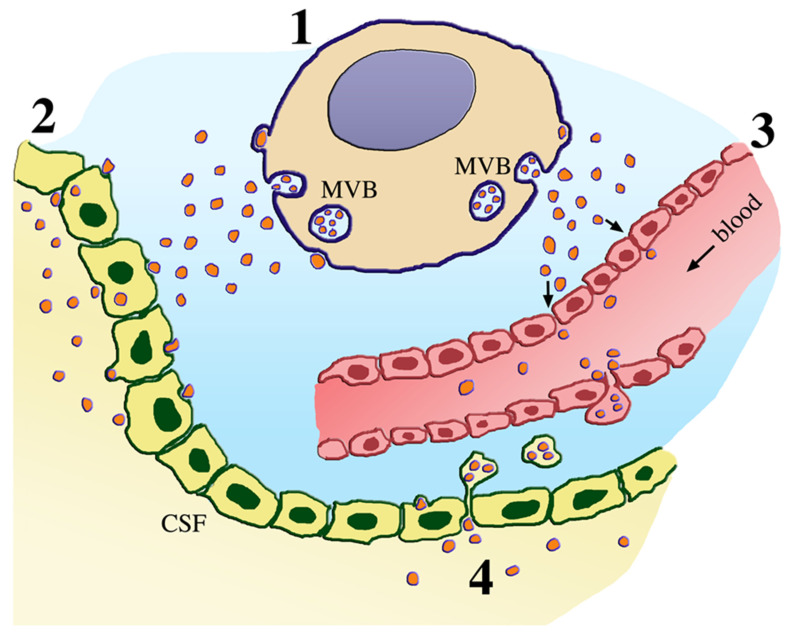
Biomarkers are molecules that are variable in their origin, nature, and mechanism of action; they are of great relevance in biology and also in medicine because of their specific connection with a single or several diseases. Biomarkers are of two types, which in some cases are operative with each other. Fluid biomarkers, started around 2000, are generated in fluid from specific proteins/peptides and miRNAs accumulated within two extracellular fluids, either the central spinal fluid or blood plasma. The switch of these proteins/peptides and miRNAs, from free to segregated within extracellular vesicles, has induced certain advantages including higher levels within fluids and lower operative expenses. Imaging biomarkers, started around 2004, are identified in vivo upon their binding by radiolabeled molecules subsequently revealed in the brain by positron emission tomography and/or other imaging techniques. A positive point for the latter approach is the quantitation of results, but expenses are much higher. At present, both types of biomarker are being extensively employed to study Alzheimer's and other neurodegenerative diseases, investigated from the presymptomatic to mature stages. In conclusion, biomarkers have revolutionized scientific and medical research and practice. Diagnosis, which is often inadequate when based on medical criteria only, has been recently improved by the multiplicity and specificity of biomarkers. Analogous results have been obtained for prognosis. In contrast, improvement of therapy has been limited or fully absent, especially for Alzheimer's in which progress has been inadequate. An urgent need at hand is therefore the progress of a new drug trial design together with patient management in clinical practice.
生物标志物是一类在起源、性质和作用机制上具有多样性的分子;由于它们与一种或多种疾病存在特定联系,因此在生物学和医学领域都具有重要意义。生物标志物有两种类型,在某些情况下它们相互作用。流体生物标志物始于2000年左右,由特定蛋白质/肽和微小RNA在两种细胞外液(脑脊液或血浆)中积累而产生于流体中。这些蛋白质/肽和微小RNA从游离状态转变为在细胞外囊泡中隔离,带来了某些优势,包括在流体中含量更高以及操作成本更低。成像生物标志物始于2004年左右,通过放射性标记分子与之结合在体内得以识别,随后通过正电子发射断层扫描和/或其他成像技术在大脑中显示出来。后一种方法的一个优点是结果可定量,但成本要高得多。目前,这两种类型的生物标志物都被广泛用于研究阿尔茨海默病和其他神经退行性疾病,涵盖从症状前到成熟阶段的研究。总之,生物标志物彻底改变了科学和医学研究及实践。仅基于医学标准的诊断往往并不充分,而生物标志物的多样性和特异性最近对此有所改善。在预后方面也取得了类似的结果。相比之下,治疗方面的改善有限或完全没有,尤其是阿尔茨海默病,其进展不足。因此,当务之急是推进新的药物试验设计以及临床实践中的患者管理。