Lo Ting-Wen, Figueroa-Romero Claudia, Hur Junguk, Pacut Crystal, Stoll Evan, Spring Calvin, Lewis Rose, Nair Athul, Goutman Stephen A, Sakowski Stacey A, Nagrath Sunitha, Feldman Eva L
Department of Chemical Engineering, University of Michigan, Ann Arbor, MI, United States.
Department of Neurology, University of Michigan, Ann Arbor, MI, United States.
Front Mol Neurosci. 2021 Oct 29;14:739016. doi: 10.3389/fnmol.2021.739016. eCollection 2021.
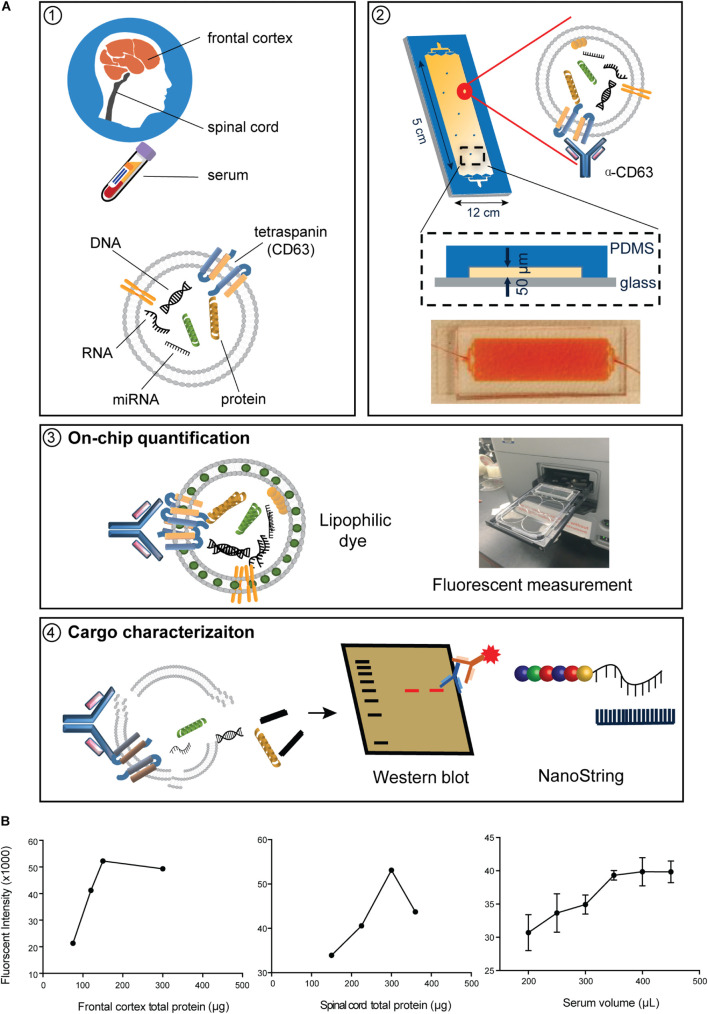
Amyotrophic lateral sclerosis (ALS) is a terminalneurodegenerative disease. Clinical and molecular observations suggest that ALS pathology originates at a single site and spreads in an organized and prion-like manner, possibly driven by extracellular vesicles. Extracellular vesicles (EVs) transfer cargo molecules associated with ALS pathogenesis, such as misfolded and aggregated proteins and dysregulated microRNAs (miRNAs). However, it is poorly understood whether altered levels of circulating extracellular vesicles or their cargo components reflect pathological signatures of the disease. In this study, we used immuno-affinity-based microfluidic technology, electron microscopy, and NanoString miRNA profiling to isolate and characterize extracellular vesicles and their miRNA cargo from frontal cortex, spinal cord, and serum of sporadic ALS ( = 15) and healthy control ( = 16) participants. We found larger extracellular vesicles in ALS spinal cord versus controls and smaller sized vesicles in ALS serum. However, there were no changes in the number of extracellular vesicles between cases and controls across any tissues. Characterization of extracellular vesicle-derived miRNA cargo in ALS compared to controls identified significantly altered miRNA levels in all tissues; miRNAs were reduced in ALS frontal cortex and spinal cord and increased in serum. Two miRNAs were dysregulated in all three tissues: miR-342-3p was increased in ALS, and miR-1254 was reduced in ALS. Additional miRNAs overlapping across two tissues included miR-587, miR-298, miR-4443, and miR-450a-2-3p. Predicted targets and pathways associated with the dysregulated miRNAs across the ALS tissues were associated with common biological pathways altered in neurodegeneration, including axon guidance and long-term potentiation. A predicted target of one identified miRNA (N-deacetylase and N-sulfotransferase 4; NDST4) was likewise dysregulated in an model of ALS, verifying potential biological relevance. Together, these findings demonstrate that circulating extracellular vesicle miRNA cargo mirror those of the central nervous system disease state in ALS, and thereby offer insight into possible pathogenic factors and diagnostic opportunities.
肌萎缩侧索硬化症(ALS)是一种晚期神经退行性疾病。临床和分子观察表明,ALS病理起源于单一部位,并以有组织的、朊病毒样的方式传播,可能由细胞外囊泡驱动。细胞外囊泡(EVs)转运与ALS发病机制相关的货物分子,如错误折叠和聚集的蛋白质以及失调的微小RNA(miRNAs)。然而,循环细胞外囊泡或其货物成分水平的改变是否反映该疾病的病理特征,目前尚不清楚。在本研究中,我们使用基于免疫亲和的微流控技术、电子显微镜和NanoString miRNA分析,从散发性ALS患者(n = 15)和健康对照者(n = 16)的额叶皮质、脊髓和血清中分离并表征细胞外囊泡及其miRNA货物。我们发现,与对照组相比,ALS脊髓中的细胞外囊泡更大,而ALS血清中的囊泡尺寸更小。然而,在任何组织中,病例组和对照组之间细胞外囊泡的数量均无变化。与对照组相比,对ALS中细胞外囊泡衍生的miRNA货物进行表征发现,所有组织中的miRNA水平均有显著改变;ALS额叶皮质和脊髓中的miRNAs减少,而血清中的miRNAs增加。有两种miRNAs在所有三个组织中均失调:ALS中miR-342-3p增加,而ALS中miR-1254减少。在两个组织中重叠的其他miRNAs包括miR-587、miR-298、miR-4443和miR-450a-2-3p。与ALS组织中失调的miRNAs相关的预测靶点和途径与神经退行性变中改变的常见生物学途径相关,包括轴突导向和长时程增强。一种已鉴定的miRNA(N-脱乙酰酶和N-磺基转移酶4;NDST4)的预测靶点在ALS的动物模型中同样失调,证实了其潜在的生物学相关性。总之,这些发现表明,循环细胞外囊泡miRNA货物反映了ALS中枢神经系统疾病状态的情况,从而为可能的致病因素和诊断机会提供了见解。