MSU-DOE Plant Research Laboratory, Michigan State University, East Lansing, MI 48824-1319, USA.
Department of Biochemistry and Molecular Biology, Michigan State University, East Lansing, MI 48824-1319, USA.
Cells. 2021 Mar 23;10(3):706. doi: 10.3390/cells10030706.
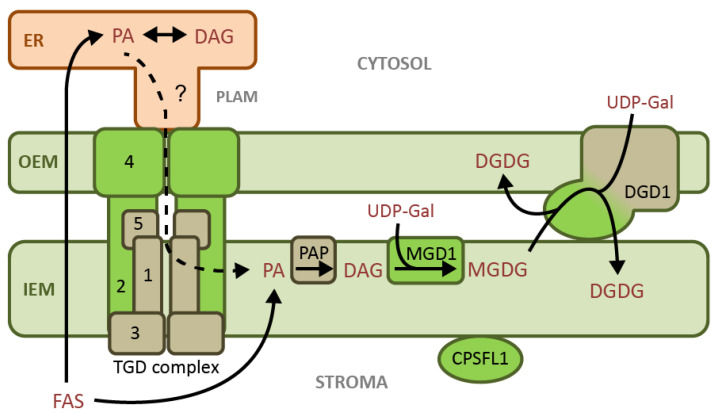
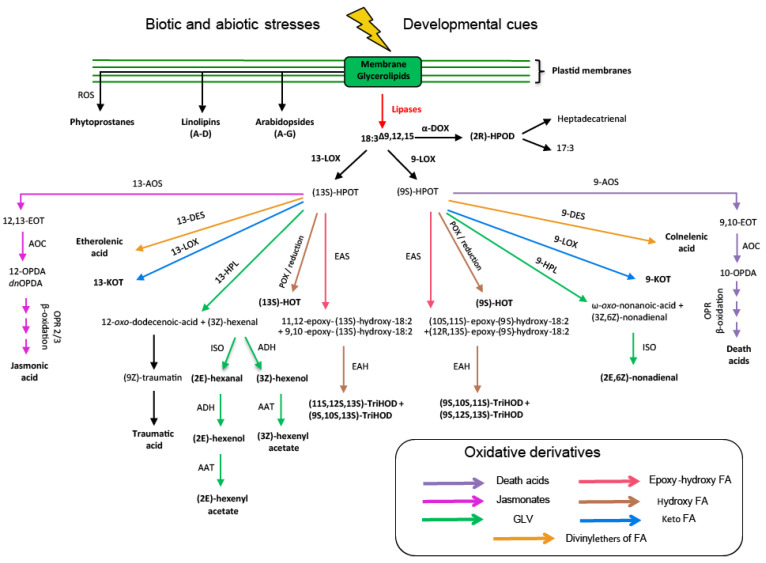
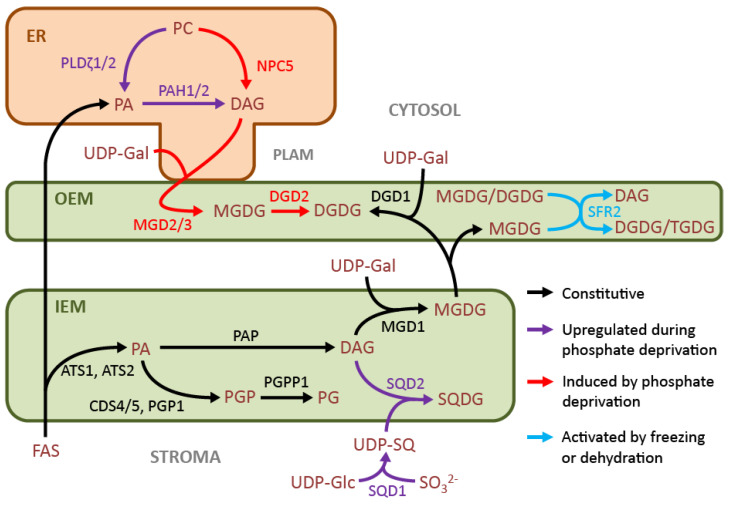
Plants are nonmotile life forms that are constantly exposed to changing environmental conditions during the course of their life cycle. Fluctuations in environmental conditions can be drastic during both day-night and seasonal cycles, as well as in the long term as the climate changes. Plants are naturally adapted to face these environmental challenges, and it has become increasingly apparent that membranes and their lipid composition are an important component of this adaptive response. Plants can remodel their membranes to change the abundance of different lipid classes, and they can release fatty acids that give rise to signaling compounds in response to environmental cues. Chloroplasts harbor the photosynthetic apparatus of plants embedded into one of the most extensive membrane systems found in nature. In part one of this review, we focus on changes in chloroplast membrane lipid class composition in response to environmental changes, and in part two, we will detail chloroplast lipid-derived signals.
植物是不能移动的生命形式,在其生命周期中会不断受到环境条件变化的影响。在昼夜和季节循环过程中,以及随着气候变化的长期影响,环境条件的波动可能非常剧烈。植物天生就能适应这些环境挑战,越来越明显的是,膜及其脂质组成是这种适应性反应的一个重要组成部分。植物可以重塑它们的膜来改变不同脂质种类的丰度,并且它们可以释放脂肪酸,这些脂肪酸会产生信号化合物来响应环境线索。叶绿体拥有植物的光合作用装置,嵌入到自然界中最广泛的膜系统之一中。在这篇综述的第一部分,我们专注于叶绿体膜脂类组成响应环境变化的变化,在第二部分,我们将详细描述叶绿体脂质衍生的信号。