Zaeck Luca M, Scheibner David, Sehl Julia, Müller Martin, Hoffmann Donata, Beer Martin, Abdelwhab Elsayed M, Mettenleiter Thomas C, Breithaupt Angele, Finke Stefan
Institute of Molecular Virology and Cell Biology, Friedrich-Loeffler-Institut, Federal Research Institute for Animal Health, 17493 Greifswald-Insel Riems, Germany.
Department of Experimental Animal Facilities and Biorisk Management, Friedrich-Loeffler-Institut, Federal Research Institute for Animal Health, 17493 Greifswald-Insel Riems, Germany.
Viruses. 2021 Mar 23;13(3):529. doi: 10.3390/v13030529.
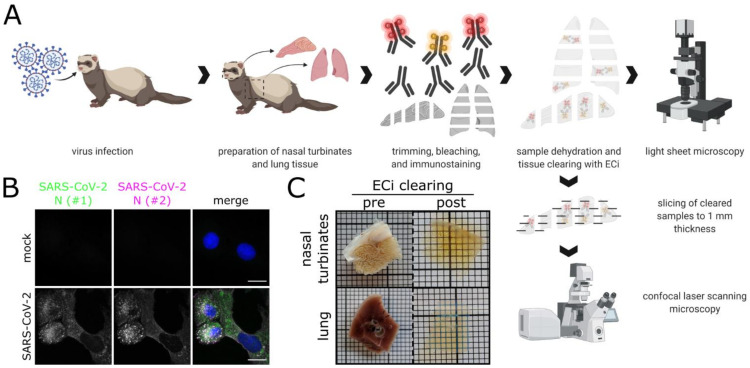
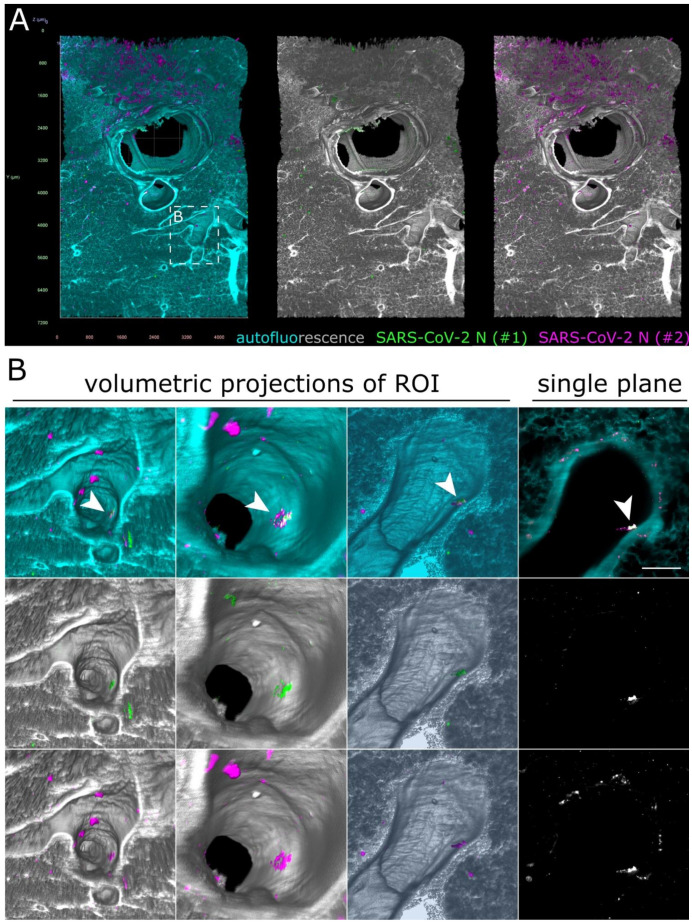
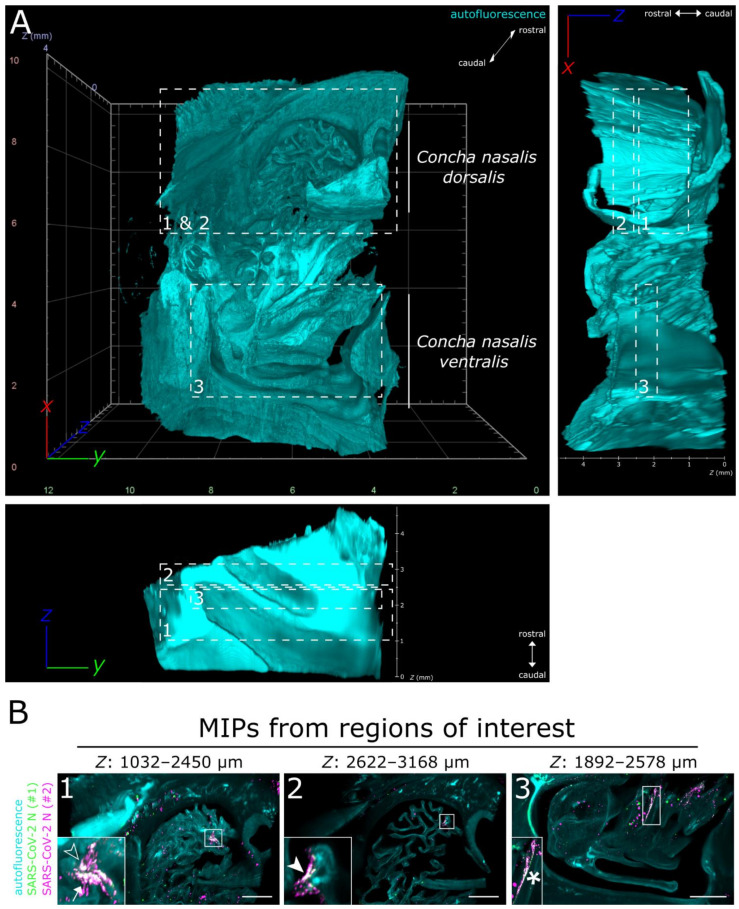
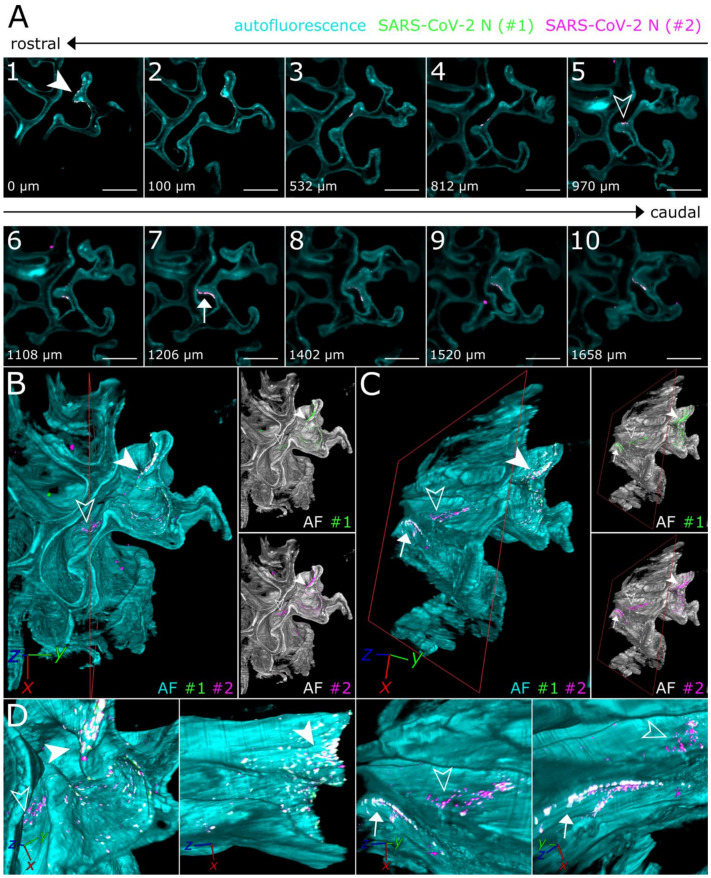
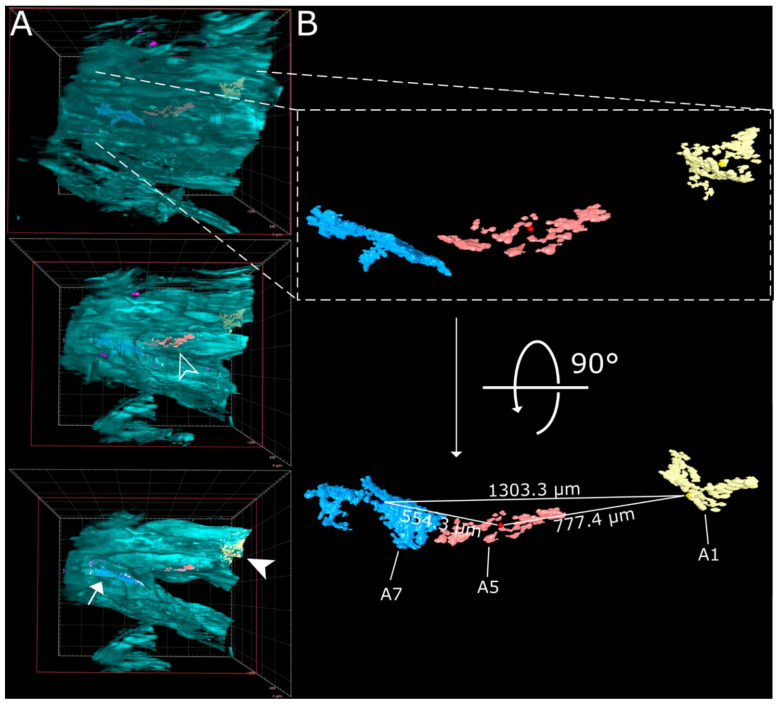
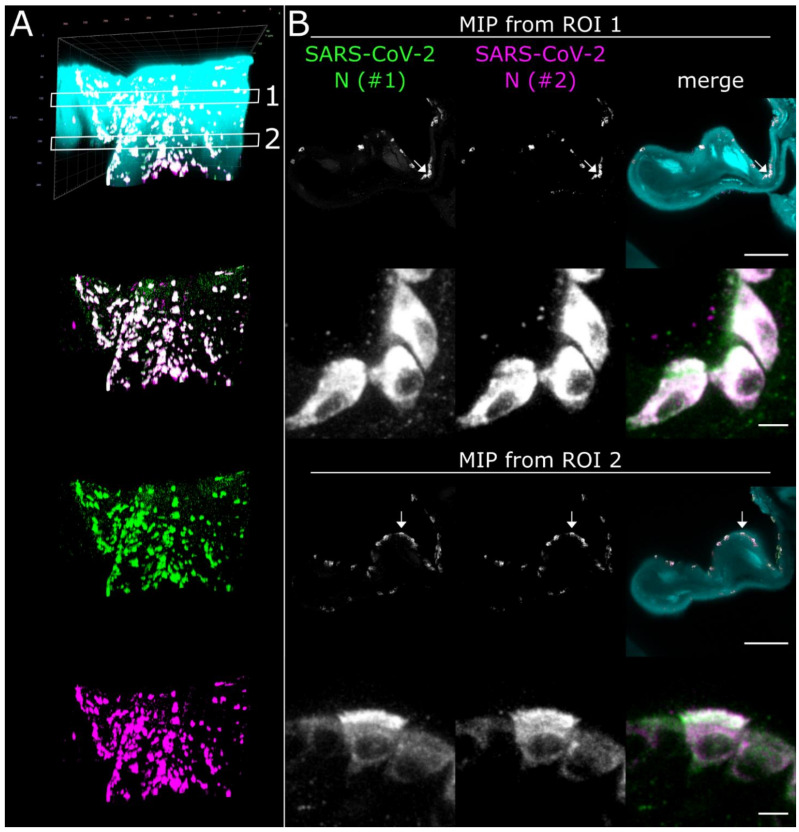
The visualization of viral pathogens in infected tissues is an invaluable tool to understand spatial virus distribution, localization, and cell tropism in vivo. Commonly, virus-infected tissues are analyzed using conventional immunohistochemistry in paraffin-embedded thin sections. Here, we demonstrate the utility of volumetric three-dimensional (3D) immunofluorescence imaging using tissue optical clearing and light sheet microscopy to investigate host-pathogen interactions of pandemic SARS-CoV-2 in ferrets at a mesoscopic scale. The superior spatial context of large, intact samples (>150 mm) allowed detailed quantification of interrelated parameters like focus-to-focus distance or SARS-CoV-2-infected area, facilitating an in-depth description of SARS-CoV-2 infection foci. Accordingly, we could confirm a preferential infection of the ferret upper respiratory tract by SARS-CoV-2 and suggest clustering of infection foci in close proximity. Conclusively, we present a proof-of-concept study for investigating critically important respiratory pathogens in their spatial tissue morphology and demonstrate the first specific 3D visualization of SARS-CoV-2 infection.
在感染组织中可视化病毒病原体是了解病毒在体内的空间分布、定位和细胞嗜性的一项宝贵工具。通常,使用传统免疫组织化学方法对石蜡包埋的薄切片中的病毒感染组织进行分析。在此,我们展示了利用组织光学透明化和光片显微镜进行三维(3D)免疫荧光成像的实用性,以在介观尺度上研究雪貂体内大流行的严重急性呼吸综合征冠状病毒2(SARS-CoV-2)的宿主-病原体相互作用。大型完整样本(>150毫米)优越的空间背景使得能够对诸如病灶到病灶距离或SARS-CoV-2感染区域等相关参数进行详细定量,有助于深入描述SARS-CoV-2感染病灶。因此,我们能够证实SARS-CoV-2对雪貂上呼吸道的优先感染,并表明感染病灶在近距离内聚集。总之,我们提出了一项概念验证研究,用于研究重要呼吸道病原体的空间组织形态,并展示了SARS-CoV-2感染的首次特异性3D可视化。