Laboratory of Cell Biology, Department of Plant Sciences, Wageningen University & Research, 6708 PB Wageningen, The Netherlands.
Laboratory of Molecular Biology, Department of Plant Sciences, Wageningen University & Research, 6708 PB Wageningen, The Netherlands.
Int J Mol Sci. 2021 Mar 5;22(5):2626. doi: 10.3390/ijms22052626.
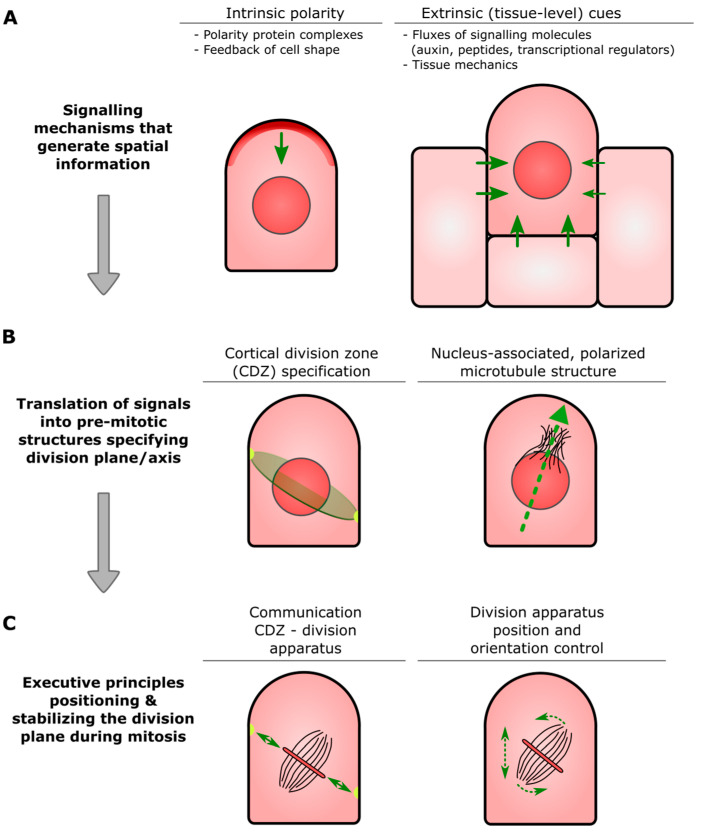
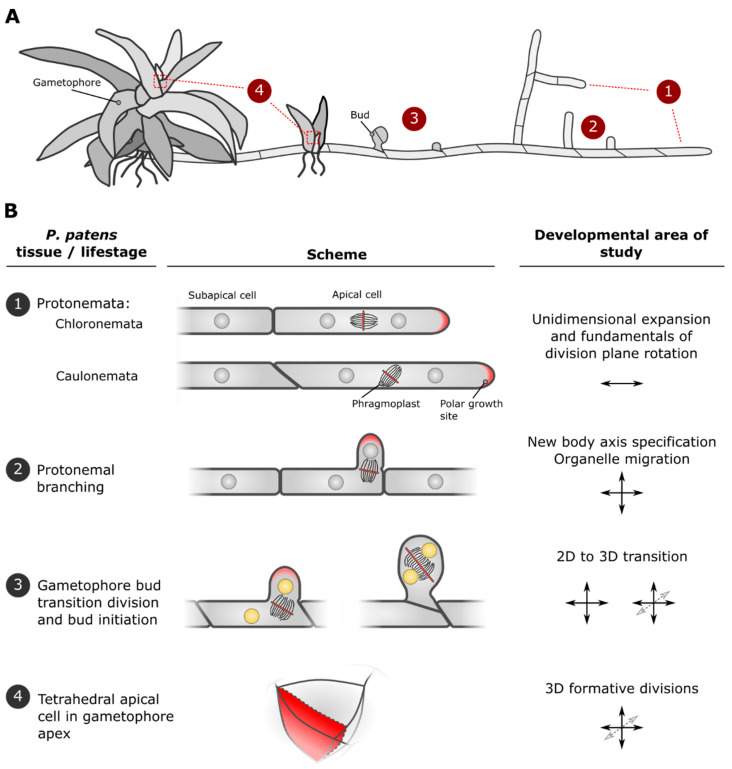
Development in multicellular organisms relies on cell proliferation and specialization. In plants, both these processes critically depend on the spatial organization of cells within a tissue. Owing to an absence of significant cellular migration, the relative position of plant cells is virtually made permanent at the moment of division. Therefore, in numerous plant developmental contexts, the (divergent) developmental trajectories of daughter cells are dependent on division plane positioning in the parental cell. Prior to and throughout division, specific cellular processes inform, establish and execute division plane control. For studying these facets of division plane control, the moss () has emerged as a suitable model system. Developmental progression in this organism starts out simple and transitions towards a body plan with a three-dimensional structure. The transition is accompanied by a series of divisions where cell fate transitions and division plane positioning go hand in hand. These divisions are experimentally highly tractable and accessible. In this review, we will highlight recently uncovered mechanisms, including polarity protein complexes and cytoskeletal structures, and transcriptional regulators, that are required for 1D to 3D body plan formation.
多细胞生物的发育依赖于细胞增殖和特化。在植物中,这两个过程都严重依赖于组织内细胞的空间组织。由于没有明显的细胞迁移,植物细胞的相对位置在分裂时几乎是永久的。因此,在许多植物发育的情况下,子细胞的(发散的)发育轨迹取决于亲代细胞的分裂面定位。在分裂之前和整个分裂过程中,特定的细胞过程会告知、建立和执行分裂面控制。为了研究分裂面控制的这些方面,苔藓植物()已成为一个合适的模式系统。该生物体的发育进程从简单开始,过渡到具有三维结构的体式。这种转变伴随着一系列的分裂,其中细胞命运的转变和分裂面的定位是齐头并进的。这些分裂在实验上是高度可行和可及的。在这篇综述中,我们将重点介绍最近发现的机制,包括极性蛋白复合物和细胞骨架结构,以及转录调节因子,这些机制对于从一维到三维体式的形成是必需的。