Gwon Kihak, Kim Youngmee, Cho Hyunjun, Lee Seonhwa, Yang So-Hyeon, Kim Sung-Jin, Lee Do Nam
Ingenium College of Liberal Arts (Chemistry), Kwangwoon University, Seoul 01897, Korea.
Department of Chemistry and Nano Science, Institute of Nano-Bio Technology, Ewha Womans University, Seoul 03760, Korea.
Nanomaterials (Basel). 2021 Mar 12;11(3):719. doi: 10.3390/nano11030719.
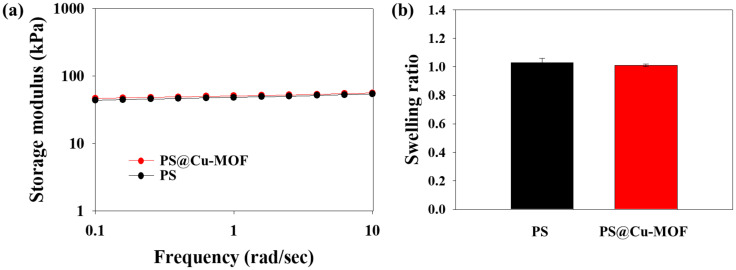
Polysiloxanes (PSs) have been widely utilized in the industry as lubricants, varnishes, paints, release agents, adhesives, and insulators. In addition, their applications have been expanded to include the development of new biomedical materials. To modify PS for application in therapeutic purposes, a flexible antibacterial Cu-MOF (metal-organic framework) consisting of glutarate and 1,2-bis(4-pyridyl)ethane ligands was embedded in PS via a hydrosilylation reaction of vinyl-terminated and H-terminated PSs at 25 °C. The bactericidal activities of the resulting Cu-MOF-embedded PS (PS@Cu-MOF) and the control polymer (PS) were tested against , , and methicillin-resistant . PS@Cu-MOF exhibited more than 80% bactericidal activity toward the tested bacteria at a concentration of 100 μg⋅mL and exhibited a negligible cytotoxicity toward mouse embryonic fibroblasts at the same concentration. Release tests of the Cu(II) ion showed PS@Cu-MOF to be particularly stable in a phosphate-buffered saline solution. Furthermore, its physical and thermal properties, including the phase transition, rheological measurements, swelling ratio, and thermogravimetric profile loss, were similar to those of the control polymer. Moreover, the low cytotoxicity and bactericidal activities of PS@Cu-MOF render it a promising candidate for use in medicinal applications, such as in implants, skin-disease treatment, wound healing, and drug delivery.
聚硅氧烷(PSs)已在工业中广泛用作润滑剂、清漆、涂料、脱模剂、粘合剂和绝缘体。此外,它们的应用范围已扩展到包括新型生物医学材料的开发。为了将PS改性用于治疗目的,通过乙烯基封端的PS和氢封端的PS在25℃下的硅氢化反应,将由戊二酸酯和1,2-双(4-吡啶基)乙烷配体组成的柔性抗菌铜金属有机框架(Cu-MOF)嵌入到PS中。测试了所得的嵌入Cu-MOF的PS(PS@Cu-MOF)和对照聚合物(PS)对[此处原文缺失具体细菌名称]、[此处原文缺失具体细菌名称]和耐甲氧西林[此处原文缺失具体细菌名称]的杀菌活性。PS@Cu-MOF在浓度为100μg·mL时对测试细菌表现出超过80%的杀菌活性,并且在相同浓度下对小鼠胚胎成纤维细胞表现出可忽略不计的细胞毒性。Cu(II)离子的释放测试表明PS@Cu-MOF在磷酸盐缓冲盐溶液中特别稳定。此外,其物理和热性能,包括相变、流变学测量、溶胀率和热重曲线损失,与对照聚合物相似。此外,PS@Cu-MOF 的低细胞毒性和杀菌活性使其成为用于医学应用的有前途的候选者,例如在植入物、皮肤病治疗、伤口愈合和药物递送中。