Key Laboratory of Aquatic Animal Diseases and Immune Technology of Heilongjiang Province, Department of Aquatic Animal Diseases and Control, Heilongjiang River Fisheries Research Institute, Chinese Academy of Fishery Sciences, Harbin 150070, China.
Fish Disease Department of Beijing Fisheries Technical Extension Station, Beijing 100176, China.
Viruses. 2021 Mar 16;13(3):488. doi: 10.3390/v13030488.
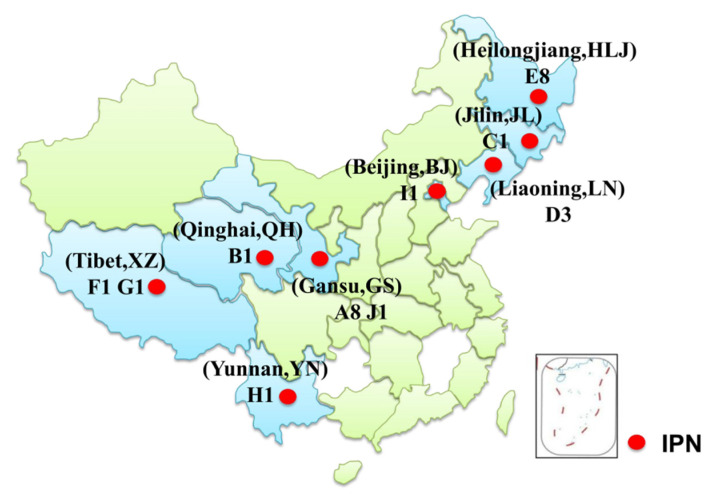
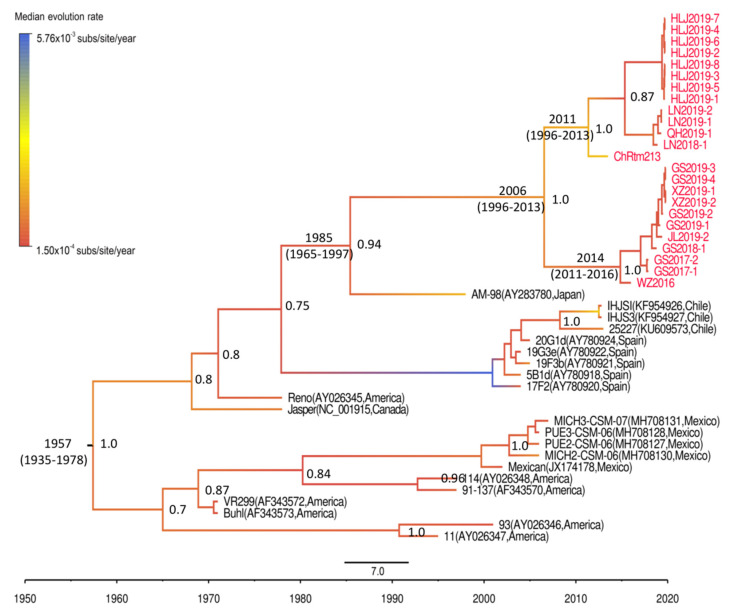
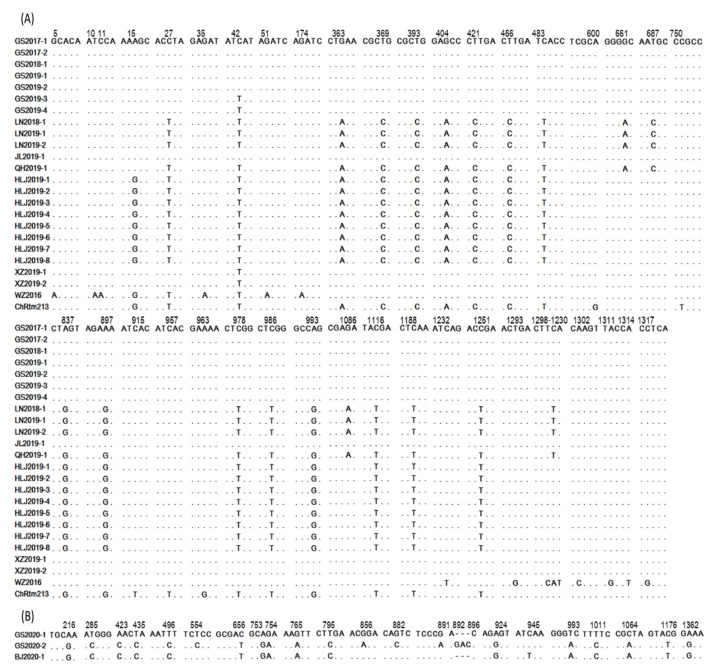
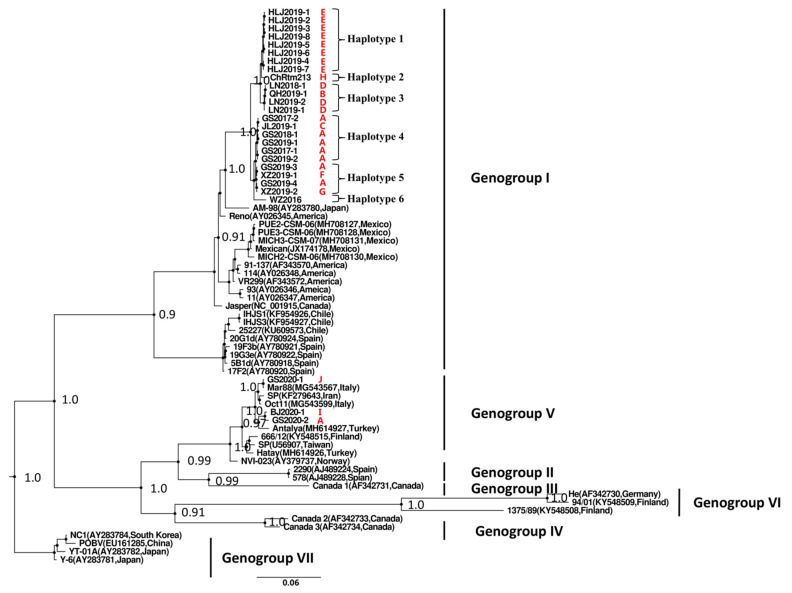
Passive virus surveillance was performed in twenty-nine salmon and trout farms from seven provinces and districts in China during the period 2017-2020. A total of 25 infectious pancreatic necrosis virus (IPNV) isolates were obtained, mainly from rainbow trout (). The molecular evolution of these Chinese IPNV isolates and the previously reported Chinese IPNV strains ChRtm213 and WZ2016 was analyzed, based on their VP2 gene coding region sequences (CDS). All 27 Chinese IPNV isolates clustered within genogroups I and V, with 24 of the IPNV isolates belonging to genogroup I (including ChRtm213 and WZ2016), and only three isolates clustering in genogroup V. The Chinese genogroup I IPNV isolates lacked diversity, composing six haplotypes with 41 polymorphic sites, and the identity of nucleotide and amino acid sequences among the entire VP2 gene CDS from these isolates was 97.44%-100% and 98.19%-100%, respectively. Divergence time analyses revealed that the Chinese genogroup I IPNV isolates likely diverged from Japanese IPNV isolates in 1985 (95% highest posterior density (HPD), 1965-1997), and diverged again in 2006 (95% HPD, 1996-2013) in China. Each of the three Chinese genogroup V IPNV isolates has a unique VP2 gene CDS, with a total of 21 polymorphic sites; the identity of nucleotide and amino acid sequences among all VP2 gene CDS from these isolates was 98.5%-99.5% and 98.6%-99.0%, respectively. The data demonstrate that genogroups I and V are more likely the currently prevalent Chinese IPNV genotypes.
2017 年至 2020 年期间,在中国七个省、自治区的 29 个三文鱼和鳜鱼养殖场进行了被动病毒监测。共获得 25 株传染性胰脏坏死病毒(IPNV)分离株,主要来自虹鳜鱼。基于其 VP2 基因编码区序列(CDS),对这些中国 IPNV 分离株和之前报道的中国 IPNV 株 ChRtm213 和 WZ2016 的分子进化进行了分析。所有 27 株中国 IPNV 分离株均聚类在基因 I 和 V 组内,其中 24 株属于基因 I 组(包括 ChRtm213 和 WZ2016),仅有 3 株分离株聚类在基因 V 组。中国基因 I 组 IPNV 分离株缺乏多样性,由 6 个单倍型组成,有 41 个多态性位点,整个 VP2 基因 CDS 的核苷酸和氨基酸序列同一性分别为 97.44%-100%和 98.19%-100%。分歧时间分析显示,中国基因 I 组 IPNV 分离株可能于 1985 年(95%最高后验密度(HPD),1965-1997)从日本 IPNV 分离株中分化而来,并于 2006 年(95% HPD,1996-2013)在中国再次分化。中国基因 V 组的 3 株 IPNV 分离株各有独特的 VP2 基因 CDS,共有 21 个多态性位点;所有 VP2 基因 CDS 的核苷酸和氨基酸序列同一性分别为 98.5%-99.5%和 98.6%-99.0%。数据表明,基因 I 和 V 组更有可能是目前流行的中国 IPNV 基因型。