Coscia Erin C, Abutaleb Nader S, Hostetter Bradley, Seleem Mohamed N, Breur Gert J, McCain Robyn R, Crain Christa J, Slaby Ondrej, Capoor Manu N, McDowell Andrew, Ahmed Fahad S, Vijayanpillai Viju, Narayanan Sanjeev K, Coscia Michael F
College of Osteopathic Medicine, Marian University, Indianapolis, IN 46222, USA.
Department of Comparative Pathobiology, College of Veterinary Medicine, Purdue University, West Lafayette, IN 47907, USA.
Vet Sci. 2021 Mar 16;8(3):48. doi: 10.3390/vetsci8030048.
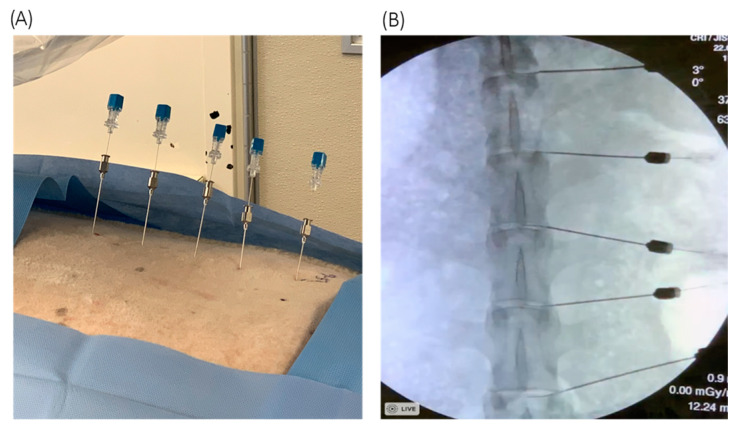
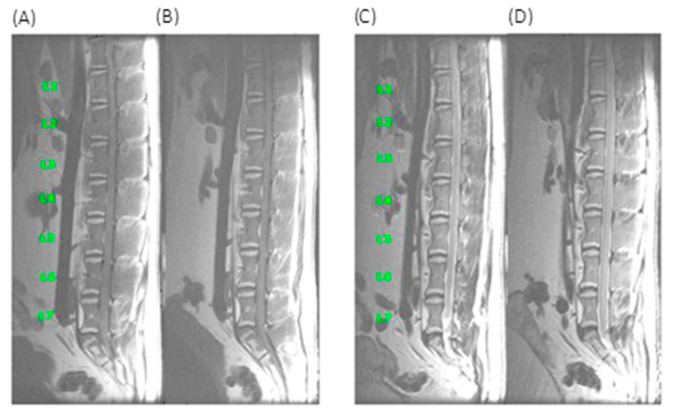
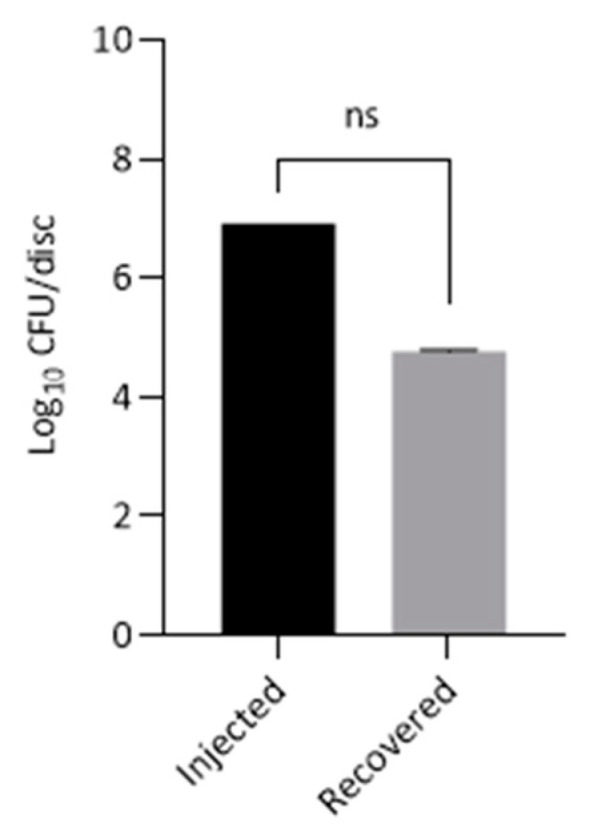
The anaerobic bacterium has been increasingly linked to the development of degenerative disc disease (DDD), although causality is yet to be conclusively proven. To better study how this organism could contribute to the aetiology of DDD, improved animal models that are more reflective of human disc anatomy, biology and mechanical properties are required. Against this background, our proof-of concept study aimed to be the first demonstration that could be safely administered percutaneously into sheep intervertebral discs (IVDs) for in vivo study. Following our protocol, two sheep were successfully injected with a strain of (8.3 × 10 CFU/disc) previously recovered from a human degenerative disc. No adverse reactions were noted, and at one-month post inoculation all triplicate infected discs in our first animal grew , albeit at a reduced load (5.12 × 10 to 6.67 × 10 CFU/disc). At six months, no growth was detected in discs from our second animal indicating bacterial clearance. This pilot study has demonstrated the feasibility of safe percutaneous injection of into sheep IVDs under fluoroscopic guidance. The design of follow-up sheep studies to investigate the potential of to drive pathological changes within infected discs should now be pursued.
这种厌氧菌与椎间盘退变疾病(DDD)的发生联系日益紧密,尽管因果关系尚未得到确凿证实。为了更好地研究这种微生物如何导致DDD的病因,需要改进动物模型,使其更能反映人类椎间盘的解剖结构、生物学特性和力学性能。在此背景下,我们的概念验证研究旨在首次证明[具体细菌名称未给出]可经皮安全注射到绵羊椎间盘(IVD)中进行体内研究。按照我们的方案,两只绵羊成功注射了一株先前从人类退变椎间盘中分离出的[具体细菌名称未给出](8.3×10[具体指数未给出]CFU/椎间盘)。未观察到不良反应,在接种后1个月,我们第一只动物的所有三份感染椎间盘均生长出[具体细菌名称未给出],尽管载量有所降低(5.12×10[具体指数未给出]至6.67×10[具体指数未给出]CFU/椎间盘)。在6个月时,我们第二只动物的椎间盘中未检测到生长,表明细菌已清除。这项初步研究证明了在透视引导下将[具体细菌名称未给出]经皮安全注射到绵羊IVD中的可行性。现在应该开展后续绵羊研究的设计,以调查[具体细菌名称未给出]在感染椎间盘中引发病理变化的潜力。