College of Human Development and Health, National Taipei University of Nursing and Health Sciences, Taipei 112, Taiwan.
Department of Exercise and Health Science, National Taipei University of Nursing and Health Sciences, Taipei 112, Taiwan.
Int J Environ Res Public Health. 2021 Mar 22;18(6):3267. doi: 10.3390/ijerph18063267.
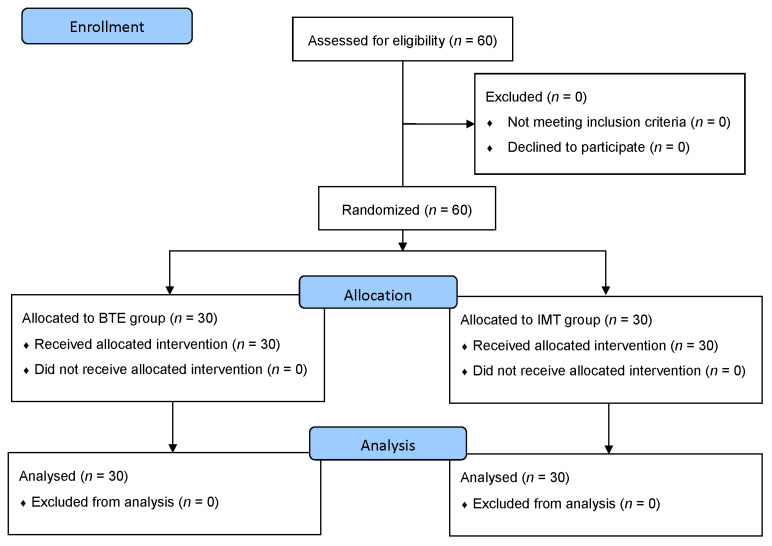
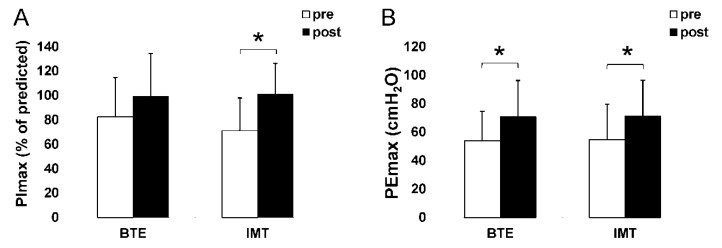
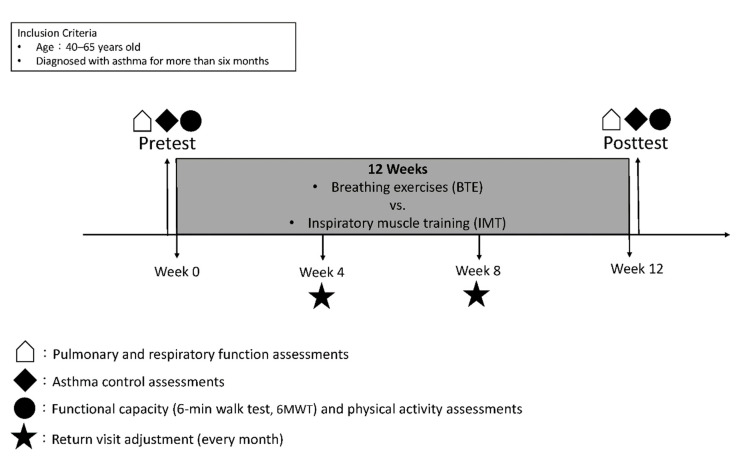
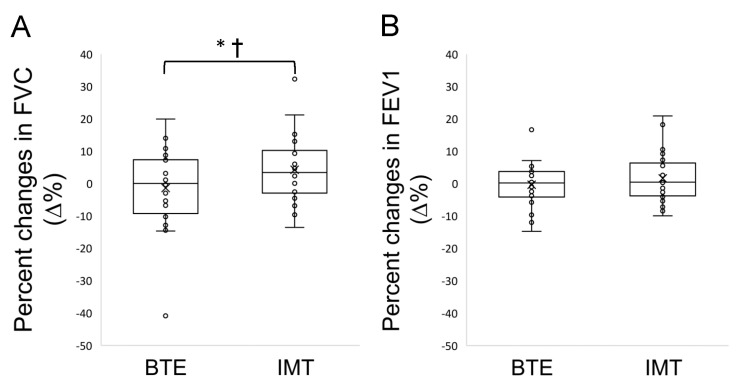
This study aims to investigate and compare the effects of conventional breathing exercises and an inspiratory muscle training intervention on clinical symptoms in asthma patients. Sixty asthma patients (40-65 years old) were randomly assigned to either the conventional breathing exercises (BTE) or inspiratory muscle training (IMT) group for a 12-week intervention period. Outcome measurements were performed before and after the intervention, including the spirometry data, maximal inspiratory and expiratory pressures (PImax and PEmax), asthma control test, asthma control questionnaire, six-minute walk test, and three-day physical activity log, were recorded. PImax expressed as % of predicted value controlled for age and gender in healthy subjects (% predicted) increased by 16.92% (82.45% to 99.38%, < 0.05) in the BTE group and by 29.84% (71.19% to 101.03%, < 0.05) in the IMT group. Except for forced vital capacity, which was reduced in the BTE group, all other measured variables improved in both groups, and no statistically significant between-group differences were found. IMT appears to be more effective than breathing exercise intervention in promoting improvements in respiratory muscle strength. IMT may act as an alternative to conventional breathing exercises for middle-aged and elderly asthma patients.
本研究旨在探讨和比较常规呼吸训练与吸气肌训练对哮喘患者临床症状的影响。将 60 名(40-65 岁)哮喘患者随机分为常规呼吸训练(BTE)组和吸气肌训练(IMT)组,进行为期 12 周的干预。在干预前后进行了肺功能测定、最大吸气和呼气压力(PImax 和 PEmax)、哮喘控制测试、哮喘控制问卷、六分钟步行试验和三天体力活动记录。PImax 以健康受试者年龄和性别校正后的预测值的百分比(%pred)表示,BTE 组增加了 16.92%(82.45%至 99.38%, < 0.05),IMT 组增加了 29.84%(71.19%至 101.03%, < 0.05)。除了 BTE 组用力肺活量降低外,两组所有其他测量变量均有改善,且组间无统计学差异。与呼吸训练干预相比,吸气肌训练在促进呼吸肌力量的改善方面似乎更有效。吸气肌训练可能是中年和老年哮喘患者常规呼吸训练的替代方法。